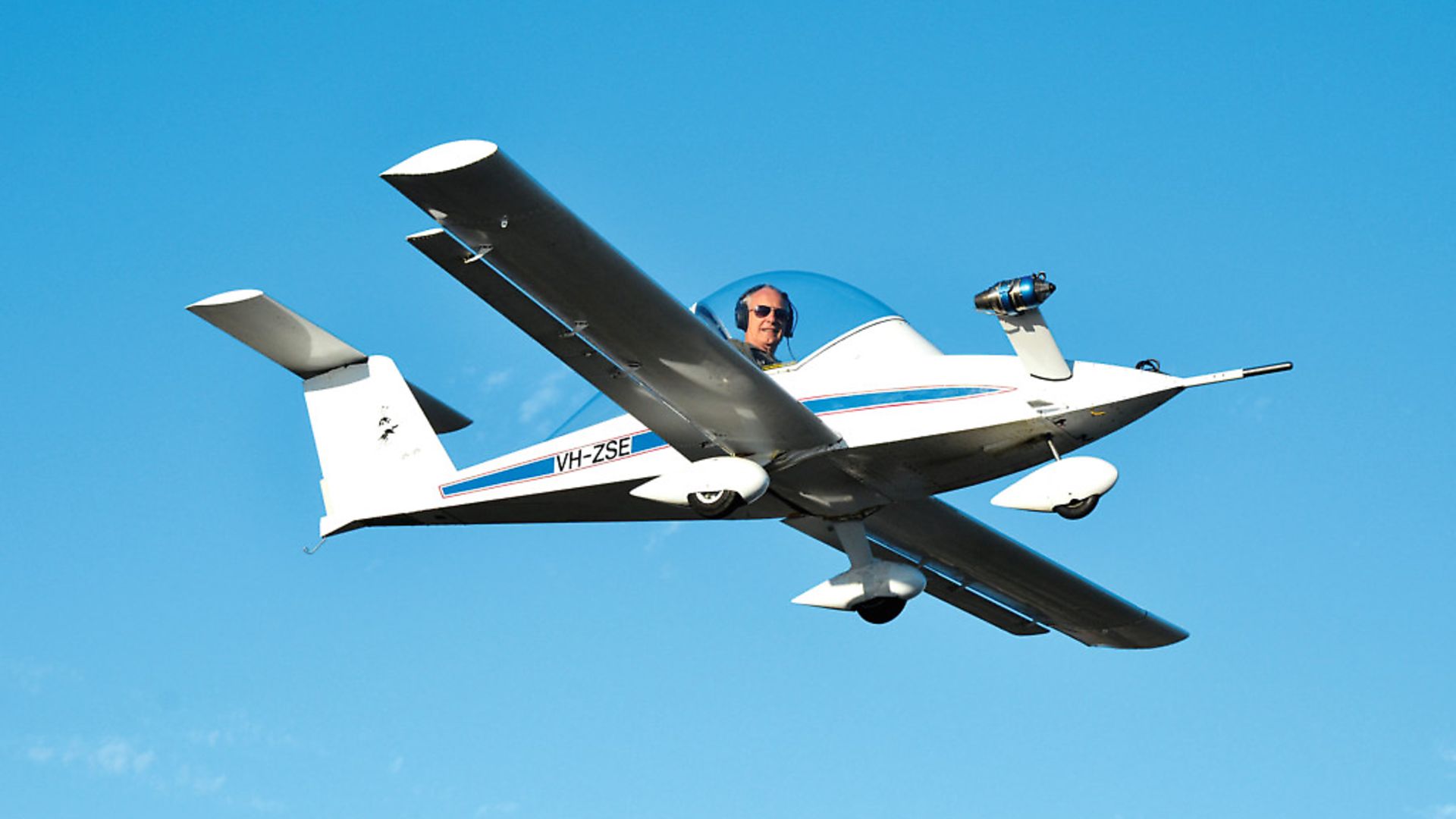
The Cri-Cri is one of the smallest manned twins ever built: a single-seat, all-metal aircraft with a 4.9 m wingspan and two tiny two-stroke engines on pylons either side of the nose. It was designed by the French engineer Michel Colomban and is built from plans, and it is cleared for a limited range of aerobatics. Its wings come off in minutes, so it can be trailered home.
In the UK it appeals to experienced builders and pilots who want something genuinely unusual, a twin that costs a fraction of a conventional one to run, and a lively, quick-rolling sport aircraft. It is not a first homebuild, and it needs a pilot who is comfortable with very light, sensitive controls and the licensing questions a twin raises.
History and design
Colomban flew the prototype on 19 July 1973, powered at first by two 9 hp Rowena single-cylinder engines. The name came from his daughter’s nickname. The design was refined into the MC-15, which most builders use, and it has since been flown with jet engines and electric motors as test and record aircraft.
The airframe is an aluminium structure with foam ribs, skinned in aluminium and assembled with pop rivets and epoxy. The wing carries Junkers-style flaperons that act as both ailerons and flaps, and it attaches to the fuselage with spar pins in the manner of a glider, so rigging and de-rigging takes minutes. The pilot sits under a canopy with the fuel tank under the legs.
Variants
MC-12 Cri-Cri: the earlier designation, covered by the same LAA type acceptance (133) as the MC-15.
MC-15 Cri-Cri: the definitive version, normally with two 15 hp JPX PUL 212 single-cylinder two-strokes. Builders have also used other small engines: G-CRIK, completed in the UK in 2014, used two Solo 210D engines.
Kit-built Cri-Cris: some aircraft were built from kits rather than Colomban’s drawings. According to the LAA type data, the aerobatic clearance covers only aircraft built to Colomban’s drawings.
Jet and electric versions: one-off and record aircraft rather than types you are likely to find for sale in the UK.
Specifications
The figures below are the designer’s MC-15 data. Builders modify these aircraft and fit different engines, so real-world weights vary: one US-built example tested by AOPA weighed 185 lb (84 kg) empty with a 420 lb (190 kg) gross weight. Always use the individual aircraft’s weight schedule and Permit limitations.
Specification
Imperial
Metric
Wingspan
16 ft 1 in
4.9 m
Length
12 ft 10 in
3.9 m
Height
3 ft 9 in
1.15 m
Wing area
33.4 sq ft
3.1 m²
Empty weight
172 lb
78 kg
Maximum take-off weight
375 lb
170 kg
Fuel capacity
5 imp gal (6 US gal)
23 litres
Engines
2 × JPX PUL 212 single-cylinder two-stroke, 15 hp (11 kW) each
Never-exceed speed (Vne)
140 kt (160 mph)
260 km/h
Maximum speed
119 kt
220 km/h
Cruise speed
103 kt
190 km/h
Stall speed (flaps down / up)
39 / 49 kt
72 / 90 km/h
Rate of climb
1,300 ft/min
6.6 m/s
Range
248 nm
460 km
Load limits
+4.5 g / −2.5 g
Performance and handling
For 30 hp in total, the Cri-Cri is remarkably quick: around 100 kt in the cruise on roughly 2.5 US gallons an hour between both engines, according to AOPA’s test. It climbs at over 1,000 ft/min and rolls very fast, which is a big part of its appeal. AOPA’s pilots found the stall gentle and symmetrical and reported that it held up well in gusty crosswinds, helped by its high wing loading.
The flip side is sensitivity. The controls are light and quick, and the owner in AOPA’s report found the landing flare hard to judge because there is so little ahead of the pilot for reference; over-rotating can strike the tail. The propellers do not feather, but the minimum control speed with one engine out is below the stall, and the aircraft will still climb on one engine, although slowly. The two-strokes are simple, with no mixture control in the cockpit of AOPA’s test aircraft, and a UK accident report (G-CRIK, 2016) describes both engines stopping on final approach after the pilot had leaned the carburettor mixture settings before the flight, so engine set-up matters.
Owning one in the UK
Permit and LAA: the MC-12 and MC-15 are accepted by the LAA (type 133) and fly on an LAA Permit to Fly, with build inspections by an LAA inspector. Because it is built from plans, there is no kit 51% assessment; the LAA’s normal plans-built process applies. Check the LAA’s Type Acceptance Data Sheet for the current engines, limitations and inspection points.
Licence: this is the awkward part. A twin normally needs a multi-engine class rating. From 2016 the CAA had an exemption (ORS4 No.1185) letting holders of a single-engine piston rating fly the Cri-Cri after suitable training. The CAA cancelled it in March 2025, noting that no Cri-Cri on the UK register then held a valid Permit to Fly. If you are buying or reviving one, talk to the CAA about licensing before you commit.
Engines and fuel: the small two-strokes run on a fuel and oil mix and need careful tuning. Spares for the JPX engines may take some hunting, and some builders have fitted alternatives, which the LAA must approve.
Storage and transport: the wings come off quickly, so it can live on a trailer or in a garage, which saves on hangar fees.
Support: there is no factory. Support comes from the builder community, the LAA engineering team and your inspector. If you want a small single-seater with simpler ownership, compare the TEAM Minimax or the Jodel D9 Bébé, or browse all LAA types.
Buying checklist
Check the Permit status and history on G-INFO; a long-dormant aircraft will need LAA re-inspection and possibly a check flight.
Confirm whether it was built to Colomban’s drawings or from a kit, as this affects its aerobatic clearance.
Settle the licensing question with the CAA before you pay, now that the single-engine exemption has gone.
Inspect the wing attachment pins and flaperon quick-connect fittings, which are checked before every flight.
Check the lap strap attachments; the LAA type data notes they can be prone to damage.
Review engine logs, carburettor set-up and the availability of spares for whichever engines are fitted.
Look for corrosion and loose rivets, and check the airframe hours against any life limit in the LAA data.
Ask for the weight schedule: many examples are heavier than the designer’s 78 kg empty weight.
The Light Aircraft Association lists these variants under the following type numbers. Check the LAA Type Acceptance Data Sheets (TADS) for the current approved engines, propellers and modifications before you buy.
Yes. It has two engines, usually 15 hp JPX PUL 212 two-strokes, one either side of the nose, which makes it one of the smallest twins ever flown.
What licence do I need to fly a Cri-Cri in the UK?
As a twin it would normally need a multi-engine class rating. A CAA exemption that let single-engine pilots fly it after training was cancelled in March 2025, so ask the CAA before buying.
Is it on an LAA Permit to Fly?
Yes. The MC-12 and MC-15 are LAA type 133 and fly on an LAA Permit. The CAA noted in 2025 that none then held a valid UK Permit, so a buyer may be reviving a dormant aircraft.
Can I build one in the UK?
Yes, it is built from plans under the LAA’s homebuilt system with an LAA inspector. It is a demanding metalwork project, so it is better suited to an experienced builder.
How fast is it?
The designer’s figures give a cruise of about 103 kt and a Vne of 140 kt. AOPA’s test aircraft cruised at around 120 mph, which is roughly the same.
What does it burn?
AOPA’s test reported about 1.25 US gallons an hour per engine, roughly 2.5 US gallons (about 9.5 litres) an hour in total.
Can it do aerobatics?
Aircraft built to Colomban’s drawings are cleared for a limited range of aerobatics. The MC-15 limits are +4.5 g and −2.5 g, so check the individual aircraft’s Permit limitations.
What happens if an engine fails?
The minimum control speed is below the stall, so it stays controllable, and it can climb slowly on one engine. The propellers do not feather.
How do I store and transport it?
The wings attach with pins like a glider’s and come off in minutes, so many owners keep it on a trailer or in a garage.
How much does a Cri-Cri cost in the UK?
We could not find enough recent UK asking prices to give a reliable range. Very few change hands.
Who supports the Cri-Cri in the UK?
There is no factory. Support comes from the LAA, your inspector and the international builder community.
What is the fuel burn?
About 9.5 L/hr (2.5 US gal/hr, 1.25 per engine) at cruise power with the two 15 hp JPX engines, according to AOPA Pilot. A French BEA report gives a logged average of 8.25 L/hr for a Cri-Cri on 212 cc engines.
Figures are typical published values for a standard example and vary with engine, propeller, build and modification state. Always use the aircraft’s own Pilot’s Operating Handbook, weight and balance schedule and LAA paperwork. Last checked November 2026.