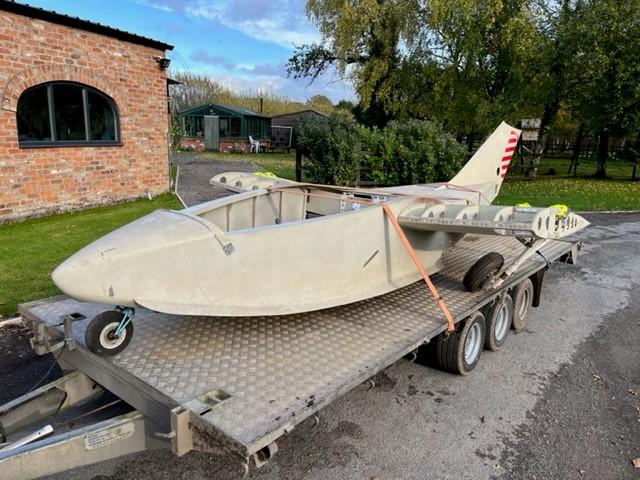
The Osprey 2 is a two-seat homebuilt amphibian designed by George Pereira. It has a wooden flying-boat hull, a mid-mounted wing with tip floats, a 150 hp Lycoming on a pylon above the cabin driving a pusher propeller, and retractable tricycle gear for land use. Plans have been sold since the mid-1970s, and the designer’s company says more than 500 are flying.
The LAA lists it as the Pereira GP-2 Osprey 2, type 070. It suits a pilot who wants to fly from water as well as land on a budget, and who is prepared to look after a wooden boat hull. Like any amphibian, it asks more of its pilot and owner than a land plane: gear position, water handling and corrosion all need constant attention.
History and design
Pereira’s first design, the single-seat GP-2 Osprey 1 flying boat of 1970, was bought by the US Navy and tested as the X-28A. Owners criticised its lack of a passenger seat and its inability to use land runways, so in January 1972 Pereira started on a two-seat amphibian. What began as a modification became a new design, the GP-3 Osprey 2, which first flew from water in April 1973, according to 1000aircraftphotos.com. Testing showed buffet behind the cabin and too much noise, so in 1974 the cabin was lengthened by 7 in, a Lycoming O-320 replaced the original Franklin, and the fin was enlarged.
The hull is wooden, with the planing bottom shaped from polyurethane foam covered with glassfibre, and the wings are wood with a single box spar, as Wikipedia and Plane & Pilot describe. The main gear folds into the wings. No moulds are needed, and Pereira’s prototype took about 1,300 hours to build. Osprey Aircraft says the outer wings can be removed for towing and home storage, and sells 46 sheets of plans with a photo-illustrated construction manual.
Variants
Osprey 2 (GP-3), LAA type 070: the two-seat amphibian. The LAA listing calls it the GP-2 Osprey 2, but Pereira’s GP-2 designation belongs to the single-seat Osprey 1 flying boat; UK paperwork may use either. Engines are Lycomings of 150 to 160 hp.
Osprey 1 (GP-2): the single-seat flying boat of 1970, without land gear. It is not the aircraft covered here.
Specifications
Figures are from Osprey Aircraft’s own specification page, cross-checked against Jane’s 1985–86 (via Wikipedia), 1000aircraftphotos.com and Plane & Pilot. Where they disagree, the manufacturer’s figure is given. We could not read an LAA TADS.
Specification
Imperial
Metric
Seats
2 side-by-side
Wingspan
26 ft
7.92 m
Length
21 ft (Jane’s: 20 ft 6 in)
6.40 m
Wing area
130 sq ft
12.1 m²
Empty weight
960 lb (Jane’s: 970 lb)
435 kg
Gross weight
1,560 lb
708 kg
Useful load
420 lb
191 kg
Engine
Lycoming O-320, 150 hp (150–160 hp per Osprey Aircraft), pusher
Maximum speed
150 mph
241 km/h
Cruise (75%, true)
130 mph
209 km/h
Stall, landing configuration
60 mph
97 km/h
Rate of climb
1,200 ft/min (Jane’s: 1,000)
6.1 m/s
Range
500 statute miles
805 km
Take-off distance
400 ft
122 m
Landing distance
700 ft
213 m
Performance and handling
The Osprey 2 is quick for a two-seat amphibian: the manufacturer quotes a 130 mph true cruise at 75% power and a 60 mph stall in landing configuration. Plane & Pilot quotes a water take-off run of 520 ft. The useful load of about 420 lb has to cover two people and fuel, so two-up flying with full tanks needs a careful weight check.
As with any single-engine aircraft, fuel system cleanliness and management matter. In 1995 a French-registered Osprey II, F-PIRA, suffered engine surging shortly after take-off from Barton and landed on rough ground beside the runway, according to the AAIB; the owner suspected dirt in the carburettor.
Owning one in the UK
You need an NPPL SSEA, LAPL(A) or PPL(A), plus a single-engine piston (sea) class rating if you want to fly from water. It flies on a Permit to Fly administered by the LAA; the LAA engineering fees page lists Permit revalidation at £336 for aircraft of 451–999 kg (checked November 2026), plus inspection costs. Before buying for water flying, check where you can legally and practically operate, as UK water landing sites need permission.
The Lycoming O-320 is a common engine with good UK support. The airframe is wood and glassfibre, so water ingress, rot and glue condition are the main worries, especially if the aircraft has been used on salt water. Plans support comes from Osprey Aircraft in the USA.
Have an LAA inspector check the hull bottom, keel and step for water ingress, delamination of the glassfibre and rot in the wood.
Ask whether it has been used on salt water and how it was washed down afterwards.
Cycle the retractable gear on jacks and check the gear warning and indication.
Inspect the engine pylon, its mounts and the pusher propeller for cracks and erosion.
Check the wingtip floats and their attachments for damage.
Look at the fuel tanks, selector and filters, and ask about any power-loss history.
Get a current weighing and work out your real two-up payload with fuel.
LAA type acceptance
The Light Aircraft Association lists these variants under the following type numbers. Check the LAA Type Acceptance Data Sheets (TADS) for the current approved engines, propellers and modifications before you buy.
A two-seat, plans-built wooden amphibian designed by George Pereira, with a 150 hp Lycoming pusher and retractable gear. It first flew in 1973.
Why does the LAA call it the GP-2?
The LAA lists it as the Pereira GP-2 Osprey 2. Pereira’s own GP-2 was the single-seat Osprey 1 flying boat; the two-seat amphibian is usually called the GP-3.
What licence do I need?
It is LAA Group A, so an NPPL SSEA, LAPL(A) or PPL(A). To operate from water you also need a sea class rating.
Is it on a Permit or a CofA?
It flies on an LAA Permit to Fly, type 070.
How fast is it?
Osprey Aircraft quotes a 130 mph true cruise at 75% power, 150 mph maximum and a 60 mph stall in landing configuration.
What is the fuel burn?
We did not find a reliable published fuel burn. Sources also disagree on fuel capacity (32 or 38 gallons).
How far can it fly?
Jane’s and the manufacturer give about 500 statute miles (434 nm).
Can I build one?
Yes. Osprey Aircraft sells plans with a construction manual; it is not a kit. Any UK build needs LAA approval.
How many have been built?
Osprey Aircraft says more than 500 are flying worldwide.
Can it be kept at home?
The manufacturer says the outer wings can be removed for towing and home storage.
What are the main things to check?
Water damage and rot in the wooden hull, the retractable gear and its warning, the engine pylon and the fuel system.
Figures are typical published values for a standard example and vary with engine, propeller, build and modification state. Always use the aircraft’s own Pilot’s Operating Handbook, weight and balance schedule and LAA paperwork. Last checked November 2026.