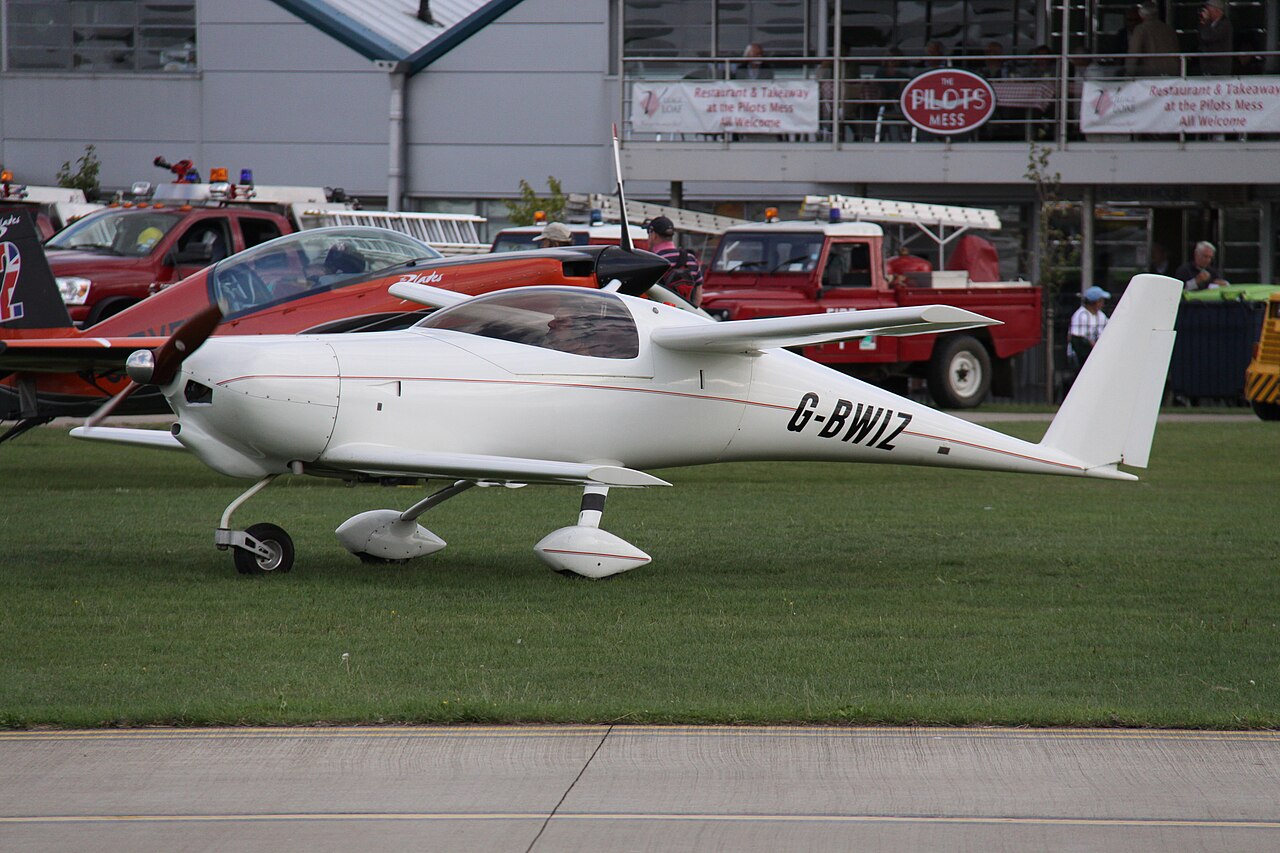
The Quickie family are some of the most distinctive aircraft at any UK fly-in: two wings in tandem, a low front wing that carries the main wheels at its tips, and a tiny composite fuselage slung between them. The single-seat Quickie showed what could be done on just 18 hp, and the two-seat Q2 and its Continental-powered Q200 development turned the idea into a fast, frugal tourer for two.
In the UK they fly on an LAA Permit to Fly as Group A aeroplanes: the single-seat Quickie under LAA type 094 and the Q2, Tri-Q, Q200, Tri-Q200 and Q235 under 094A. They suit pilots who want a lot of speed for very little fuel and who are prepared to learn, and keep current on, a type the AAIB describes as having a reputation for being difficult to control directionally on take-off and landing.
History and design
Tom Jewett and Gene Sheehan came up with the idea in 1975 of a cheap, low-powered single-seat homebuilt, and Burt Rutan designed it for them, settling on a tractor engine and two wings in tandem. Gene Sheehan built the prototype at the Rutan Aircraft Factory from August 1977 and it first flew that November, powered by an 18 hp Onan industrial engine. It won the Outstanding New Design award at Oshkosh in 1978. Jewett and Sheehan formed the Quickie Aircraft Corporation (QAC) that June to sell kits, and Wikipedia records 350 kits sold by 1980. The company closed in the mid-1980s.
The two-seat Q2 was not a Rutan design. Canadian builder Garry LeGare, who had already built a VariEze, proposed a side-by-side version with a bigger Volkswagen-based engine and built the proof-of-concept prototype himself in British Columbia. It first flew in July 1980 and QAC put it into kit production the same year. Like the Quickie it is built of glass fibre and resin over foam. The front wing (the canard) carries full-span elevators and the main wheels at its tips, the rear wing carries inboard ailerons, and a steerable tailwheel sits at the back. The canard provides a large share of the lift, which is why its surface condition matters so much.
Variants
Quickie (LAA 094, Group A): the original single-seater with the 18 hp Onan engine, which is no longer made and which many builders found underpowered. Modified aircraft are covered as the Quickie 1 (Mod).
Q2 (LAA 094A): the two-seat side-by-side version with a 64 hp Revmaster 2100 Volkswagen-based engine. G-BVYT, built in 1983, had a Revmaster R2100D.
Q200 (LAA 094A): a substantially faster Q2 with the 100 hp Continental O-200 and an LS-1 aerofoil canard that is far less sensitive to rain and insects. Mazda, Subaru, Rotax and Corvair engines have also been tried.
Tri-Q and Tri-Q200 (LAA 094A): Q2 and Q200 built with tricycle landing gear in place of the tailwheel layout. G-BUOO was a 1989 Tri-Q 200 with an O-200-A.
Q235 (LAA 094A): listed on the LAA type; we could not confirm its details.
Specifications
Q2 figures are from the Quickie Builders Association and museum data cited by Wikipedia, with Plane & Pilot’s figures where they differ. Quickie (single-seat) figures are for the prototype, from Flight International and Rutan’s Canard Pusher newsletter as cited by Wikipedia. No Q200 data could be confirmed.
Specification
Imperial
Metric
Quickie Q2 (Revmaster)
Seats
2 side-by-side
Wingspan
16 ft 8 in
5.08 m
Length (Wikipedia)
19 ft 10 in
6.05 m
Empty weight
490 lb (Plane & Pilot 537 lb)
222 kg (244 kg)
Maximum take-off weight
1,000 lb (Plane & Pilot 960 lb)
454 kg (435 kg)
Engine
Revmaster 2100 Volkswagen-based, 64 hp (48 kW)
Top speed
180 mph (156 kt)
290 km/h
Cruise
140 mph (Plane & Pilot: 155 mph at 12,000 ft density altitude)
225 (249) km/h
Never-exceed speed (Wikipedia)
200 mph (174 kt)
322 km/h
Rate of climb
1,200 ft/min (Plane & Pilot 1,000)
6.1 (5.1) m/s
Quickie (single-seat prototype)
Rear wing span
16 ft 8 in
5.08 m
Canard span
15 ft 4 in
4.67 m
Length
17 ft 4 in
5.28 m
Empty weight
243.5 lb
110 kg
Maximum take-off weight
485 lb
220 kg
Engine
Onan B48M, 18 hp
Cruise
121 mph (105 kt)
195 km/h
Never-exceed speed
150 mph (130 kt)
240 km/h
Stall, power off
53 mph (46 kt)
85 km/h
Rate of climb
425 ft/min
2.2 m/s
Performance and handling
Efficiency is the headline. Plane & Pilot reports a Q2 cruising at 155 mph at 12,000 ft density altitude on about 3.6 US gallons an hour, roughly 45 miles per gallon. The Q200’s extra power makes it substantially faster still.
In the air the controls are light and quick. A pilot who flew the Q2 production prototype, writing for the EAA, describes a side-stick, very light, responsive controls and a canard that made a conventional stall essentially impossible. The weak point of early aircraft was the original canard aerofoil: rain or insects could cut its lift sharply, producing a sudden nose-down pitch that needed a lot of back stick. The cures were vortex generators or the LS-1 canard, which became standard on the Q200.
On the ground the type demands respect. With the main wheels about 22 ft apart on the canard tips and a small tailwheel, ground loops were common, and the EAA writer needed about 2,000 ft as a minimum landing distance because of the low drag and marginal brakes. In the UK, the AAIB has reported a Q2 that tipped onto its nose under heavy braking on Dunkeswell’s 641 m runway after a fast approach, after which the pilot chose not to use runways under 900 m, and a Tri-Q 200 that entered a pitch oscillation after landing at Cranfield, collapsed its nose leg and caught fire. Wikipedia notes that early glass spar caps flexed enough to cause propeller strikes in hard landings, and that the stiffer carbon spars of the Q200 reduced porpoising.
Owning one in the UK
All variants are LAA Group A aeroplanes, flown on an NPPL SSEA, a LAPL(A) or a PPL(A). They fly on an LAA-administered Permit to Fly, revalidated each year after inspection by an LAA inspector, and annual Permit costs are generally modest. Fuel approval for your engine should be checked on the aircraft’s Operating Limitations and the LAA Aeroplane TADS for types 094 and 094A.
QAC has long gone, so support comes from owners. Quickheads keeps plans, newsletters, LS-1 canard instructions, safety pages and a forum. Get proper type conversion training before flying one solo; G-BVYT’s pilot had about four hours of dual before his accident. Background reading includes the Wikipedia article on the Q2. Browse current listings and other LAA aircraft, or compare the related Viking Dragonfly and the Rutan VariEze.
Buying checklist
Establish exactly which variant it is (Quickie, Q2, Q200, Tri-Q) and which engine is fitted, and read the Operating Limitations.
Find out which canard is fitted (original or LS-1) and whether vortex generators are installed; ask how it behaves in rain.
Inspect the canard and its spar for damage from hard landings or prop strikes, and the wheel spats and brakes at the canard tips.
Check the tailwheel steering linkage: many builders separated the rudder and tailwheel cables after tailspring failures.
Check brake condition and feel, and how the brake lever operates differentially.
Ask about angle of attack on the ground and tailwheel geometry, which affect ground handling.
Arrange type conversion with an experienced Quickie pilot and plan to use longer hard runways at first.
LAA type acceptance
The Light Aircraft Association lists these variants under the following type numbers. Check the LAA Type Acceptance Data Sheets (TADS) for the current approved engines, propellers and modifications before you buy.
They are LAA Group A aeroplanes, so you need an NPPL SSEA, a LAPL(A) or a PPL(A).
Are they on a Permit or a CofA?
They fly on an LAA-administered Permit to Fly: the single-seat Quickie under LAA type 094 and the Q2, Tri-Q, Q200 and Tri-Q200 under 094A.
What is the difference between a Q2 and a Q200?
The Q2 has a 64 hp Revmaster Volkswagen-based engine. The Q200 has a 100 hp Continental O-200 and the LS-1 canard aerofoil, and is substantially faster.
What is a Tri-Q?
A Q2 or Q200 built with tricycle landing gear instead of the standard tailwheel layout.
Is it hard to land?
It needs care. The AAIB says the type has a reputation for being difficult to control directionally on take-off and landing, and UK accidents have involved braking and pitch oscillation after touchdown.
How economical is it?
Plane & Pilot reports a Q2 cruising at 155 mph on about 3.6 US gallons an hour, around 45 miles per gallon.
What happens in rain?
On the original canard aerofoil, rain or insects can cut lift and cause a nose-down pitch. Vortex generators or the LS-1 canard largely cure it.
Can I buy a kit?
No. Quickie Aircraft Corporation closed in the mid-1980s. Plans and information are kept by the owner community at Quickheads.
Who supports it in the UK?
There is no UK agent. Owners rely on LAA engineering and inspectors and the international Quickie owner groups.
Is the single-seat Quickie worth considering?
It is very light and cheap to run, but its original 18 hp Onan engine is no longer made and many builders found it underpowered.
How long a runway do I need?
Plan on longer hard runways. The EAA writer who flew the Q2 prototype needed about 2,000 ft to land, and one UK pilot chose not to use runways under 900 m after an accident.
What is the fuel burn?
Plane & Pilot gives a Revmaster-powered Q2 about 13.6 L/hr (3.6 US gal/hr) at a typical cruise of 155 mph at 12,000 ft density altitude. No sourced figure was found for the O-200-powered Q200.
Figures are typical published values for a standard example and vary with engine, propeller, build and modification state. Always use the aircraft’s own Pilot’s Operating Handbook, weight and balance schedule and LAA paperwork. Last checked November 2026.