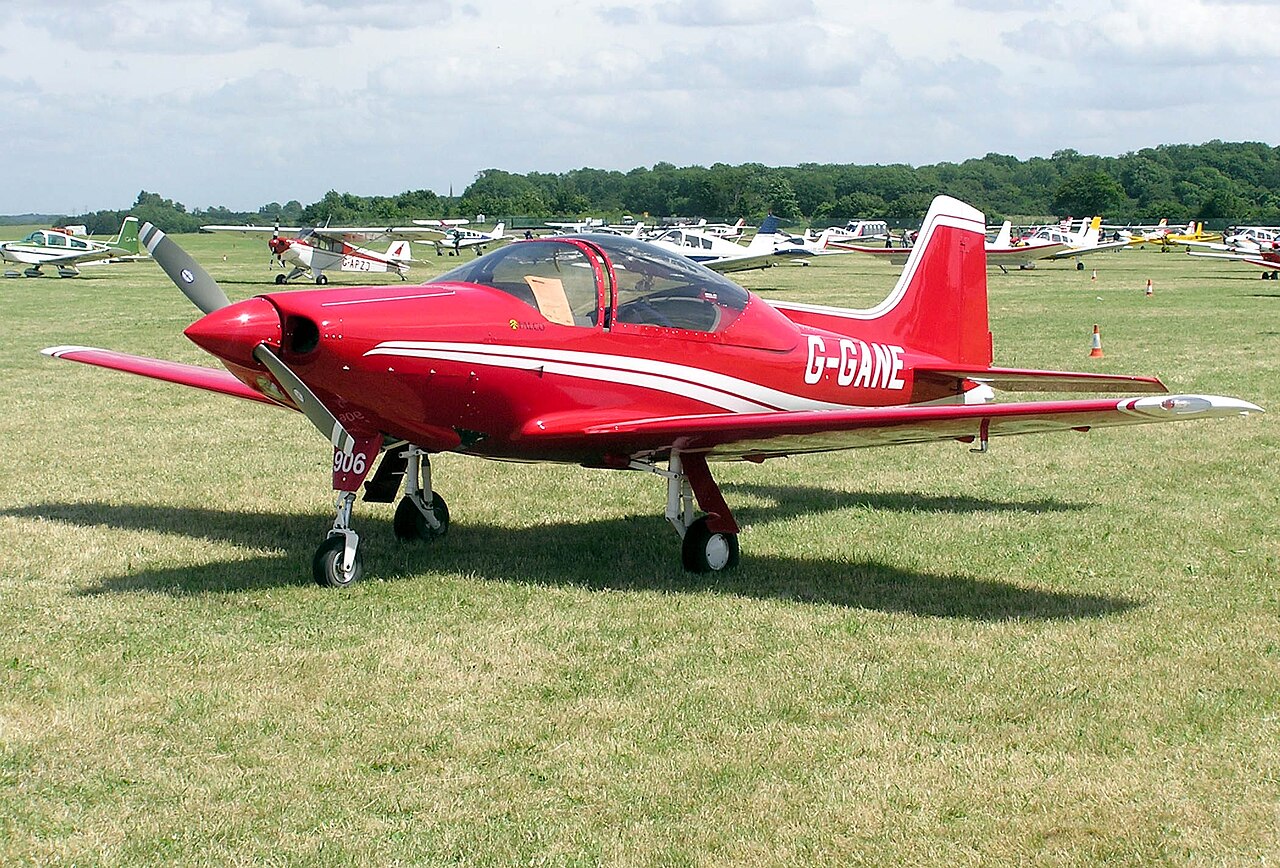
The Falco F.8L is Stelio Frati’s classic Italian two-seater: a small, beautifully shaped wooden low-wing aircraft with a retractable tricycle undercarriage, a sliding canopy and enough strength for aerobatics. The Sequoia Falco is the homebuilt version, redrawn for amateur construction and sold as plans and kits by Sequoia Aircraft in the United States.
In the UK the Sequoia Falco is LAA type 100, Group A, flown on a Permit to Fly. It suits an experienced pilot who wants a fast, elegant aircraft that can also be flown aerobatically, and who values craftsmanship. Building one is a very long project in spruce and birch plywood, so most buyers look for a completed example, and the best ones are treated as works of art.
History and design
Frati designed the Falco in the mid-1950s, and the prototype first flew on 15 June 1955 with a 90 hp Continental C-90. A 135 hp Lycoming O-290 became the production engine. Aviamilano built the Series I (10 aircraft) and the 150 hp Series II (20), Aeromere built the Series III or ‘America’ (35) to meet US airworthiness rules, and Laverda built the 160 hp Super Falco Series IV (20). Plane & Pilot puts factory production at 1956 to 1968.
In the 1980s Alfred Scott’s Sequoia Aircraft, working with David Thurston of Lake Buccaneer fame, re-engineered the Falco for home building and sold plans and kits until the company closed in 2014. The structure is spruce with birch plywood skins and laminated spruce bulkheads; reviewers describe it as a complex and time-consuming wooden build. The firewall-forward installation, the landing gear and the sliding canopy are the main non-wooden parts. The fuselage and wing skins are covered with Dacron fabric over the plywood, and the gear is fully retractable. The design is rated at +6 g and -3 g.
Variants
Sequoia Falco F.8L (LAA 100, Group A): the amateur-built Falco, built from Sequoia plans and kits. Sequoia specified a 150 or 160 hp Lycoming with a fixed-pitch or constant-speed propeller; one UK example advertised in 2023 had a 165 hp Superior IO-320 and an MT three-blade propeller.
The Italian factory-built Falcos (Aviamilano Series I and II, Aeromere Series III and Laverda Super Falco Series IV) are the same basic design, but the LAA type list names only the Sequoia Falco under type 100. If you are offered one of these, check its UK paperwork carefully, because its status will differ from a Sequoia-built aircraft.
Specifications
The table uses the Laverda Super Falco IV figures from Jane’s (via Wikipedia), which match the Sequoia weights and dimensions published by Plane & Pilot. The cruise figure is Sequoia’s 75% power figure. UK limits are set by the LAA type data sheet and each aircraft’s Operating Limitations.
Specification
Imperial
Metric
Seats
2 side by side
Wingspan
26 ft 3 in
8.00 m
Length
21 ft 4 in
6.50 m
Height
7 ft 5 in
2.27 m
Wing area
108 sq ft
10.0 m²
Empty weight
1,212 lb
550 kg
Maximum take-off weight
1,808 lb
820 kg
Useful load
596 lb
270 kg
Engine
Lycoming O-320 / IO-320, 160 hp (120 kW)
Propeller
Fixed pitch or constant speed
Undercarriage
Retractable tricycle
Never-exceed speed
208 kt (239 mph)
385 km/h
Cruise (75% power, Sequoia)
165 kt (190 mph)
306 km/h
Economical cruise (Jane’s, Super Falco IV)
130 kt
250 km/h
Stall (landing configuration)
53-54 kt (61-62 mph)
98-100 km/h
Load factors
+6 g / -3 g
Performance and handling
The Falco is fast for its power. Sequoia quotes about 190 mph (165 kt) at 75% power on 160 hp, and Plane & Pilot gave a top speed of 212 mph. Jane’s more conservative economical cruise for the Super Falco IV is 130 kt. Either way, the Falco covers ground far quicker than most two-seat Permit aircraft, with a landing-configuration stall in the low 50s of knots.
It is fully aerobatic within its +6/-3 g limits, and Plane & Pilot noted that an optional inverted fuel and oil system allows sustained inverted flight. Being a retractable, it needs disciplined gear management. UK AAIB reports include a wheels-up landing after a pilot forgot to lower the gear on a grass runway (G-REEC, 2009), a gear that jammed after a hard landing had bent the nose strut, leading to a belly landing during a rating revalidation flight (G-FATE, 2018), a hard landing that broke the nosewheel (G-BWYO, 2015) and a go-around from a damp grass strip that did not clear the trees after the brakes proved ineffective (G-REEC, 2014).
Owning one in the UK
The Sequoia Falco is an LAA Group A aircraft, so you need an NPPL with an SSEA rating, a LAPL(A) or a PPL(A) with an SEP rating. It flies on an LAA-administered Permit to Fly, revalidated each year after an LAA inspection. If you have not flown a retractable or aerobatic aircraft before, arrange proper conversion training with an instructor familiar with the type before you fly it solo.
The structure is wood and plywood with a fabric finish, so a dry hangar is essential and the glue joints and plywood deserve a close look at every inspection. Sequoia has closed, so builder support comes from the Falco owner and builder community and from LAA inspectors who know wooden aircraft. The Lycoming engine is easy to support in the UK.
Confirm whether the aircraft is a Sequoia-built Falco (LAA 100) or an Italian factory-built one, and check its UK paperwork accordingly.
Have an inspector experienced with wooden aircraft check the spar, glue joints and plywood skins for damp, delamination and rot.
Check the retractable gear, including the nose strut for any bending from past hard landings, and ask for gear swing records.
Check the brakes, especially if the aircraft is based on grass.
Ask for the build log, the LAA paperwork and the weight and balance schedule.
Check the engine and propeller type, hours and history, and whether an inverted fuel and oil system is fitted.
If you plan aerobatics, confirm the aircraft’s Operating Limitations allow them and check the aerobatic weight limit.
LAA type acceptance
The Light Aircraft Association lists these variants under the following type numbers. Check the LAA Type Acceptance Data Sheets (TADS) for the current approved engines, propellers and modifications before you buy.
It is an LAA Group A aircraft, so you need an NPPL with an SSEA rating, a LAPL(A) or a PPL(A) with an SEP rating.
Is the Sequoia Falco on a Permit or a CofA?
Sequoia-built Falcos in the UK fly on an LAA-administered Permit to Fly under LAA type 100. The LAA type list names only the Sequoia Falco, so check the paperwork of any Italian factory-built Falco separately.
Who designed the Falco?
Stelio Frati. The prototype first flew in June 1955, and Sequoia Aircraft later re-engineered it for home building.
Is the Falco aerobatic?
Yes. It is rated at +6 g and -3 g, and an optional inverted fuel and oil system allows sustained inverted flight. Check each aircraft’s Operating Limitations.
How fast is it?
Sequoia quotes about 165 kt (190 mph) at 75% power with 160 hp. Jane’s gives an economical cruise of 130 kt for the factory Super Falco IV.
What engine does it use?
Most are built with a 160 hp Lycoming O-320 or IO-320, with either a fixed-pitch or constant-speed propeller.
Does it have retractable gear?
Yes. The Falco has a fully retractable tricycle undercarriage, and UK AAIB reports include gear-up and gear-jam landings, so gear discipline matters.
Can I still buy a kit?
Sequoia Aircraft closed in 2014, so new kits are no longer sold by the company. Most UK buyers look for a completed aircraft or an advanced project.
How long does it take to build?
It is a complex all-wooden structure in spruce and plywood, and reviewers describe it as time-consuming to build. Expect a very long project.
What is the maximum take-off weight?
Jane’s and Plane & Pilot both give 1,808 lb (820 kg). Check the UK figure on the aircraft’s Operating Limitations.
Does it need a hangar?
Yes. The wooden structure and fabric-covered plywood skins must be kept dry.
Figures are typical published values for a standard example and vary with engine, propeller, build and modification state. Always use the aircraft’s own Pilot’s Operating Handbook, weight and balance schedule and LAA paperwork. Last checked November 2026.