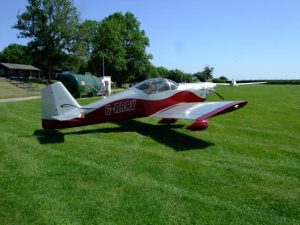
The Van’s RV-6 is the side-by-side member of the classic RV family and, for many years, the best-selling kit aircraft in the world. It is an all-metal, low-wing two-seater built from a Van’s kit, available as the tailwheel RV-6 or the nosewheel RV-6A, and flown in the UK on an LAA Permit to Fly. It combines the RV-4’s wing and handling with a cabin where pilot and passenger sit next to each other.
UK pilots like the RV-6 as a fast, economical touring two-seater that is also capable of sport aerobatics. Because kit production ended in 2001, every RV-6 on the market is a used, individually built aircraft, so condition and build quality vary from one example to the next.
History and design
After the tandem RV-4, customers asked Van’s for a side-by-side version. The RV-6 first flew in 1985 (Wikipedia notes some disagreement, with 1986 also cited) and was the first RV to seat its occupants next to each other, in a cabin about 43 inches wide. It used the RV-4 wing, and Van’s says its handling and short-field behaviour stayed very close to the RV-4’s while giving up only about 3 mph of speed.
In 1986 Van’s added the RV-6A, the first RV with a nosewheel, using simple steel-rod main gear legs. Van’s says the 6A often came out slightly lighter and faster than an equivalent RV-6. Over the production run a rear-sliding canopy became an option alongside the original forward-hinged canopy, and fuel capacity was increased for cross-country use. The Nigerian Air Force even used RV-6As as trainers from 1989, according to Wikipedia.
Van’s replaced the RV-6/6A with the RV-7/7A in 2001 after about 15 years. The RV-7 has a longer wing, more fuel (42 against 38 US gal), a larger rudder, more cabin room and accepts bigger engines, so the RV-6 is the lighter, simpler predecessor. Van’s says more than 2,600 RV-6s have flown, and Wikipedia, citing Van’s First Flights list, gives 2,706 by November 2022.
Variants
RV-6 (LAA type 181A): tailwheel version, 1,600 lb gross in Van’s specification table, 965 lb typical empty weight.
RV-6A (LAA type 181A): nosewheel version with steel-rod main gear, 1,650 lb gross and 985 lb typical empty weight. Slightly shorter and taller than the RV-6.
Both share the same 23 ft wing, 38 US gal fuel, 100 lb baggage and 150-180 hp Lycoming engine range. Canopies are either forward-hinged (tip-up) or rear-sliding, depending on how the builder finished the kit.
Specifications
Van’s published figures, measured with a Hartzell two-blade constant-speed propeller. Performance is for the RV-6 at 1,650 lb unless stated; speeds converted from statute mph.
Specification
Imperial
Metric
Wingspan
23 ft
7.01 m
Length (RV-6 / RV-6A)
20 ft 2 in / 19 ft 9 in
6.15 / 6.02 m
Height (RV-6 / RV-6A)
5 ft 3 in / 6 ft 8 in
1.60 / 2.03 m
Wing area
110 sq ft
10.2 m²
Empty weight (RV-6 / RV-6A)
965 / 985 lb
438 / 447 kg
Gross weight (RV-6 / RV-6A)
1,600 / 1,650 lb
726 / 748 kg
Baggage
100 lb
45 kg
Fuel capacity
38 US gal
144 L
Engine
Lycoming, 150-180 hp
112-134 kW
Propeller
Fixed-pitch or constant-speed
–
Cruise, 75% at 8,000 ft (160 hp)
190 mph / 165 kt
306 km/h
Cruise, 75% at 8,000 ft (180 hp)
198 mph / 172 kt
319 km/h
Top speed (180 hp)
209 mph / 182 kt
336 km/h
Stall speed (gross / solo)
55 / 49 mph (48 / 43 kt)
89 / 79 km/h
Rate of climb (160 / 180 hp)
1,500 / 1,790 fpm
7.6 / 9.1 m/s
Ceiling (180 hp)
20,800 ft
6,340 m
Range, 75% at 8,000 ft (160 / 180 hp)
673 / 626 nm
1,246 / 1,159 km
Range, 55% at 8,000 ft (180 hp)
765 nm
1,417 km
Take-off distance (180 hp)
475 ft
145 m
Landing distance
500 ft
152 m
Performance and handling
The RV-6 shares the RV-4’s wing, so it inherited much of that aircraft’s light, responsive handling and short-field ability, at a small cost in speed. With 180 hp Van’s quotes a 75% cruise of 198 mph (172 kt) at 8,000 ft at gross weight and a climb of about 1,800 fpm, and the 160 hp version is only around 7 kt slower. The tricycle RV-6A gives up a few mph to the tailwheel model in Van’s tables (196 against 198 mph at 75% with 180 hp).
The side-by-side cabin is what sets it apart from the RV-4: easier to share with a passenger, with 100 lb of baggage space and 38 US gal of fuel. Van’s range figures of roughly 620-670 nm at 75% power make it a capable tourer for trips to France and beyond.
Owning one in the UK
The RV-6 and RV-6A are LAA Group A (type 181A), so you need an NPPL SSEA, LAPL(A) or PPL(A); the tailwheel RV-6 also needs tailwheel differences training. They fly on an LAA Permit to Fly, revalidated each year after an LAA inspector’s check, and any modifications or engine changes need LAA approval. Running costs are generally lower than for a certified aircraft of similar performance because much of the maintenance can be owner-done under LAA oversight.
Check the individual aircraft’s Permit operating limitations for aerobatic clearance, and read the LAA Type Acceptance Data Sheet for type 181A through the LAA engineering pages. Whether mogas can be used depends on the specific engine and fuel system. Van’s Aircraft no longer sells RV-6/6A wing or empennage kits but still supplies parts and technical support. Look for examples on our aircraft listings and other LAA aircraft.
Buying checklist
Establish exactly which model it is (RV-6 or RV-6A), the canopy type (tip-up or slider) and the engine and propeller fitted.
Review the LAA file: build log, Permit history, approved modifications and current operating limitations, including aerobatic clearance.
On an RV-6A, have the nose gear leg, fork and attachment inspected by someone experienced with RVs.
Check the tailwheel assembly and spring on an RV-6, and the main gear legs and mounts on both.
Check for corrosion, working rivets and fuel tank sealant condition, which matter more on older airframes.
Confirm the actual empty weight and centre of gravity: gross weight is 1,600 lb (RV-6) or 1,650 lb (RV-6A), so a heavy example limits fuel and baggage.
Check whether Van’s service bulletins relevant to the airframe have been reviewed and recorded.
LAA type acceptance
The Light Aircraft Association lists these variants under the following type numbers. Check the LAA Type Acceptance Data Sheets (TADS) for the current approved engines, propellers and modifications before you buy.
The RV-6 and RV-6A are LAA Group A aeroplanes, so an NPPL SSEA, LAPL(A) or PPL(A) is suitable. The tailwheel RV-6 also requires tailwheel differences training.
Is the RV-6 on a Permit or a CofA?
UK RV-6s are amateur-built and operate on an LAA Permit to Fly, renewed annually after inspection by an LAA inspector.
What is the difference between the RV-6 and RV-6A?
The RV-6 has a tailwheel; the RV-6A has a nosewheel with steel-rod main gear. Van’s lists the RV-6A at 1,650 lb gross against 1,600 lb for the RV-6.
Can I buy a new RV-6 kit?
No. Van’s replaced the RV-6/6A with the RV-7/7A in 2001 and no longer sells RV-6 wing or empennage kits, though parts and support are still available.
How fast is an RV-6?
Van’s quotes a 75% power cruise at 8,000 ft of 190 mph (165 kt) with 160 hp and 198 mph (172 kt) with 180 hp at gross weight.
What range does the RV-6 have for touring?
From 38 US gal, Van’s quotes about 673 nm at 75% power with 160 hp and 626 nm with 180 hp, rising to 765 nm at 55% power with 180 hp.
Is the RV-6 aerobatic?
It shares the RV-4’s wing and handling and is used for sport aerobatics, but in the UK you must check that aerobatics are cleared on that individual aircraft’s Permit operating limitations.
How does the RV-6 compare with the RV-7?
The RV-7 replaced it in 2001 with a longer wing, 42 rather than 38 US gal of fuel, a larger rudder, more cabin room and approval for larger engines up to about 215 hp.
Can I fly an RV-6 on a microlight licence?
No. At 1,600-1,650 lb (726-748 kg) gross it is well above UK microlight limits and is an LAA Group A type.
Who supports the RV-6 in the UK?
Van’s Aircraft supplies parts and technical help directly from Oregon, and the LAA oversees continued airworthiness through its inspectors and engineering department.
How many RV-6s have been built?
Van’s says more than 2,600 have flown, and Wikipedia, using Van’s figures, gives 2,706 as of November 2022.
Figures are typical published values for a standard example and vary with engine, propeller, build and modification state. Always use the aircraft’s own Pilot’s Operating Handbook, weight and balance schedule and LAA paperwork. Last checked November 2026.