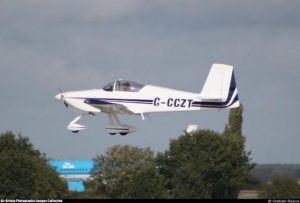
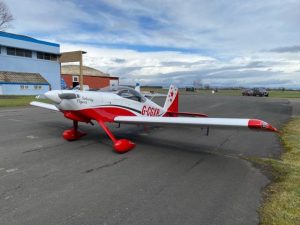
The Van’s RV-9 is the touring RV: a side-by-side, all-metal two-seater that shares its fuselage and canopy with the RV-7 but has a longer, more efficient wing and is intended for cross-country flying rather than aerobatics. It comes as a tailwheel RV-9 or nosewheel RV-9A kit and in the UK flies on an LAA Permit to Fly.
UK pilots buy the RV-9 for comfortable, economical touring with RV speed. It is designed to fly well on modest power (Van’s prototype used 118 hp), it is gentle at low speed, and the RV-9A in particular is often chosen by pilots who do not want the extra workload of a taildragger or the aerobatic focus of the other RVs.
History and design
Every earlier two-seat RV had been designed with aerobatics in mind. With the RV-9, Richard VanGrunsven deliberately traded aerobatic capability for stability, efficiency and easy handling. The nosewheel RV-9A flew first, on 15 June 2000 according to Wikipedia, with the tailwheel RV-9 following in 2002 and kits introduced from early 2001. The RV-9A was also the first Van’s design built from matched-hole parts, which shortened building time.
The key difference is the wing. The RV-9’s 28 ft wing has a higher aspect ratio than the RV-7’s 25 ft wing and uses a Roncz aerofoil unique to the type, with a long-span slotted flap. Van’s says this gives strong climb on low power, a long glide and slow landing speeds. The fuselage and canopy are the same as the RV-7, but the RV-9 is limited to 160 hp (the airframe was designed to take a 160 hp Lycoming O-320) and carries 36 US gal of fuel rather than 42. Wikipedia, citing Van’s First Flights list, gives 1,173 RV-9s and RV-9As completed by November 2022.
Compared with the older side-by-side RV-6, the RV-9 has a much bigger wing (124 against 110 sq ft) and a lower stall speed, but it is not intended for aerobatics.
Variants
RV-9 (LAA type 320): tailwheel version, 6 ft high, empty weight 1,015-1,057 lb.
RV-9A (LAA type 320): nosewheel version, 7 ft 10 in high, empty weight 1,028-1,075 lb and a couple of mph slower in Van’s tables.
Both have the same 28 ft wing and 36 US gal fuel, with a gross weight of 1,600-1,750 lb depending on configuration. Engines run from 118 hp to 160 hp, with fixed-pitch or constant-speed propellers.
Specifications
Van’s published figures for the tailwheel RV-9, measured with a Hartzell two-blade constant-speed propeller, at 1,750 lb gross unless stated. Speeds converted from statute mph.
Specification
Imperial
Metric
Wingspan
28 ft
8.53 m
Length
20 ft 5 in
6.22 m
Height (RV-9 / RV-9A)
6 ft / 7 ft 10 in
1.83 / 2.39 m
Wing area
124 sq ft
11.5 m²
Empty weight (RV-9 / RV-9A)
1,015-1,057 / 1,028-1,075 lb
460-479 / 466-488 kg
Gross weight (MTOW)
1,600-1,750 lb
726-794 kg
Baggage
100 lb (weight and balance permitting)
45 kg
Fuel capacity
36 US gal
136 L
Engine
118-160 hp
88-119 kW
Propeller
Fixed-pitch or constant-speed
–
Cruise, 75% at 8,000 ft (118 / 135 / 160 hp)
166 / 174 / 188 mph (144 / 151 / 163 kt)
267 / 280 / 303 km/h
Top speed (160 hp)
196 mph / 170 kt
315 km/h
Stall speed (gross, 160 hp / solo)
50 / 44 mph (43 / 38 kt)
80 / 71 km/h
Rate of climb (118 / 160 hp)
1,000 / 1,400 fpm
5.1 / 7.1 m/s
Ceiling (160 hp)
19,000 ft
5,790 m
Range, 75% at 8,000 ft (118 / 160 hp)
760 / 617 nm
1,408 / 1,143 km
Range, 55% at 8,000 ft (160 hp)
747 nm
1,383 km
Take-off distance (160 hp)
475 ft
145 m
Landing distance (160 hp)
450 ft
137 m
Performance and handling
With the 160 hp O-320 the RV-9 cruises at 188 mph (163 kt) at 75% power and 8,000 ft at full weight, according to Van’s, roughly 10 kt slower than an RV-7 on 180 hp but on less power. Even the 118 hp version manages 144 kt and the longest range of the line-up, about 760 nm at 75%. The big wing shows in the low-speed numbers: a 44 mph (38 kt) solo stall and 50 mph (43 kt) at gross with 160 hp.
Van’s describes the handling as docile, with firmer controls than the other RVs, a gentle stall and good control at low speed, qualities that suit long, relaxed trips. It is not designed for aerobatics. With 36 US gal and 100 lb of baggage (weight and balance permitting), it suits two people touring the UK and Europe.
Owning one in the UK
The RV-9/9A is LAA Group A (type 320), so you need an NPPL SSEA, LAPL(A) or PPL(A), plus tailwheel differences training for the RV-9. It flies on an LAA Permit to Fly with an annual LAA inspection and Permit revalidation; new builds are overseen by an LAA inspector, and changes of engine or modifications need LAA approval. Running costs are generally lower than for a certified aircraft because much of the maintenance can be owner-done under LAA oversight.
Read the LAA Type Acceptance Data Sheet for type 320 through the LAA engineering pages for UK-accepted engine and propeller combinations and the UK maximum weight for each aircraft. Whether mogas can be used depends on the engine and fuel system fitted. Kits come direct from Van’s Aircraft: the 2026 price list gives US$51,500 for a standard RV-9 airframe kit (US$53,300 RV-9A) and US$75,900 for QuickBuild (US$77,700 RV-9A), excluding engine, propeller, avionics, firewall-forward kit and shipping. See current aircraft on our listings and other LAA aircraft.
Buying checklist
Confirm the maximum weight on the aircraft’s Permit: Van’s lists 1,600-1,750 lb, and it makes a large difference to payload.
Check the engine and propeller: performance varies a lot between 118 hp and 160 hp installations, and the combination must be LAA-accepted.
Get a current weighing report: with empty weights of roughly 1,015-1,075 lb, a heavy example can struggle to carry two people, full fuel and bags.
On an RV-9A, have the nose gear leg and fork checked by an RV-experienced inspector.
Do not assume aerobatic clearance: the RV-9 is not designed for aerobatics, so be wary of any history of aerobatic use.
Review the LAA build file, stage inspections and Permit history, and check that applicable Van’s service bulletins are recorded.
Inspect the flaps and their operation, as the long-span slotted flap is central to the RV-9’s low-speed performance.
LAA type acceptance
The Light Aircraft Association lists these variants under the following type numbers. Check the LAA Type Acceptance Data Sheets (TADS) for the current approved engines, propellers and modifications before you buy.
The RV-9 and RV-9A are LAA Group A aeroplanes, so an NPPL SSEA, LAPL(A) or PPL(A) is suitable. The tailwheel RV-9 also needs tailwheel differences training.
Is the RV-9 on a Permit or a CofA?
UK RV-9s are amateur-built and fly on an LAA Permit to Fly, revalidated each year after an LAA inspection.
Is the RV-9 aerobatic?
No. Van’s designed it for cross-country touring and traded aerobatic capability for stability and efficiency, unlike the RV-4, RV-6, RV-7 and RV-8.
How fast is the RV-9?
Van’s quotes a 75% power cruise at 8,000 ft at gross weight of 166 mph (144 kt) on 118 hp, 174 mph (151 kt) on 135 hp and 188 mph (163 kt) on 160 hp.
What engine does the RV-9 use?
Engines from 118 hp to 160 hp. The prototype used a 118 hp Lycoming and the airframe was designed to accept the 160 hp Lycoming O-320.
How far can an RV-9 fly?
From 36 US gal Van’s gives about 617 nm at 75% power with 160 hp and 747 nm at 55%, or about 760 nm at 75% with 118 hp.
How is the RV-9 different from the RV-7?
They share the fuselage and canopy, but the RV-9 has a longer 28 ft wing with a Roncz aerofoil and slotted flaps, is limited to 160 hp, carries 36 rather than 42 US gal and is not aerobatic.
Is the RV-9 a good first RV?
Van’s describes its handling as docile with a gentle stall and good low-speed control, and the nosewheel RV-9A avoids the need for tailwheel training.
Can I build an RV-9 in the UK?
Yes. Kits are bought direct from Van’s Aircraft and built under LAA oversight. The 2026 standard airframe kit is US$51,500 (RV-9) or US$75,900 QuickBuild, before engine, avionics and shipping.
Can I fly an RV-9 on a microlight licence?
No. With a gross weight of 1,600-1,750 lb (726-794 kg) it is well above UK microlight limits and is an LAA Group A type.
Who supports the RV-9 in the UK?
Van’s Aircraft supplies kits, parts and technical support directly from Oregon, and the LAA oversees building and airworthiness through its inspectors and engineering department.
Figures are typical published values for a standard example and vary with engine, propeller, build and modification state. Always use the aircraft’s own Pilot’s Operating Handbook, weight and balance schedule and LAA paperwork. Last checked November 2026.