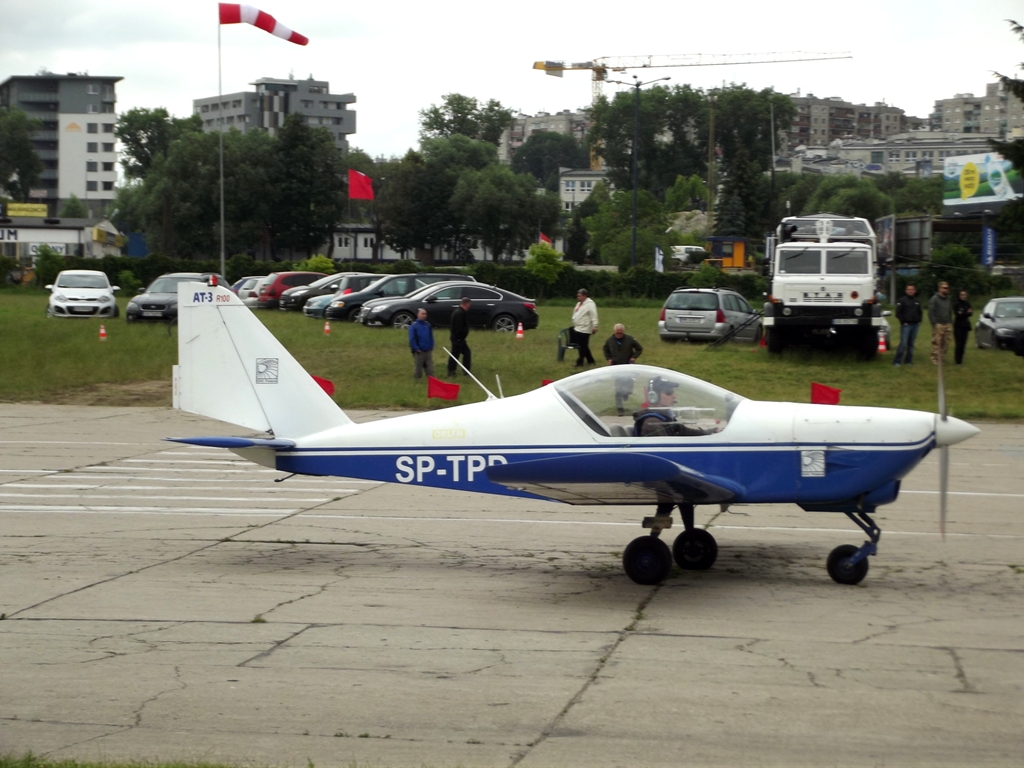
The Aero AT-3 is a compact, all-metal, low-wing two-seater built in Mielec, Poland. It was designed as a simple, economical trainer and runabout, with a Rotax 912S up front, a fixed tricycle undercarriage and side-by-side seats under a large canopy.
The UK was the AT-3’s first export market, and British flying schools such as Old Sarum have operated it. That makes it one of the more common modern Polish light aircraft on the UK register. Most were sold factory-built and certified as Very Light Aeroplanes (VLA), and the type also appears on the LAA’s list of accepted types. For a buyer it offers modern Rotax economy, metal construction and a cruise of around 108 knots, in a size that is easy to hangar.
History and design
The AT-3 was designed by Tomasz Antoniewski and is described as a development of the French Pottier P.220S Koala. It first flew in 1997, and deliveries began in 2002. The type was certified under the European VLA rules and gained EASA VLA approval in January 2005. The US FAA issued a type certificate in 2010 on the strength of the European approval. The first aircraft went to the Warsaw Aeroclub, and the first export sales were to the UK in 2004. Wikipedia records 16 sold to the UK and about 70 delivered worldwide by early 2014, mostly to flight training organisations.
The airframe is all-metal with a semi-monocoque structure, a cantilever low wing and a fixed tricycle undercarriage on steel leaf springs, with independent hydraulic toe brakes. Ownership has changed more than once. Aero AT was bought by a Chinese aerospace group in 2013, and according to Airframer it ceased operations in 2021, when Extend Aero acquired its assets. The manufacturer’s website still lists the AT-3 R100 in EASA CS-VLA form.
Variants
AT-3 R100: the factory-built, EASA VLA-certified aircraft with a Rotax 912S. The original data gives a 582 kg MTOW, and EASA added a 630 kg option in 2019. Current versions offer the fuel-injected Rotax 912iSc and glass-cockpit or analogue panels.
AT-3 SK: the kit (amateur-built) version of the same aircraft.
LAA type 327 (Group A): the LAA’s single entry for the AT-3. It covers AT-3s operated on an LAA Permit to Fly rather than a Certificate of Airworthiness. Check which system a particular aircraft is on.
AT-4: a larger-wing version for the US light sport market, also sold as the Gobosh 700. It is not a separate LAA type.
Specifications
Weights and fuel below are for the AT-3 R100 as published in Jane’s All the World’s Aircraft 2004-05 and Plane & Pilot. Speeds are the manufacturer’s current figures. The current 630 kg R100 is quoted at 380 kg empty with a 250 kg useful load.
Specification
Imperial
Metric
Seats
2 side by side, plus a 30 kg baggage area
Wingspan
24 ft 9 in
7.55 m
Length (manufacturer)
20 ft 6 in
6.25 m
Height
7 ft 4 in
2.23 m
Wing area
100 sq ft
9.3 m²
Empty weight (582 kg version)
772 lb
350 kg
Maximum take-off weight
1,283 lb (1,389 lb option)
582 kg (630 kg option)
Fuel capacity
18 US gal
70 litres
Engine
Rotax 912S, 100 hp
Never-exceed speed (manufacturer)
127 kt
236 km/h
Cruise
108 kt
200 km/h
Maximum cruise
119 kt
220 km/h
Stall
44 kt
82 km/h
Take-off run
525 ft
160 m
Landing run
492 ft
150 m
Service ceiling
12,500-13,100 ft
3,800-4,000 m
Load factors
+3.8 / -1.5 g
Fuel consumption (manufacturer)
4.8 US gal/hr
18 L/hr (912S); 15 L/hr (912iSc)
Performance and handling
On 100 hp the AT-3 cruises at about 108 knots, with up to 119 knots available at higher power. That is typical of a modern Rotax two-seater, and quicker than many older 100 hp trainers. Stall speed is a modest 44 knots, and the published take-off and landing runs of around 150-160 m make it practical from shorter grass strips.
The manufacturer quotes 18 L/hr for the carburetted 912S and 15 L/hr for the injected 912iSc, without stating the power setting. Airport Technology gives a similar 16 L/hr. Published climb rates vary from about 730 to 906 ft/min, so judge an individual aircraft on its own test-flight figures. The AT-3 is not cleared for aerobatics. Its design limits are +3.8 / -1.5 g, which is normal-category territory.
Owning one in the UK
The AT-3 is a single-engine piston aeroplane, so you need an NPPL SSEA, LAPL(A) or PPL. Before buying, establish whether the aircraft is on an EASA-type Certificate of Airworthiness (as most factory R100s were delivered) or on an LAA Permit to Fly under type 327. A Permit aircraft is maintained under LAA oversight, with an annual inspection by an LAA inspector and a Permit revalidation. That is usually cheaper than CofA maintenance, but it has its own rules on modifications and use for hire.
The Rotax 912S can use unleaded motor fuel or avgas according to Rotax’s guidance, and its TBO is quoted at 2,000 hours. Many UK AT-3s have a training history, so expect higher airframe hours and plenty of landings. The UK AAIB has published several reports on AT-3 accidents, which are worth reading for context. Support comes from the factory in Mielec, now under Extend Aero. Rotax engine parts are easy to find in the UK.
Confirm whether the aircraft is on a CofA or an LAA Permit, and that the paperwork matches (type 327 for Permit aircraft).
Check the MTOW in the flight manual or Operating Limitations: 582 kg on earlier aircraft, or 630 kg where the later option is embodied.
Review the training history: hours, number of landings, and any heavy-landing or prop-strike records.
Inspect the nose leg, the steel leaf-spring main gear and the hydraulic brakes for wear.
Check the Rotax 912S hours against its 2,000-hour TBO, plus carburettor, hose and gearbox maintenance.
Look for corrosion on the all-metal airframe, especially aircraft kept outside.
Find out the fuel set-up (standard 70 L or optional wing tanks) and confirm usable fuel in the manual.
LAA type acceptance
The Light Aircraft Association lists these variants under the following type numbers. Check the LAA Type Acceptance Data Sheets (TADS) for the current approved engines, propellers and modifications before you buy.
An NPPL SSEA, LAPL(A) or PPL with a single-engine piston rating. The AT-3 is not a microlight.
Is the AT-3 on a Permit or a CofA?
It can be either. Factory-built R100s were certified to EASA VLA standards, while the LAA lists the AT-3 as Group A type 327 for aircraft on an LAA Permit to Fly. Check the individual aircraft.
What is the fuel burn?
The manufacturer quotes 18 L/hr (about 4.8 US gal/hr) for the Rotax 912S and 15 L/hr (about 4.0 US gal/hr) for the 912iSc. It does not state the power setting.
How fast does it cruise?
The manufacturer gives 108 knots cruise and 119 knots maximum cruise on 100 hp.
What is the maximum take-off weight?
The original AT-3 R100 figure is 582 kg. EASA approved a 630 kg option in 2019, and the current factory brochure uses 630 kg.
Is it good for training?
Yes. It was designed as a trainer, and most AT-3s have been used by flying schools, including in the UK.
Can I buy a new one?
The manufacturer’s website still lists the AT-3 R100 in EASA CS-VLA form. The original company ceased operations in 2021, and Extend Aero took over its assets.
Can it use mogas?
The Rotax 912S is cleared by Rotax for suitable unleaded motor fuel as well as avgas. Check the aircraft’s flight manual for the approved fuels.
How much useful load does it have?
At 630 kg the factory quotes 380 kg empty and a 250 kg useful load. Earlier 582 kg aircraft were around 350 kg empty, so always work from the individual weight schedule.
Is it aerobatic?
No. Its design load limits are +3.8 / -1.5 g, and it is not an aerobatic aircraft.
Who supports the AT-3?
Parts and technical support come from the factory in Mielec, Poland, now run by Extend Aero. Rotax dealers and service centres in the UK handle the engine.
Figures are typical published values for a standard example and vary with engine, propeller, build and modification state. Always use the aircraft’s own Pilot’s Operating Handbook, weight and balance schedule and LAA paperwork. Last checked November 2026.