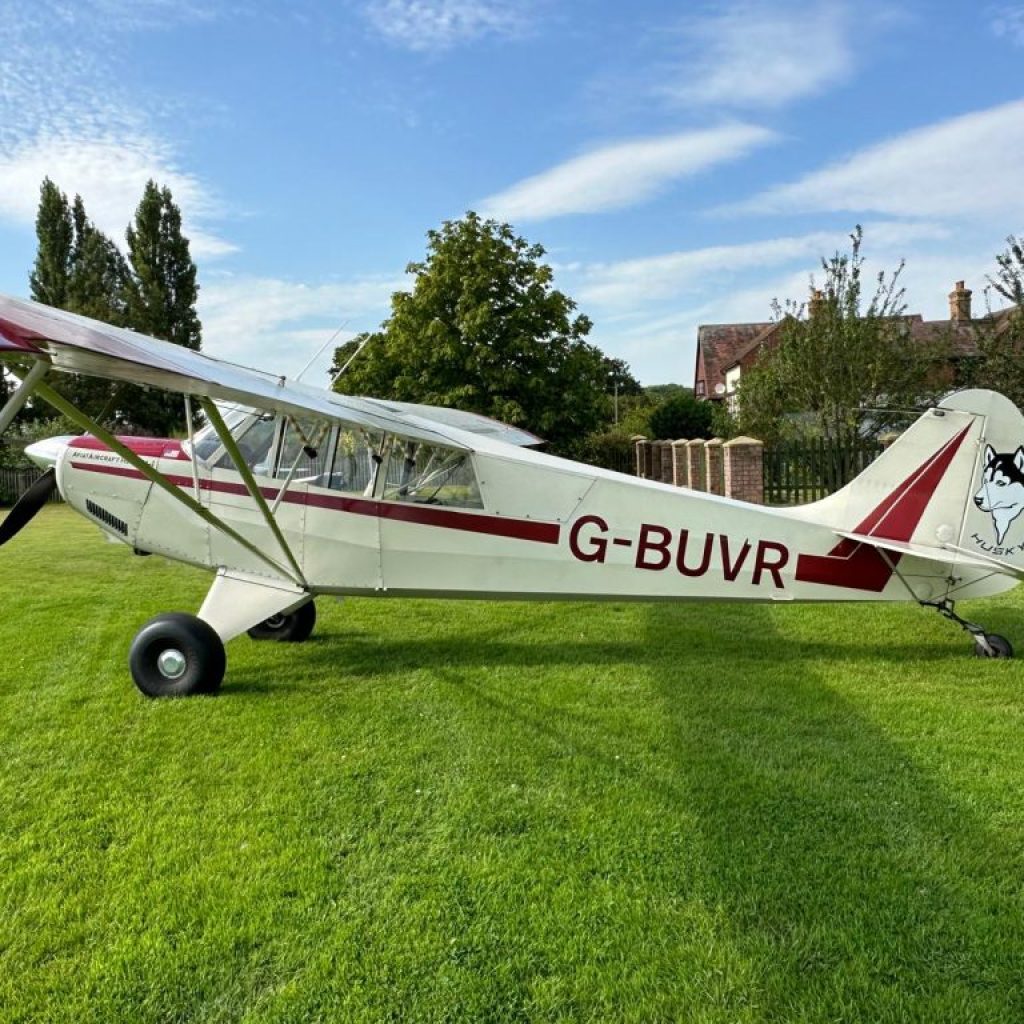
The Aviat Husky is a certified two-seat, high-wing tailwheel utility aircraft built for short, rough strips. It looks like a classic Cub-family tube-and-fabric design, but it was designed from scratch in the mid-1980s and has a 180 hp Lycoming, a constant-speed propeller, flaps and a big, strong airframe. Pilot and passenger sit in tandem with dual controls, and the type can go on floats or skis or tow gliders and banners.
In the UK the Husky appeals to pilots who want serious short-field and grass-strip capability in a factory-built, certified aircraft that still cruises at well over 100 kt. It is used in the UK as a tailwheel trainer, and elsewhere as a glider tug, patrol aircraft and floatplane.
History and design
Christen Industries began designing the Husky in 1985, using computer-aided design at a time when few light-aircraft makers did. The prototype flew in 1986, and the A-1 received its FAA type certificate on 1 May 1987. Aviat Aircraft of Afton, Wyoming, took over the type, and more than 650 had been sold by 2008. It is unusual as an all-new light aircraft put into series production in the US in that period.
The fuselage and tail are welded steel tube with Dacron fabric covering, and the braced high wing has metal leading edges. The high wing gives a good view of the ground, and the tandem cabin has dual controls. Options have included floats, skis, and banner and glider tow hooks, and the type is used for observation, patrol, pipeline inspection and glider towing.
Variants
A-1: the original 1987 version with a 180 hp Lycoming O-360 and an 816 kg (1,800 lb) MTOW.
A-1A: certified in 1998 with an 857 kg (1,890 lb) MTOW.
A-1B: certified in 1998 with a 907 kg (2,000 lb) MTOW; an optional 200 hp IO-360 is available under an STC.
A-1B-160 Husky Pup: a lighter-powered A-1B with a 160 hp Lycoming O-320, offered with or without flaps, and a fixed-pitch propeller.
A-1C-180 and A-1C-200: certified in 2007, with MTOWs of 998 kg (2,200 lb) and 1,021 kg (2,250 lb) and engines of 180 hp and 200 hp.
The Husky is a certified type, so it is not on the LAA’s list of Permit types.
Specifications
Figures are for the A-1C-180 unless noted. Limits and fuel are from the EASA type certificate data sheet; performance is the manufacturer’s.
Specification
Imperial
Metric
Wingspan
35 ft 6 in
10.82 m
Length
22 ft 7 in
6.88 m
Wing area
183 sq ft
17.0 m²
Empty weight
1,275 lb
578 kg
Maximum take-off weight
2,200 lb (A-1: 1,800 lb)
998 kg (A-1: 816 kg)
Useful load
925 lb
420 kg
Fuel
52 US gal total, 50 US gal usable
196.8 L total, 189.2 L usable
Engine
Lycoming O-360-A1P, 180 hp
Propeller
Hartzell two-blade constant speed
Never-exceed speed (Vne)
133 KIAS (153 mph)
246 km/h
Maximum structural cruise (Vno)
103 KIAS
191 km/h
Cruise, 75% power
122 kt (140 mph)
225 km/h
Maximum speed
126 kt (145 mph)
233 km/h
Stall, flaps down, power off
46 kt (53 mph)
85 km/h
Rate of climb
1,500 ft/min
7.6 m/s
Range, 55% power
695 nm (800 statute miles)
1,287 km
Take-off / landing, full flap
200 ft / 350 ft
61 m / 107 m
Maximum operating altitude
18,500 ft
5,640 m
Performance and handling
With 180 hp, a big wing and powerful flaps, the Husky gets off very short strips: Plane & Pilot quoted a 200 ft take-off and 350 ft landing with full flap, and the stall with flap and power on is around 43 mph. At the other end of the scale it cruises at about 140 mph (122 kt) at 75% power, or 130 mph at 55% on about 7.7 US gal/h, and climbs at around 1,500 ft/min. Range at economy power is about 800 statute miles.
As a tailwheel aircraft with plenty of power and a constant-speed propeller, it needs proper tailwheel training, but it is widely used for exactly that: Jigsaw Aviation at Sleap in Shropshire uses a Husky A-1B-160 for tailwheel instruction.
Owning one in the UK
Airworthiness: the Husky is a certified aircraft holding a Certificate of Airworthiness, maintained to the approved maintenance programme by a suitably approved organisation, with an annual airworthiness review. That costs more than an LAA Permit aircraft but brings fewer limits on use, including night and IFR flight when suitably equipped (the type certificate approves day and night VFR and IFR with the right equipment, but not flight into icing).
Licence: a PPL or LAPL, or an NPPL (SSEA), with tailwheel and variable-pitch propeller differences training. The flapless Husky Pup has a fixed-pitch propeller, which removes one differences item.
Engines and fuel: the type certificate specifies 100/100LL avgas as the minimum grade. If you want to use mogas, check whether the individual aircraft has an approved modification for it.
Insurance and hangarage: insurers will want tailwheel experience, and a fabric-covered aircraft should be hangared. It does not fold.
Support: Aviat Aircraft (UK) Ltd handles sales and servicing enquiries in Britain, backed by the factory in Afton, Wyoming. Browse aircraft for sale, or compare Permit-based alternatives such as the CubCrafters Carbon Cub and Rans S-7 Courier among the LAA types.
Buying checklist
Confirm the exact model (A-1, A-1A, A-1B, Pup or A-1C), as MTOW, engine and propeller differ.
Check the CofA, airworthiness review certificate and maintenance records, including compliance with airworthiness directives for the airframe, engine and propeller.
Inspect the fabric for age, damage and the results of any fabric strength tests.
Look for corrosion in the lower fuselage tubes and tail, particularly on aircraft that have operated on floats or from wet strips.
Check the main gear, tailwheel and brakes, and any large tyres or tundra gear, for approval and wear.
Review the engine and propeller logs for time since overhaul, and check the constant-speed propeller and governor.
Check any tow hook, float or ski installations are approved and recorded.
Ask for the weight schedule to confirm the real useful load with the installed equipment.
The Husky is a certified type, so UK examples hold a Certificate of Airworthiness and are maintained by an approved organisation. It is not an LAA Permit type.
What licence do I need?
A PPL, LAPL or NPPL (SSEA), with tailwheel differences training and, for constant-speed propeller models, variable-pitch propeller training.
Is the Husky side-by-side or tandem?
Tandem. The pilot and passenger sit one behind the other, with dual controls.
What engine does it have?
Most Huskies have a 180 hp Lycoming O-360 with a constant-speed propeller. The A-1C-200 has a 200 hp IO-360, and the Husky Pup a 160 hp O-320.
How fast is it?
Aviat quotes about 140 mph (122 kt) at 75% power and 130 mph at 55%. Vne is 133 KIAS.
How much fuel does it burn?
Plane & Pilot quoted about 7.7 US gal/h at 55% power. Usable fuel is 50 US gallons (189 litres).
What fuel does it use?
The type certificate specifies 100/100LL avgas as the minimum grade. Mogas would need an approved modification, so check the aircraft’s records.
How short a strip can it use?
Plane & Pilot quoted a 200 ft take-off and 350 ft landing with full flap for the A-1C. Allow generous margins for UK grass, slopes and obstacles.
Can it go on floats?
Yes. Floats and skis are options, and the A-1B is approved for banner and glider towing with an approved tow hook.
Is it good for tailwheel training?
Yes. UK schools use it for that; Jigsaw Aviation at Sleap uses a Husky A-1B-160 for tailwheel instruction.
Can it fly at night or in IFR?
The type certificate allows day and night VFR and IFR when the aircraft is suitably equipped, but not flight into known icing. Your licence and ratings must cover it too.
Who supports the Husky in the UK?
Aviat Aircraft (UK) Ltd handles UK sales enquiries, with factory support from Aviat in Afton, Wyoming.
Figures are typical published values for a standard example and vary with engine, propeller, build and modification state. Always use the aircraft’s own Pilot’s Operating Handbook, weight and balance schedule and LAA paperwork. Last checked November 2026.