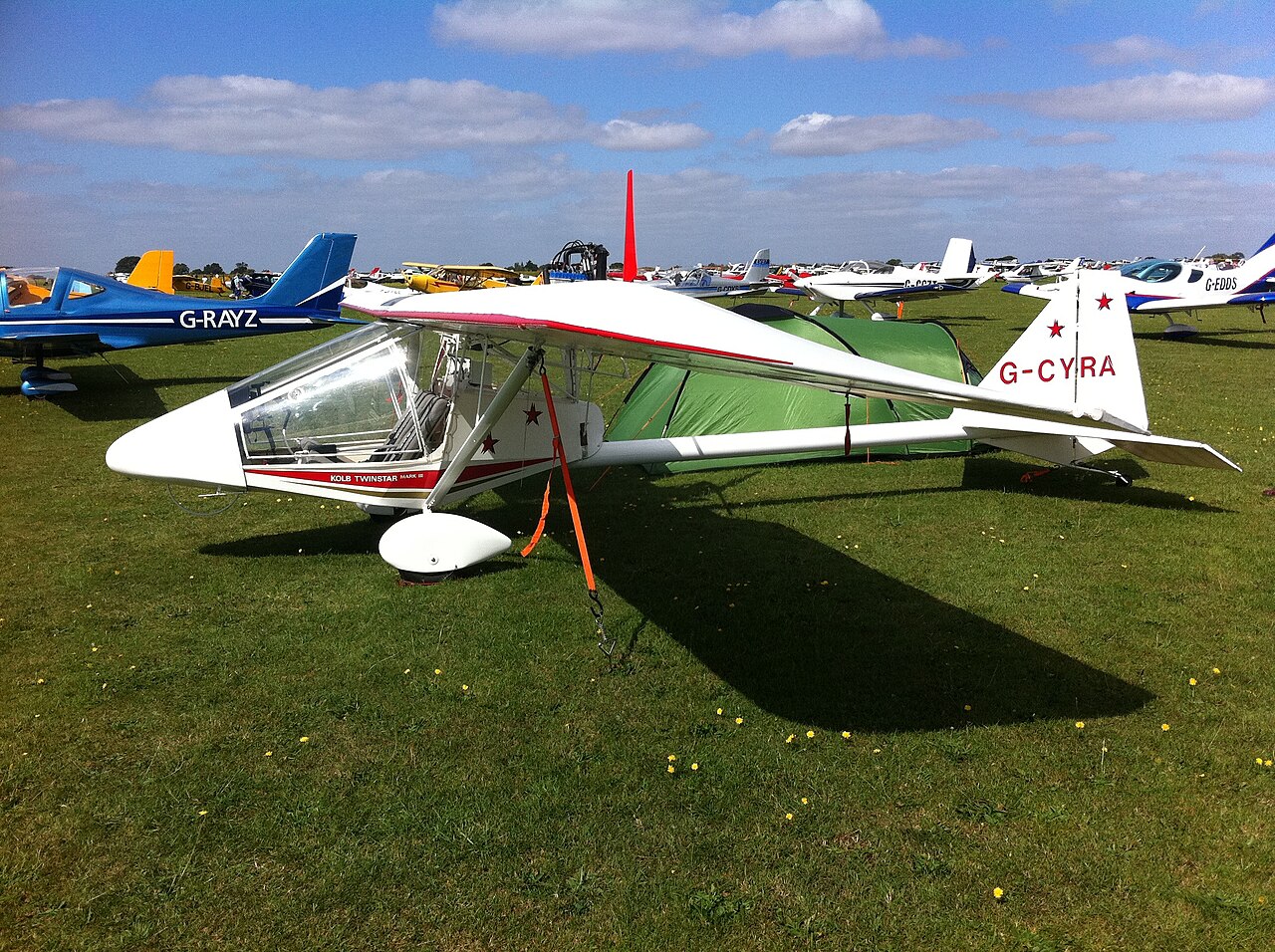
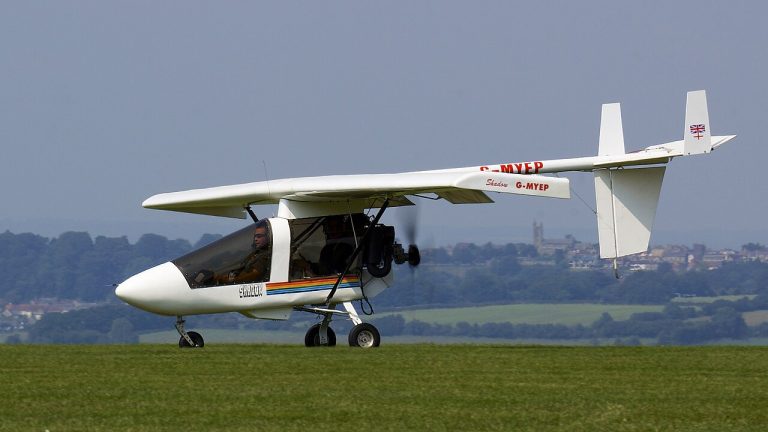
The Kolb Twinstar is a two-seat, side-by-side microlight with a high wing and a pusher engine mounted behind the cabin. It comes from the American Kolb company and was sold as a kit for amateur construction, so every UK example was put together by its builder and flies on an LAA Permit to Fly as a microlight under type 205.
Its big attraction for UK owners is that the wings and tailplane fold, so a Twinstar can live in a trailer or a corner of a barn rather than a paid hangar. It suits pilots who want a simple, low-cost two-seater for local flying from farm strips, and who are happy with two-stroke Rotax power, an open-tube airframe and the leisurely pace that goes with it.
History and design
The Twinstar name belongs to Kolb’s line of two-seat pusher designs. Wikipedia notes that the Mark III was also marketed as the Twinstar and Mark III Classic, and that the later Mark III Xtra (M3X) arrived in 1999 with an aerodynamic clean-up by Barnaby Wainfan. The kits were later sold by New Kolb Aircraft of London, Kentucky.
Construction mixes a welded 4130 steel-tube forward fuselage with an aluminium tail boom. The wings, tail surfaces and fin are riveted aluminium tube covered in doped fabric. The main gear is sprung tube with a steerable tailwheel, and the cabin is about 45 in (114 cm) wide. Wikipedia records that one person can rig the original Mark III for flight in about eight minutes without tools; the Xtra takes rather longer.
The engine sits above the wing, driving a pusher propeller; one UK Mk III examined by the AAIB had a ground-adjustable three-blade Warp Drive propeller.
Variants
Twinstar Mk II: the earlier version covered by LAA type 205. We could not confirm its UK engine or weight limits.
Twinstar Mk III: the main production two-seater. Wikipedia lists Rotax 503, 582, 618 and 912UL engines; the UK Mk III accident reports we read all involve Rotax 582 installations.
Mk III (Mod): the LAA’s designation for modified Mk IIIs, listed under the same type number.
Mk 3 Extra (Xtra): the cleaned-up 1999 model. In the UK it has its own LAA data sheet (TADS 205A) allowing either the Rotax 582 or Jabiru 2200A, an MTOW of 405 kg, or 431 kg with the approved wing vortex generator modification.
Single-seat conversions: at least one Twinstar has been modified to carry no passenger and flown as a Single Seat DeRegulated (SSDR) microlight, outside the Permit system.
Specifications
Specification
Imperial
Metric
Wingspan (Mk III)
30 ft 0 in
9.14 m
Length (Mk III)
22 ft 6 in
6.86 m
Height (Mk III)
6 ft 2 in
1.88 m
Wing area (Mk III)
160 sq ft
15 m²
Empty weight (Mk III, US data)
450 lb
204 kg
Max permitted empty weight (Mk 3 Extra, UK)
496 lb (Rotax 582), 514 lb (Jabiru)
225 kg (Rotax 582), 233 kg (Jabiru)
MTOW (Mk 3 Extra, UK)
893 lb (950 lb with vortex generators)
405 kg (431 kg with vortex generators)
Gross weight (Mk III, US data)
1,000 lb
454 kg
Fuel (Mk III)
10 US gal
38 litres
Engine
Rotax 582, 64 hp (Jabiru 2200A approved on Mk 3 Extra)
48 kW
Vne (Mk 3 Extra, UK)
95 mph IAS (83 kt)
153 km/h
Max speed, flaps extended (Mk 3 Extra, UK)
60 mph IAS (52 kt)
97 km/h
Cruise (Mk III, Rotax 582)
75 mph (65 kt)
121 km/h
Stall (Mk III)
33 mph (29 kt)
53 km/h
Climb (Mk III)
950 ft/min
4.8 m/s
Range (Mk III)
130 miles (110 nm)
210 km
Performance and handling
With a Rotax 582 the Mk III cruises at around 65 kt and stalls at about 29 kt, according to the figures Wikipedia draws from Kitplanes and other buyer’s guides. That makes it a local-flying aircraft rather than a tourer. In the UK the Mk 3 Extra is limited to non-aerobatic flight, with intentional spinning and sideslipping both prohibited, and the LAA sets a minimum solo pilot weight of 77 kg without ballast.
The AAIB’s report on a single-seat Twinstar that crashed after take-off at St Albans in 2022 is a reminder that slow-flying pusher microlights lose control authority quickly near the stall. The same report found the propeller pitch had been reset by the owner well away from the manufacturer’s recommended setting for that configuration.
Owning one in the UK
Two-seat Twinstars are LAA-administered microlights, so you need a pilot licence with microlight privileges, and the aircraft needs an annual Permit revalidation with an inspection by an LAA inspector. Owners can do much of their own maintenance under LAA oversight; budget for the LAA fee, inspection, insurance and storage. Folding wings mean you may be able to keep the aircraft at home or in a trailer rather than paying for a hangar.
The LAA’s TADS 205A for the Mk 3 Extra lists two Mandatory Permit Directives (flexible fuel tubing and a seat pan modification) and a set of mandatory modifications, including uprated control hinges, aileron stops, 3 mm elevator cables, uprated wing struts and a seat change for crew protection. It also notes that a microlight needs a CAA noise certificate for each aircraft, and that changing the engine, propeller, gearbox ratio or exhaust means getting a new one.
Two AAIB reports point to specific checks. In 2007 a Jabiru-powered Mk 3 Extra lost its propeller in cruise when the bolts holding the crankshaft extension failed in fatigue; the then PFA said it would require plain-shank bolts on Jabiru-engined Twinstars. In 2022 the AAIB found poor maintenance and no logbooks on a Twinstar flown as an SSDR, and reminded owners that they remain legally responsible for airworthiness. See the LAA Aeroplane TADS library for the current data sheet.
The 2007 TADS gave Silver Fern Microlights as the UK contact for the Mk 3 Extra; check whether it still trades before relying on it for parts. Two-stroke Rotax engines run on unleaded motor fuel mixed with two-stroke oil.
Buying checklist
Check whether the aircraft is on an LAA Permit or has been converted to single-seat SSDR, and that the paperwork matches.
Confirm the LAA mandatory modifications and both MPDs are recorded in the logbooks.
On Jabiru-powered aircraft, look for evidence that the crankshaft extension bolts have been replaced with plain-shank items and are correctly wire-locked.
If the seller claims 431 kg MTOW, check the vortex generator modification is approved and the generators are positioned correctly.
Ask for full engine and airframe logbooks; the AAIB has seen Twinstars with poor maintenance and no records.
Check the propeller pitch against the manufacturer’s setting and that a valid noise certificate covers the fitted engine and propeller.
Inspect the doped fabric, the folding wing and tail fittings, and the welded steel cabin frame for corrosion.
The Light Aircraft Association lists these variants under the following type numbers. Check the LAA Type Acceptance Data Sheets (TADS) for the current approved engines, propellers and modifications before you buy.
Two-seat Twinstars are microlights in the UK, so you need a pilot licence with microlight privileges, such as an NPPL with a microlight rating. It is a tailwheel aircraft, so tailwheel training is sensible.
Is the Twinstar on a Permit or a CofA?
Two-seat Twinstars fly on an LAA Permit to Fly under type 205 (Mk II, Mk III and Mk III Mod), with the Mk 3 Extra covered by TADS 205A. At least one has been converted to single seat and flown as an SSDR instead.
What is the UK maximum take-off weight?
For the Mk 3 Extra the LAA data sheet gives 405 kg, or 431 kg with the approved wing vortex generator modification. We could not confirm the UK figure for the Mk II and Mk III.
What engines are fitted?
The Rotax 582 two-stroke was originally the standard engine on the Mk III. The LAA also approves the Jabiru 2200A on the Mk 3 Extra, and Wikipedia lists Rotax 503, 618 and 912UL options on the Mk III.
How fast does it cruise?
Published Mk III figures give a cruise of about 75 mph (65 kt) with a Rotax 582. The UK never-exceed speed for the Mk 3 Extra is 95 mph IAS.
Do the wings fold?
Yes. Both the wings and the tailplane fold, which lets owners keep the aircraft in a trailer or at home.
Can I do aerobatics or spin it?
No. The LAA limits the Mk 3 Extra to non-aerobatic flight and prohibits intentional spinning and sideslipping.
Is there a minimum pilot weight?
Yes. For the Mk 3 Extra the LAA sets a minimum solo pilot weight of 77 kg without ballast.
Are there any known safety issues?
The AAIB has reported a propeller detaching from a Jabiru-powered Mk 3 Extra after the crankshaft extension bolts failed in fatigue. Another report found poor maintenance on a single-seat SSDR conversion.
Can I convert it to single seat?
One UK Twinstar was modified to carry no passenger and flown as a Single Seat DeRegulated microlight. Owners of SSDR aircraft stay legally responsible for keeping them airworthy and keeping logbooks.
What should I check on the engine and propeller?
Check the propeller pitch against the manufacturer’s setting, the condition and locking of the propeller and extension bolts, and that the noise certificate matches the fitted engine and propeller.
What is the fuel burn?
Rotax gives the 582 as 20.5 L/hr (5.4 US gal/hr) at 75% continuous power. That is an engine figure rather than a Twinstar flight test. Aircraft with the Jabiru 2200 option will differ.
Figures are typical published values for a standard example and vary with engine, propeller, build and modification state. Always use the aircraft’s own Pilot’s Operating Handbook, weight and balance schedule and LAA paperwork. Last checked November 2026.