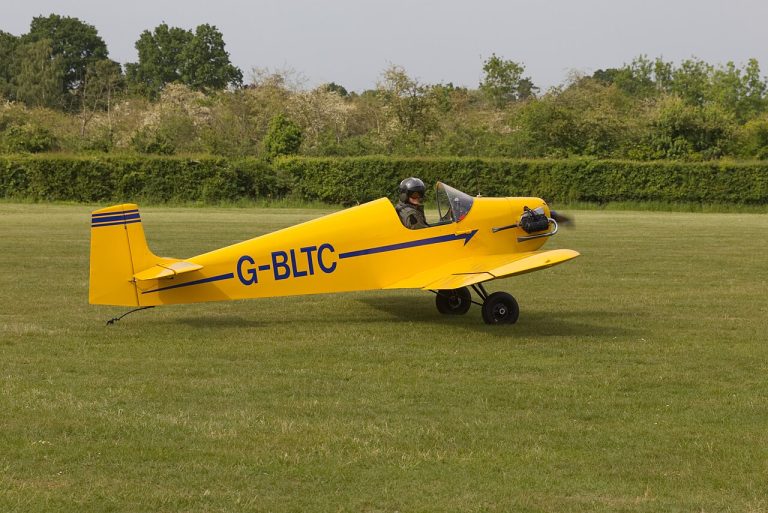
The American Legend Cub is a modern, newly built aircraft in the style of the Piper J-3 Cub. It has the classic yellow Cub shape, tandem seats, a tailwheel and a fabric-covered steel-tube fuselage. Underneath it uses a 100 hp Continental O-200 instead of the J-3’s 65 hp engine, along with modern materials and an electrical system with panel lighting.
In the UK the Legend Cub is LAA type 373, accepted in the Group A category and flown on a Permit to Fly. It suits pilots who want the low-and-slow Cub experience, grass strips and open-door summer flying, without the age, paperwork and restoration risk of an 80-year-old Piper. It is rare here, so expect to search hard for one.
History and design
American Legend Aircraft Company designed the Legend Cub to meet the US light-sport aircraft rules, with a maximum gross weight of 1,320 lb. It is a high-wing tandem two-seater with conventional (tailwheel) landing gear. The fuselage is welded steel tube covered in doped Superflite fabric. The look is deliberately close to the Piper J-3, down to the cylinders poking out of the cowling on the open-cowl AL3 version.
The company later broadened the range. It added a closed-cowl Cub Special, a Jabiru-engined model and the Super Legend, which is styled on the PA-18 Super Cub, with a Lycoming engine and flaps. In 2020 came the MOAC, a back-country version with a 180 hp Continental Titan, slats and shock-absorbing landing gear. The factory sells complete light-sport aircraft and kits. Its kits come in four groups (fuselage, wing, tail surfaces, and cowling and engine mount) and do not include the engine or propeller.
Variants
Legend Cub (LAA 373, Group A): the only LAA-listed type. The LAA’s TADS sets which models, engines and weights it covers in the UK.
AL3C-100 Classic Cub: the J-3-style open cowl with exposed cylinders and the 100 hp Continental O-200D.
AL11C-100 Cub Special: the same aircraft with an enclosed cowling in the style of the PA-11. There was also an AL11J-120 with a 120 hp Jabiru 3300.
AL18 Super Legend and MOAC: Super Cub-style models with Lycoming or Titan engines of 115 hp and up, and flaps. Check the TADS before assuming these are covered by type 373.
Specifications
Figures are American Legend’s for the AL3 Classic Cub with the Continental O-200D unless stated. The UK maximum weight and limits come from the LAA TADS and the aircraft’s Operating Limitations.
Specification
Imperial
Metric
Seats
2 in tandem
Wingspan
35 ft 5.5 in
10.8 m
Length
22 ft 5 in
6.83 m
Height (stock gear)
6 ft 7 in
2.01 m
Empty weight
820 lb
372 kg
Gross weight (US light-sport)
1,320 lb
599 kg
Gross weight (US amateur-built kit)
1,600 lb
726 kg
Engine
Continental O-200D, 100 hp, 2,000 hr TBO
Fuel grade
100LL avgas minimum
Maximum speed
90 kt (103 mph)
166 km/h
Cruise (75% power)
83 kt (95 mph)
153 km/h
Cruise (65% power)
78 kt (90 mph)
145 km/h
Stall
33 kt (38 mph)
61 km/h
Rate of climb (sea level)
700 ft/min
3.6 m/s
Take-off ground roll
210 ft
64 m
Landing
205 ft
62 m
Performance and handling
Nobody buys a Cub for speed. The factory figures for the O-200 Classic Cub give about 83 kt at 75% power and 78 kt at 65%. Wikipedia’s figures, also from the manufacturer, agree at 84 kt. What the extra power over a J-3 brings is short take-offs and a better climb. American Legend quotes a 210 ft ground roll and 700 ft/min at sea level, and Wikipedia gives the same climb rate.
The stall is gentle and low. The factory says 38 mph (33 kt), and Wikipedia says 30 kt. As with any tailwheel aircraft, it needs active footwork on landing and in crosswinds. With tandem seating, check the aircraft’s Operating Limitations for which seat it is flown solo from.
Owning one in the UK
The Legend Cub is LAA Group A, so you need an NPPL with an SSEA rating, a LAPL(A) or a PPL(A), plus tailwheel differences training if you do not already have it. It flies on a Permit to Fly, renewed each year after an inspection by an LAA inspector. The O-200 runs on avgas: American Legend gives 100LL as the minimum grade.
A fabric-covered steel-tube airframe is best kept in a hangar. Damp attacks the tubing and UV degrades the fabric. There is no UK dealer listed on the manufacturer’s site, so parts and kits come from American Legend in the USA. The LAA’s Aeroplane TADS for type 373 lists the approved engines, propellers and any required modifications, and the Wikipedia overview covers the model range. Browse aircraft for sale and other LAA aircraft, or compare the Wag-Aero Cuby and the CubCrafters Carbon Cub.
Buying checklist
Check exactly which model it is (AL3, AL11 or AL18) and that its engine and propeller match what the LAA TADS for type 373 allows.
Read the Operating Limitations for the UK maximum weight, which may differ from the US light-sport or kit figures.
Have the fabric punch-tested and look for cracking, UV damage and repairs.
Inspect the steel-tube fuselage, especially the lower longerons and tail post area, for corrosion.
Check the Continental O-200’s hours against its 2,000-hour TBO, plus compressions and the oil analysis history.
Look at the tailwheel assembly, springs and steering links, and the main gear for signs of heavy landings or ground loops.
For a kit-built aircraft, ask for the build records, LAA inspection sign-offs and flight test results.
Budget for parts shipped from the USA, and find out how long they take to arrive.
LAA type acceptance
The Light Aircraft Association lists these variants under the following type numbers. Check the LAA Type Acceptance Data Sheets (TADS) for the current approved engines, propellers and modifications before you buy.
It is an LAA Group A aircraft, so you need an NPPL with an SSEA rating, a LAPL(A) or a PPL(A), plus tailwheel differences training.
Is the Legend Cub on a Permit or a CofA?
UK examples fly on a Permit to Fly under LAA type 373, revalidated each year after an LAA inspection.
Is it an original Piper Cub?
No. It is a newly designed and built aircraft in the style of the J-3, with a 100 hp Continental O-200 and modern materials, made by American Legend Aircraft Company in the USA.
What engine does it have?
The Classic Cub uses the 100 hp Continental O-200D. Other models have used a Jabiru 3300 and Lycoming or Titan engines.
How fast does it cruise?
American Legend quotes 95 mph (83 kt) at 75% power and 90 mph (78 kt) at 65% for the O-200 Classic Cub.
What fuel does it burn?
The O-200 runs on avgas, with 100LL as the minimum grade given by the manufacturer.
Can I build one from a kit?
American Legend sells the Cub as a four-part kit. Its listed price for the Classic Cub kit is $85,650, excluding the engine and propeller, though the factory says 2026 pricing is being updated. Any UK build must go through the LAA.
Is it good for grass strips?
Yes. The factory quotes a take-off ground roll of 210 ft and a landing roll of 205 ft for the Classic Cub.
Who supports it in the UK?
The manufacturer’s site lists no UK dealer, so airframe parts and kits come from American Legend in the USA.
Is it aerobatic?
No. It is a light sport and touring aircraft. Check the Operating Limitations of the individual aircraft.
Do I need a hangar?
A hangar is strongly advisable, because the fabric covering and steel-tube structure suffer from UV and damp if the aircraft is left outside.
Figures are typical published values for a standard example and vary with engine, propeller, build and modification state. Always use the aircraft’s own Pilot’s Operating Handbook, weight and balance schedule and LAA paperwork. Last checked November 2026.