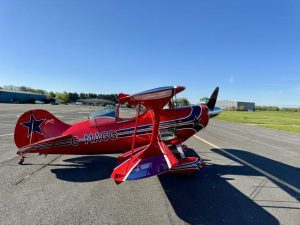
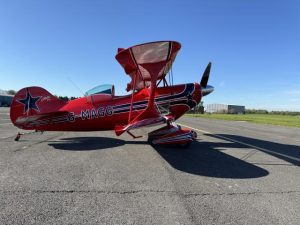
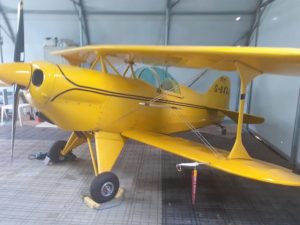
The Pitts S-1 Special is the classic single-seat aerobatic biplane: tiny, very responsive and powerful for its weight. Curtis Pitts’ design dominated world aerobatic competition in the 1970s, and its descendants still fly in clubs, competitions and displays. In the UK the S-1 series flies on an LAA Permit to Fly as a Group A aeroplane.
It suits current tailwheel pilots who want serious aerobatics in a cheap-to-run single-seater, and who are happy to put in the training a short-coupled biplane needs. UK prices are modest for the performance. Browse current examples on our aircraft listings and other LAA aircraft.
History and design
Curtis Pitts began the design in the mid-1940s and the first prototype flew in 1944. In 1962 he started selling plans for the S-1C to homebuilders, and many hundreds have since been completed. Factory production of the competition S-1S began at Afton, Wyoming, in the early 1970s. The FAA type-certified the S-1S in 1972, and US teams flying mainly Pitts biplanes won the world team championships in 1970 and 1972.
Ownership of the design passed through several hands: Doyle Child in 1977, then Frank Christensen’s Christen Industries in 1981. In 1994 the homebuilt rights went to Steen Aero Lab and the Afton factory to Aviat, which now owns the Pitts name.
The fuselage is welded steel tube with fabric covering, the wings are fabric-covered, and the S-1 has a fixed tailwheel undercarriage. Early homebuilts used bungee-sprung main gear, and many have since been converted to spring-steel legs.
Variants
S-1C (LAA 009): the original plans-built ‘flatwing’, with a flat-bottomed aerofoil and ailerons on the lower wing only. Plans were offered from the early 1960s, and engines range from 85 hp Continentals to 180–200 hp Lycomings.
S-1C four-aileron (Mod) and S-1D (LAA 009): S-1Cs fitted with ailerons on all four wings for a quicker roll. The S-1D also has a slightly stretched fuselage.
S-1E (LAA 009): an amateur-built S-1C variant from factory kits, with a symmetrical aerofoil.
S-1S (LAA 009): the ’roundwing’ competition model with symmetrical aerofoils and four ailerons, factory-built with a 180 hp Lycoming IO-360-B4A. Plans-built aircraft to the same layout also exist.
S-1SE (LAA 009): also on the LAA’s type 009 list. We couldn’t confirm how it differs from the S-1S, so check the individual aircraft’s records.
S-1T (LAA 009B): the later factory model with a 200 hp Lycoming AEIO-360-A1E, constant-speed propeller, redesigned ailerons and the top wing moved forward. It replaced the S-1S in 1981.
Specifications
Figures are for the factory S-1S unless stated. Homebuilt S-1s vary widely with engine and equipment.
Everything about the S-1 is quick. AOPA’s flight test of an S-1 found the tailwheel lifted at about 30 mph and the mains left the ground in about 600 ft at around 70 mph. It climbed at about 100 mph showing 2,500 ft/min. The test aircraft stalled at 60 mph power-off. Spins recovered in under two turns, and the aircraft spun noticeably faster to the right. Controls are light and instant, with no aileron-rudder interconnect.
Landing is the challenge. Forward view disappears in the flare, so alignment relies on peripheral vision, and the short fuselage, small tailwheel and narrow track make it lively below about 30 mph. There are no flaps, so slips are used to lose height. AvWeb’s used-aircraft guide notes that loss of directional control on the landing roll is a common accident cause. The Smithsonian’s notes on the S-1S say its four ailerons improve roll rate and its symmetrical aerofoils let it fly manoeuvres in any attitude.
Owning one in the UK
Licence: the S-1 is Group A, so you need an NPPL SSEA, LAPL or PPL with tailwheel differences training. Most insurers and owners expect proper transition training, often in a two-seat Pitts first. Check current CAA rules on any aerobatic rating needed for your licence.
Permit to Fly: UK S-1s are on LAA Permits, with an annual inspection by an LAA inspector.
Airworthiness notice: EASA AD 2005-0031, which replaced UK CAA AD 002-06-93, applies to S-1S and S-1T aircraft without external lower diagonal tailplane support tubes. It followed a near-catastrophic in-flight failure of the tailplane support tube. The tube had to be inspected and, if it was part number 1-210-126, replaced with 1-210-166. Aerobatics are prohibited until compliance. The AD warns that similar homebuilt Pitts may also be affected, so check any S-1.
Engine and fuel: most S-1s use Lycoming four-cylinder engines of 180–200 hp, and some S-1Cs use smaller Continentals. Budget for engine, propeller and any smoke system on top of the airframe.
Fabric and hangarage: the fabric covering needs a hangar and eventually recovering. Treat the fabric on an aircraft kept outside with suspicion.
Insurance: expect insurers to look closely at your tailwheel and aerobatic experience. AOPA reported that US insurers commonly require dual training in a two-seat Pitts before covering a single-seater.
Support: Aviat holds the type rights for the factory models, and Steen Aero Lab supplies plans for the S-1C. Day-to-day support in the UK comes through the LAA and aerobatic specialists.
Related types: for a two-seat Pitts see the Pitts S-2.
Confirm compliance with EASA AD 2005-0031 (tailplane support tube), and check the same area on homebuilt aircraft.
Look for evidence of ground-loop or landing damage. AOPA notes many airframes have had ground mishaps, and AvWeb advises inspecting each wing because an impact to one can damage the other.
Check for slop in the control system. It may be adjustment, but bearings do wear.
Make sure inspection holes have been cut under the wings, which shows the structure has been inspected.
If the spinner and nose bowl do not line up, suspect worn engine mount bushes and a sagging engine.
Check the top wing’s anti-drag wires for signs of hard aerobatic use.
Assess the fabric condition and when it was last recovered.
Review inverted fuel and oil systems, harnesses, undercarriage (bungee or spring-steel) and right main tyre wear.
LAA type acceptance
The Light Aircraft Association lists these variants under the following type numbers. Check the LAA Type Acceptance Data Sheets (TADS) for the current approved engines, propellers and modifications before you buy.
It is an LAA Group A aeroplane, so an NPPL SSEA, LAPL or PPL with tailwheel differences training. Plan on proper Pitts transition training before flying a single-seater.
Is the Pitts S-1 on a Permit or a CofA?
UK S-1s covered by LAA types 009 and 009B fly on an LAA Permit to Fly, maintained under LAA oversight.
Which Pitts S-1 variants are there?
The plans-built S-1C flatwing, the four-aileron S-1C (Mod) and S-1D, the S-1E, the roundwing S-1S and S-1SE, and the later 200 hp S-1T.
How much does a Pitts S-1 cost in the UK?
Recent aircraftsale.co.uk listings asked £32,000–£65,000 (2023–24 asking prices), from an S-1C to S-1S examples. Projects were cheaper.
Is it hard to land?
Yes, by most accounts. The runway disappears from view in the flare, it has no flaps and a narrow track, and loss of directional control on landing is a common accident type.
What engine does it have?
The factory S-1S uses a 180 hp Lycoming IO-360-B4A and the S-1T a 200 hp AEIO-360-A1E. Homebuilt S-1Cs range from about 85 hp Continentals to 200 hp Lycomings.
Is there an airworthiness directive I should know about?
EASA AD 2005-0031 covers the tailplane support tube on S-1S and S-1T aircraft without external lower diagonal support tubes, and warns that similar homebuilts may be affected.
How fast is it?
The S-1S has a maximum cruise of about 140 mph (120 kt) and climbs at around 2,600 ft/min.
Can I use it for touring?
Only for short trips. It is a single-seater with about 19 US gallons of fuel and minimal baggage space. It is built for aerobatics, not cross-country comfort.
Can I build one?
Yes. S-1C plans have been sold to homebuilders since the 1960s and are now supplied by Steen Aero Lab. A UK build would go through the LAA.
Will insurance be expensive?
Hull cover for single-seat aerobatic biplanes is usually expensive, and insurers want to see tailwheel and Pitts-specific dual training.
Figures are typical published values for a standard example and vary with engine, propeller, build and modification state. Always use the aircraft’s own Pilot’s Operating Handbook, weight and balance schedule and LAA paperwork. Last checked November 2026.