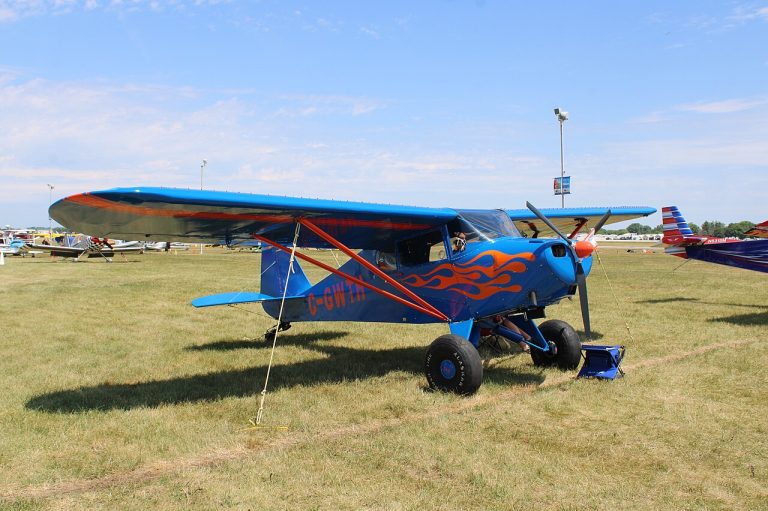
The Midget Mustang is a tiny, all-metal, single-seat low-wing sport aircraft that started life as a 1940s air racer. Its short wings, small size and Continental or Lycoming flat-four give it fast cruise speeds on modest power, and it has been a popular plans and kit design for more than 60 years.
In the UK it is accepted by the Light Aircraft Association as type 168, so examples fly on an LAA Permit to Fly. It suits pilots who want a fast, nimble single-seater for sport flying and light aerobatics, and who are happy with a small cockpit and minimal baggage space.
History and design
According to Wikipedia, the aircraft was designed by Piper engineer David Long and first flew in 1948 as the Long Midget, aimed at Goodyear-style midget air racing. It was only moderately successful as a racer, but its looks and handling suited sport flying. Long died about two years later, while production plans were being discussed. Bert Wilcut bought the rights and tooling in 1955 and renamed it the Midget Mustang, and in 1959 Robert Bushby acquired the design. He built a 90 hp Continental-powered example and sold plans and kits until 1992.
In 1992 the rights to the Midget Mustang and its two-seat development, the Mustang II, passed to Mustang Aeronautics, which Kitplanes places near Oakland-Troy Airport north of Detroit. Wikipedia reports 435 built by 2011, with about 1,000 hours needed to build one. The structure is stressed-skin 2024-T3 aluminium with flush rivets, and Plane & Pilot notes that construction needs only two simple wooden jigs. Kitplanes says the Continental O-200 is the original engine, and that the factory recommends 150-160 hp installations only for experienced pilots. Current builds can have a bubble canopy, which makes them an M-IA.
Variants
Midget Mustang (LAA type 168): one LAA entry covers UK Midget Mustangs, whatever engine and canopy they have.
Engines: from the 90-100 hp Continentals, including the O-200, to the 125-135 hp Lycoming O-290 and up to 160 hp O-320 installations. Performance figures differ a lot between them.
M-IA: the current build standard with a bubble canopy.
Tricycle and retractable versions: Wikipedia lists a tricycle-gear Midget Mustang GG and the Graham Super Midget with manually retracting gear.
The two-seat Mustang II is a separate, larger design and not covered by this page.
Specifications
Figures are for the MM-1-125 with a 135 hp Lycoming O-290-D2, from Jane’s All the World’s Aircraft 1982-83 as quoted by Wikipedia, unless noted. Plane & Pilot gives similar weights for a 125 hp example.
Specification
Imperial
Metric
Seats
1
Wingspan
18 ft 6 in
5.64 m
Length
16 ft 5 in
5.00 m
Height
4 ft 6 in
1.37 m
Wing area
68 sq ft
6.32 m²
Empty weight
590 lb (Plane & Pilot: 580 lb)
268 kg (263 kg)
Gross weight
900 lb
408 kg
Engine
Lycoming O-290-D2, 135 hp (O-200 100 hp to O-320 160 hp also used)
Maximum speed
225 mph
196 kt
Economy cruise
165 mph
143 kt
Never exceed speed (manufacturer data via Pilotfriend)
230 mph
200 kt
Stall (Plane & Pilot; Pilotfriend 60-62 mph)
60 mph
52 kt
Climb
2,200 ft/min
11.2 m/s
Range
375 miles
326 nm
Service ceiling
19,000 ft
5,790 m
Manufacturer data published by Pilotfriend for the O-200 (100 hp) version gives a 175 mph cruise, 202 mph maximum speed, 570 ft take-off ground roll and 680 ft landing roll. For the 160 hp O-320 version it gives 215 mph cruise and 230 mph maximum speed. Treat these as optimistic brochure figures.
Performance and handling
The Midget Mustang’s appeal is speed for its power: Jane’s gives the 135 hp version a 143 kt economy cruise and a 2,200 ft/min climb. Pilotfriend describes it as one of the most admired and enduring homebuilt designs. Kitplanes notes that the main gear track is only 5 ft 1 in, so it needs attention on the ground, especially in crosswinds. The factory’s advice that 150-160 hp installations are for experienced pilots only is a useful guide to how lively the higher-powered versions are.
Fuel capacity varies by build: Plane & Pilot lists 15 for its example (units not stated), so check the actual tank sizes and the aircraft’s own fuel-burn records.
Owning one in the UK
You need an aeroplane licence with single-engine piston privileges (NPPL SSEA, LAPL or PPL) and tailwheel experience for the standard version. For aerobatics the UK CAA requires an aerobatic rating on your licence. It is a single-seater, so you can’t fly it with an instructor; build up tailwheel time in a two-seat type first.
UK examples fly on an LAA Permit to Fly, renewed each year after an inspection by an LAA inspector. Approved engines, weights, speeds and manoeuvres come from the aircraft’s own Permit paperwork. The all-metal structure is more tolerant of outside storage than wood and fabric, but corrosion inspection is still important on older airframes. Mustang Aeronautics in the USA supplies plans, kits and parts.
Check the engine type and horsepower, and that it matches what the LAA Permit approves.
Read the build file: who built it, when, from plans or kit, and any modifications such as canopy, gear or engine changes.
Inspect the aluminium structure for corrosion, cracked skins and working or loose rivets, especially around the wing attachments and tail.
Check the landing gear legs and attachments; the narrow track means ground loops and hard landings happen.
Confirm the fuel tank capacity, fuel system and any wing tanks fitted, and the real endurance.
Check the weight-and-balance report: these are small aircraft and pilot weight matters.
If the aircraft has been flown aerobatically, confirm the approved manoeuvres and look at the history.
LAA type acceptance
The Light Aircraft Association lists these variants under the following type numbers. Check the LAA Type Acceptance Data Sheets (TADS) for the current approved engines, propellers and modifications before you buy.
It is a single-seat, all-metal homebuilt sport aircraft designed by David Long in 1948 as a midget racer. Robert Bushby developed and sold it from 1959, and Mustang Aeronautics has owned the design since 1992.
What licence do I need to fly one in the UK?
An aeroplane licence with single-engine piston privileges, such as an NPPL SSEA, LAPL or PPL, plus tailwheel experience. For aerobatics the CAA requires an aerobatic rating on your licence.
Is the Midget Mustang on a Permit or a CofA?
UK examples fly on an LAA Permit to Fly under LAA type 168.
How fast is a Midget Mustang?
Jane’s gives the 135 hp MM-1-125 a 143 kt (165 mph) economy cruise and 196 kt maximum speed. Lower-powered O-200 versions are slower.
What engines are used?
The Continental O-200 is the original engine. Lycoming O-290 and O-320 engines of 125-160 hp have also been fitted; the factory recommends the 150-160 hp versions only for experienced pilots.
Can I train in a Midget Mustang?
No, it is a single-seater. You need to be current and confident on tailwheel aircraft before flying one.
Is it aerobatic?
The design is marketed as an aerobatic sport aircraft, but what an individual UK example may do depends on its LAA Permit and Operating Limitations.
What is the fuel burn?
We couldn’t find a published cruise fuel burn figure, so ask the seller for the aircraft’s own fuel records for its engine.
Can I build one?
Yes. Mustang Aeronautics in the USA sells plans and kits. Wikipedia puts building time at about 1,000 hours, and a UK build would be registered with and inspected by the LAA.
Is it good for touring?
It is fast, with a quoted 326 nm range for the 135 hp version, but it is a small single-seater with very little baggage space.
What is the difference between the Midget Mustang and the Mustang II?
The Midget Mustang is the original single-seater. The Mustang II is a larger two-seat development, also from Bushby and now Mustang Aeronautics, and is a separate type.
Figures are typical published values for a standard example and vary with engine, propeller, build and modification state. Always use the aircraft’s own Pilot’s Operating Handbook, weight and balance schedule and LAA paperwork. Last checked November 2026.