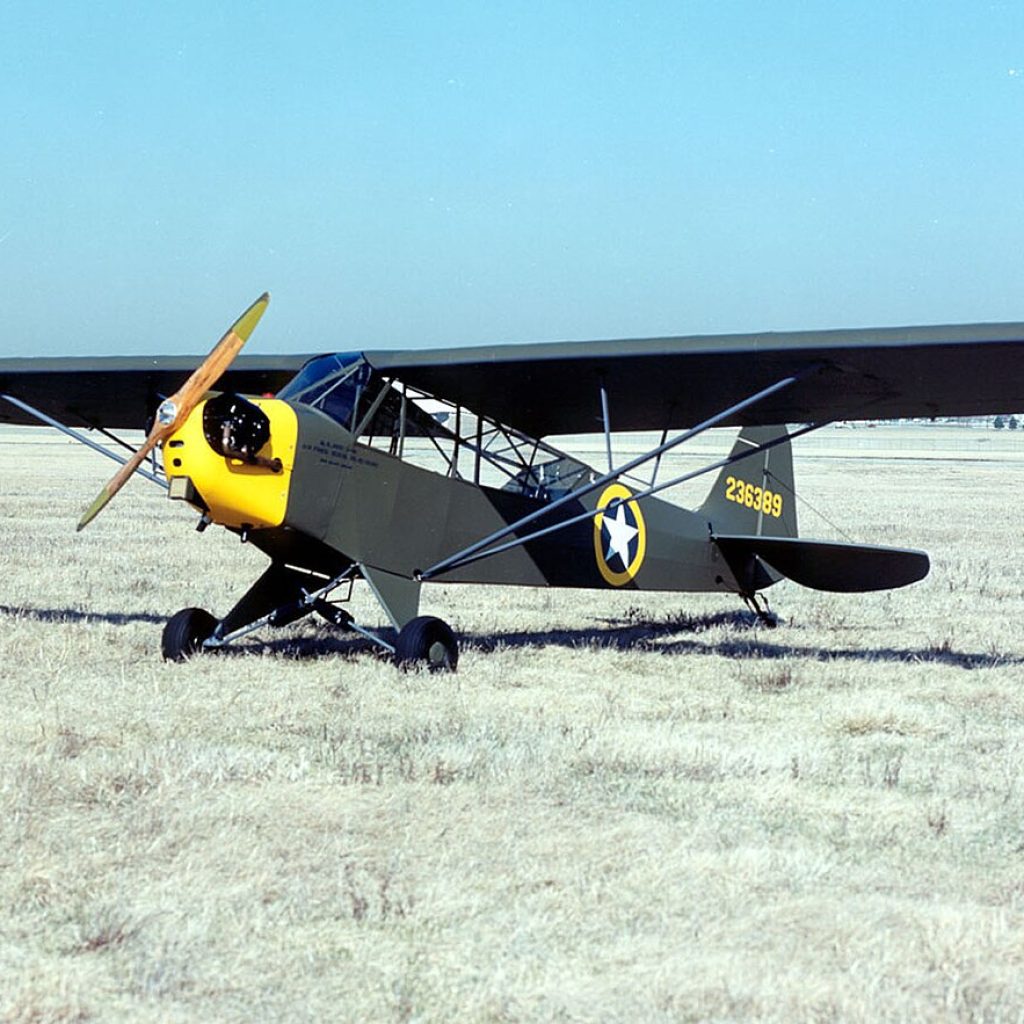
The Piper L-4 is the military Cub: a J-3 Cub built for the US Army as a liaison and artillery-spotting aircraft in the Second World War, nicknamed the Grasshopper. Mechanically it is the same simple, 65 hp, tube-and-fabric taildragger as the civil J-3, but with extra glazing in the roof and rear of the cabin so the observer could see out. Thousands went back into civil use after the war, and several still fly in the UK, often restored in their wartime markings.
UK buyers come to the L-4 for the history and for the flying. It is slow, light, forgiving and huge fun on a grass strip, and it is one of the cheapest ways to own a genuine wartime aircraft. It suits pilots who want stick-and-rudder flying and a type that turns heads at every fly-in, rather than a touring machine.
History and design
Piper’s J-3 Cub first flew in 1938 and was built until 1947. The US Army Air Corps took its first military Cubs as the O-59, and the type was later redesignated L-4. It was used for liaison, observation and artillery spotting. In total about 5,413 were delivered to US forces, including 250 for the US Navy as the NE-1 and NE-2.
The structure is a welded steel-tube fuselage and a strut-braced high wing, all fabric-covered, with a 65 hp flat-four engine. Two people sit in tandem. As on the civil J-3, the fuel tank sits ahead of the instrument panel, so the Cub is normally flown solo from the rear seat to keep the centre of gravity in limits; some L-4s were modified with wing tanks so that a solo pilot could sit in front. Check which arrangement your aircraft has.
Variants
O-59 / L-4: the first Army batch, 140 built.
O-59A / L-4A: the main early production version with the 65 hp Continental O-170-3 (the military name for the A-65), 948 built.
L-4B: as the L-4A but without radio, 980 built.
L-4H: improved equipment and a fixed-pitch propeller, 1,801 built.
L-4J: as the L-4H with a controllable-pitch propeller, 1,680 built.
L-4C and L-4D: small numbers of civil Cubs impressed into service.
After the war thousands of surplus L-4s were civil-registered as J-3s, so the paperwork may describe the aircraft as a J-3C-65 even though it was built as an L-4. UK examples include an L-4J built in 1945 and flying with a Continental A65-8, and a 1943 L-4 that served with the Free French before coming to Britain in 1973.
Specifications
Figures below are the published J-3C-65 data, which the L-4 shares. Individual aircraft vary with equipment, propeller and restoration standard.
Specification
Imperial
Metric
Wingspan
35 ft 3 in
10.74 m
Length
22 ft 5 in
6.83 m
Height
6 ft 8 in
2.03 m
Wing area
178.5 sq ft
16.58 m²
Empty weight
765 lb
345 kg
Maximum take-off weight
1,220 lb
550 kg
Useful load
455 lb
205 kg
Engine
Continental A-65-8 (military O-170-3), 65 hp
Maximum speed
76 kt (87 mph)
140 km/h
Cruise speed
65 kt (75 mph)
121 km/h
Stall speed
33 kt (38 mph)
61 km/h
Rate of climb
450 ft/min
2.3 m/s
Range
191 nm
354 km
Endurance (wartime figure, pilot only)
About 3 hours
Performance and handling
Nobody buys an L-4 for speed. It cruises at around 65 kt and stalls in the low 30s, so a stiff headwind can make a cross-country a long afternoon. In return you get docile handling, a big wing that is happy on short grass, and the open-door summer flying the Cub is famous for. Climb is modest at around 450 ft/min with two up on a warm day, so plan departures from short or tree-lined strips with care.
The L-4 is a classic taildragger with a narrow-track main gear and no flaps. It rewards accurate rudder work on take-off and landing, and crosswinds need respect. Visibility from the rear seat over the nose is limited on the ground, so S-turns while taxiing are normal. With the extra roof and rear glazing, the view in the air is better than in a standard J-3.
Owning one in the UK
Paperwork: UK L-4s and J-3s are found on both a Certificate of Airworthiness and a Permit to Fly. The CAA notes that ex-military aircraft commonly fly on a Permit, while factory-built types usually hold a CofA. Check the aircraft’s entry on the CAA’s G-INFO register and its documents before you buy, because the basis affects who can maintain it, what modifications are allowed and what the annual paperwork costs. A Permit aircraft is generally cheaper to look after and lets an owner do more of the work under an inspector’s supervision.
Licence: a PPL, LAPL or NPPL (SSEA) covers the L-4, but you will need tailwheel differences training if you have not flown one before. It is not a microlight, so a microlight-only licence is not enough.
Running costs: the 65 hp Continental is simple and frugal, and parts for the A-65 family are still widely available. Whether the aircraft may use mogas depends on its engine and airworthiness approval, so check the aircraft’s own documents. Most owners keep a Cub in a hangar to protect the fabric; outside parking shortens fabric life considerably. Insurers will want to see tailwheel experience and time on type.
Support: there is no factory support for the original airframe, but Cub parts and expertise are plentiful, and the large US Cub community means drawings and spares are easy to find. For more modern takes on the same formula, see the American Legend Cub or CubCrafters Carbon Cub, both of which fly on an LAA Permit (browse LAA types).
Buying checklist
Confirm the airworthiness basis (CofA or Permit) on G-INFO and check that the paperwork matches the aircraft.
Trace the wartime history and serial number. Provenance adds value, and a gap in the records should be explained.
Check the age and condition of the fabric covering, and look for corrosion in the lower fuselage tubes and tail post.
Inspect wing struts, strut fittings and wooden spars (if fitted) for corrosion, cracking or old repairs.
Check the engine logbooks, time since overhaul and compression; ask which fuel grades are approved for this aircraft.
Find out whether it flies solo from the front or rear seat, and how the fuel system is arranged.
Look at the tailwheel, brakes and main gear for wear, as these work hard on grass strips.
Check that any modern radio and transponder installation is properly approved for the aircraft’s basis.
What is the difference between an L-4 and a J-3 Cub?
The L-4 is the military version of the J-3. Mechanically it is the same aircraft, but it has extra roof and rear-cabin glazing so the observer could see out.
What licence do I need to fly a Piper L-4 in the UK?
A PPL, LAPL or NPPL (SSEA) will cover it, plus tailwheel differences training if you have not flown a taildragger. A microlight licence does not cover it.
Is a UK L-4 on a Permit to Fly or a CofA?
It can be either. Ex-military aircraft commonly fly on a Permit, but some Cubs keep a CofA, so check the individual aircraft on the CAA’s G-INFO register and in its documents.
What engine does the L-4 have?
A 65 hp Continental, called the O-170-3 in military service. It is the same family as the civil A-65, and UK examples often carry the civil A65-8 designation.
How fast is it?
The published cruise is about 65 kt (75 mph), with a top speed of about 76 kt and a stall of about 33 kt.
Can I fly it solo from the front seat?
Usually not. With the fuel tank in front of the panel, a solo Cub is normally flown from the rear seat for balance, although some L-4s were modified with wing tanks. Check the aircraft’s flight manual.
Is the L-4 good for learning tailwheel flying?
Its low speeds and gentle handling make it a classic tailwheel trainer, but it has no flaps and needs good rudder work, so get proper instruction first.
Could I tour to France in one?
Yes, but plan for its slow cruise and a range of under 200 nm, and allow for headwinds. Many owners prefer short hops and fly-ins.
How many were built?
About 5,413 L-4s were delivered to US forces, including 250 for the US Navy, out of roughly 20,000 Cubs in total.
Can it do aerobatics?
No. Treat it as a non-aerobatic aircraft unless the individual aircraft’s flight manual and approvals say otherwise.
Where can I get parts and support in the UK?
There is no factory support for the original airframe, but Cub spares and expertise are plentiful thanks to the huge number built. LAA or CAA-approved engineers familiar with vintage types can maintain it, depending on its airworthiness basis.
Figures are typical published values for a standard example and vary with engine, propeller, build and modification state. Always use the aircraft’s own Pilot’s Operating Handbook, weight and balance schedule and LAA paperwork. Last checked November 2026.