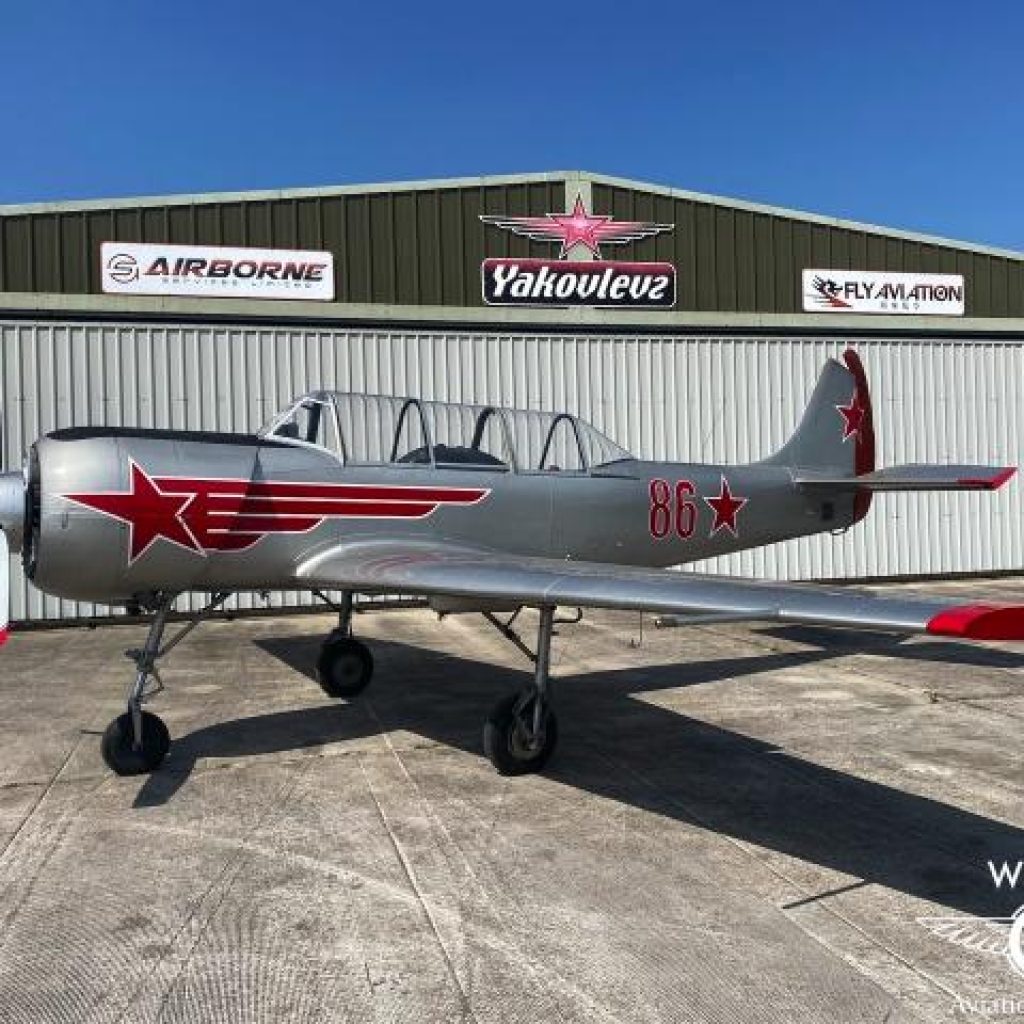
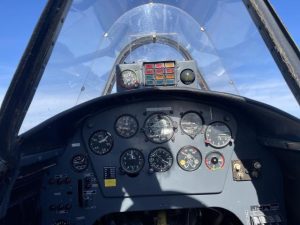
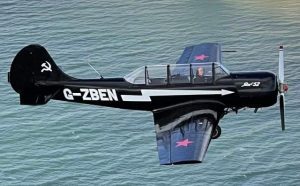
The Yak-52 is a two-seat, all-metal Soviet primary trainer with a 360 hp nine-cylinder radial engine, a tandem cockpit and full aerobatic capability. It was designed by Yakovlev for the DOSAAF training organisation and built in Romania, and a significant number have flown on the UK register for many years.
In the UK the Yak-52 is one of the most affordable ways into radial-engined aerobatic flying. Aircraft with the factory strengthening modifications are cleared to +7/-5 g and can fly a full aerobatic sequence. UK examples do not have a type certificate; they fly on a Permit to Fly approved individually by the CAA as ex-military aircraft. They are not on the LAA type acceptance list, but the LAA’s inspection system now covers them.
History and design
The Yak-52 first flew in 1976 as a two-seat development of the single-seat Yak-50. Production was handed to Aerostar (then IAv Bacău) in Romania under a COMECON agreement, where it was known as the Iak-52; manufacture ran into the late 1990s and well over 1,800 were built. The CAA notes that the 1,000th aircraft was delivered in 1987.
The design is distinctive. The tricycle undercarriage retracts but the wheels stay partly exposed to protect the aircraft in a wheels-up landing. Engine starting, undercarriage, flaps and brakes all run on a compressed-air system working at 50 bar, with an independent emergency air supply for lowering the gear. The fuel and oil systems are fully inverted, and the front seat is the command cockpit. Control surfaces are fabric-covered over a light-alloy structure.
Variants
Yak-52 / Iak-52: the standard nosewheel trainer with the 360 hp M-14P and a two-blade V530TA-D35 variable-pitch propeller. Most UK aircraft are this version.
Iak-52W and Iak-52TW: westernised versions; the TW has a tailwheel and larger fuel tanks.
Yak-52M: a 2003 modernised version with the M-14X engine, three-blade propeller and new avionics.
Yak-52TD: a Lithuanian modification with the more powerful M-14PF.
UK upgrades: some UK aircraft have been fitted with the 400 hp M-14PF and an MTV-9 three-blade propeller, and long-range wing tanks are available.
Specifications
Figures are for the standard Iak-52 (Jane’s) and UK Permit aircraft (CAA AAN and UK specialist data). Limits vary between individual aircraft, so always use the aircraft’s own approved pilot’s notes and AAN.
Specification
Imperial
Metric
Wingspan
30 ft 6 in
9.30 m
Length
25 ft 5 in
7.75 m
Height
8 ft 10 in
2.70 m
Wing area
161 sq ft
15.0 m²
Empty weight
2,238-2,249 lb
1,015-1,020 kg
Maximum take-off weight
2,899 lb (UK AAN, aerobatic); 2,877 lb (Jane’s)
1,315 kg; 1,305 kg
Fuel (standard)
26 imp gal (two 60 L wing tanks)
120 L
Engine
Vedeneyev M-14P nine-cylinder supercharged radial, 360 hp (268 kW)
Propeller
V530TA-D35 two-blade variable pitch, 2.40 m (7 ft 10 in)
Never-exceed speed (Vne)
Varies by aircraft: 360 km/h (194 kt) in Jane’s; 420 km/h (227 kt) on one UK AAN; up to 450 km/h with factory bulletins
Maximum level speed
146-154 kt
270-285 km/h
Cruise (70% power)
124-130 kt
230-241 km/h
Stall (landing configuration)
46-55 kt
85-102 km/h
Service ceiling
13,000 ft
4,000 m
Range (Jane’s)
300 nm
550 km
Take-off run
About 490-590 ft
150-181 m
Load factors
+7 / -5 g (aerobatic, at 1,315 kg)
Performance and handling
A Yak-52 cruises at about 124-130 kt at 70% power, burning roughly 60 litres an hour; UK specialist data gives 46 L/h at 60% power and 65 L/h at 75%. Aerobatics at full power use far more. Published climb figures vary widely, from under 1,000 ft/min in Jane’s to around 1,800 ft/min in UK specialist data, depending on weight and power.
Pilots describe crisp roll response and plenty of energy for looping, with clear buffet before the stall but a sharp wing drop at the full stall. Braking is by a pneumatic lever on the control stick combined with rudder, which takes practice. The compressed-air engine start and the need to recharge the air system after take-off are part of the ritual. The high seating position and torque from the big radial mean crosswind take-offs need care.
Owning one in the UK
Permit: each UK Yak-52 has been approved by the CAA for a Permit to Fly through an Airworthiness Approval Note (AAN) on the basis of its military service history. The AAN sets the aircraft’s limits, required modifications (such as disabling some rear-cockpit override switches and English placarding), life-limited parts and maintenance schedule. The aircraft is restricted to day VMC. The LAA lists the Yak-52 among types that need individually approved LAA inspectors, so check who will inspect and sign off your aircraft. See the CAA’s ex-military aircraft guidance.
Licence: a PPL, LAPL or NPPL with an SEP rating, plus differences training for the variable-pitch propeller, retractable undercarriage and supercharged engine, logged and signed by a suitably qualified instructor. Aerobatic instruction is strongly advised.
Airworthiness notices: the CAA issues Mandatory Permit Directives for Russian-built Yaks. MPD 2026-004 (August 2026) requires inspection of the pneumatic landing gear and flap actuators. Older MPDs cover airframe overhaul life and engine overhaul intervals. Airframe life depends on whether factory strengthening bulletins 59-R, 60-R and 107-BD are embodied, which also sets the g limits.
Costs and support: fuel burn, the 500-hour engine overhaul interval set out in one UK AAN, propeller overhaul and air bottle lives all make the Yak more expensive to run than a light trainer. UK specialists such as Yak UK supply aircraft and overhauls. Compare a tandem aerobatic kitplane such as the Van’s RV-8, or browse current listings. More history is on Wikipedia.
Buying checklist
Read the aircraft’s own CAA AAN: it defines the MTOW, Vne, g limits and required modifications for that airframe.
Check the serial number against the strengthening bulletins (59-R, 60-R, 107-BD); they decide the airframe life and whether it is cleared for full aerobatics.
Confirm compliance with all MPDs, including MPD 2026-004 on the pneumatic gear and flap actuators.
Check engine hours since overhaul and total time against the overhaul limits, and propeller hours and calendar life.
Check air bottle, flexible hose and other life-limited parts against their lives.
Inspect the fabric-covered control surfaces and confirm they have been re-covered with approved Western materials.
Confirm who will inspect the aircraft (an LAA inspector with Yak approval) and get a pre-purchase inspection from a Yak specialist.
Budget for differences training and aerobatic instruction if you are new to the type.
Frequently asked questions
Is the Yak-52 on a Permit to Fly or a CofA in the UK?
A Permit to Fly. Each UK Yak-52 is approved individually by the CAA through an Airworthiness Approval Note as an ex-military aircraft; there is no type certificate.
Is the Yak-52 an LAA type?
It is not on the LAA type acceptance list, but the LAA lists the Yak-52 among types that need individually approved LAA inspectors, so its inspections are handled within the LAA system.
What licence do I need to fly a Yak-52?
A PPL, LAPL or NPPL with an SEP rating, plus differences training for the variable-pitch propeller, retractable undercarriage and supercharged engine.
Can a Yak-52 do aerobatics?
Yes. Aircraft with the factory strengthening bulletins are cleared to +7/-5 g. Aerobatics are prohibited with gear or flaps down or with 20 litres of fuel or less, per one UK AAN.
How much fuel does a Yak-52 use?
About 46 L/h at 60% power to 65 L/h at 75% power in cruise, according to UK specialist data, and much more during aerobatics.
How fast is a Yak-52?
It cruises at about 124-130 kt at 70% power, with a maximum level speed of roughly 146-154 kt.
Is the Yak-52 a tailwheel aircraft?
The standard Yak-52 has a retractable nosewheel undercarriage. The Iak-52TW is a tailwheel version.
Can I fly a Yak-52 at night or in cloud?
No. UK Yak-52 Permits restrict the aircraft to day VMC.
What airworthiness directives affect the Yak-52?
The CAA issues Mandatory Permit Directives for Yaks, including MPD 2026-004 on the pneumatic landing gear and flap actuators, plus older MPDs on airframe and engine overhaul lives.
Can a Yak-52 fly solo from either seat?
Solo flight is from the front cockpit only, which is the command cockpit.
Who supports the Yak-52 in the UK?
UK Yak specialists such as Yak UK supply aircraft, parts and overhauls, and LAA inspectors with Yak approval carry out inspections.
Figures are typical published values for a standard example and vary with engine, propeller, build and modification state. Always use the aircraft’s own Pilot’s Operating Handbook, weight and balance schedule and LAA paperwork. Last checked November 2026.