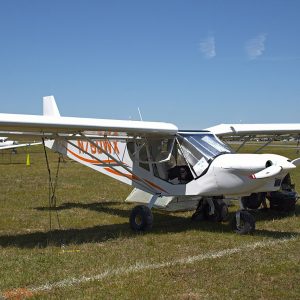
The Sling 4 is a four-seat, low-wing, all-metal touring aircraft from Sling Aircraft (originally The Airplane Factory) of Johannesburg, South Africa. It is a scaled-up Sling 2, with a turbocharged 115 hp Rotax 914 UL, an electric constant-speed propeller and gull-wing doors. It was sold as a kit, and factory-built examples also flew.
In the UK the Sling 4 is an LAA Group A type (TADS 400), so it can be built and flown on a Permit to Fly. It appeals to pilots who want a modern four-seat tourer that burns car fuel and costs far less to run than a certified four-seater. Its successor, the Sling TSi, has its own LAA type acceptance (400A) and is covered on this page only for comparison.
History and design
The Sling 4 was introduced in 2011 as a development of the Sling 2, with a larger wing and fuselage, a bigger engine and a constant-speed propeller. In July 2013 designer Mike Blyth and his son flew one from South Africa to AirVenture at Oshkosh, carrying fuel for about 20 hours and including a 14-hour leg over water. In 2014 a team of 40 factory staff built a kit in four days and flew it at a South African airshow.
The airframe is mostly aluminium, with composite main gear, wheel spats, cowling, wingtips, tail fairing and canopy. AOPA reported that a ballistic parachute was optional but chosen by most buyers, with MGL or Garmin avionics. Sling replaced the Sling 4 with the Sling TSi in 2018. The TSi has reinforced, flush-riveted wing and fuselage sections and Rotax 915 iS power, and the current version uses the 160 hp Rotax 916 iS.
Variants
Sling 4 (LAA 400, Group A): the original four-seater with the turbocharged 115 hp Rotax 914 UL and an Airmaster electric constant-speed propeller. Kits could be built from scratch or as a quick-build, introduced in 2015.
Sling 4 TSi (LAA 400A, not part of this page’s LAA row): the successor with Rotax 915 iS or 916 iS power, faster cruise and a revised structure. Check which type number an aircraft is registered under, because the two have separate data sheets.
Related types: the two-seat Sling 2 shares the design approach, and the newer Sling High Wing is a separate four-seater.
Specifications
Manufacturer figures for the Rotax 914 UL Sling 4, as published in AOPA’s 2016 flight test (standard day, sea level, gross weight). Empty weight varies with equipment: AOPA’s test aircraft weighed 1,104 lb (501 kg).
Specification
Imperial
Metric
Wingspan
32 ft 7 in
9.93 m
Length
23 ft 4 in
7.11 m
Height
8 ft
2.44 m
Wing area
141 sq ft
13.1 m²
Cabin width
3 ft 11 in
1.19 m
Empty weight
1,080 lb
490 kg
Maximum take-off weight
2,028 lb
920 kg
Useful load
948 lb
430 kg
Payload with full fuel
688 lb
312 kg
Baggage
77 lb
35 kg
Fuel capacity
44.38 US gal (43.32 usable)
168 litres (164 usable)
Engine
Rotax 914 UL turbocharged, 115 hp (5 minutes), 2,000 h TBO
Propeller
Airmaster electric constant-speed hub, three 73 in Whirlwind blades
Vne
135 kt IAS
250 km/h
Vno
110 kt IAS
204 km/h
Cruise, 80% power, 4,000 ft
130 kt TAS
241 km/h
Stall, clean
54 kt IAS
100 km/h
Stall, landing configuration
48 kt IAS
89 km/h
Rate of climb, sea level
800 fpm
4.1 m/s
Service ceiling
14,000 ft
4,270 m
Fuel burn, cruise
6.1 US gal/h
23 l/h
Endurance (45 min reserve)
6.4 hours
Take-off over 50 ft
1,476 ft
450 m
Landing over 50 ft
1,148 ft
350 m
Max demonstrated crosswind
15 kt
28 km/h
Performance and handling
AOPA’s 2016 test pilot saw 130.5 kt TAS at 85% power at 2,500 ft, burning about 6.1 US gallons (23 litres) of auto fuel an hour. With three aboard, the initial climb was about 900 fpm. The 115 hp take-off rating is limited to five minutes, and 85% (about 100 hp) is the highest continuous setting. Stalls broke with a mild left wing drop. The tester found visibility excellent, the approach easy to manage at 65–70 kt on short final, and the step up to the wing a big one. Plane & Pilot’s spec sheet gave slightly more conservative figures: 120 kt at 75% power, a 780 nm range with reserves, and a full-flap stall of 42 KCAS. Wikipedia, using AOPA and manufacturer data, gives 700 nm at 75% power with 45 minutes’ reserve. AOPA summed up the appeal as more than 900 lb (408 kg) of people and fuel carried a long way on 115 hp.
Owning one in the UK
At 920 kg the Sling 4 is an LAA Group A aircraft, so you need an NPPL SSEA, LAPL(A) or PPL with an SEP rating. UK aircraft are kit-built and fly on an LAA Permit to Fly, inspected annually by an LAA inspector, with limitations set by TADS 400. The Rotax 914 runs on unleaded car fuel, which AOPA’s test aircraft used, and the engine has a 2,000-hour TBO. Check the TADS for UK-approved fuel grades.
Sling has published a long list of Sling 4 service bulletins. They include main landing gear cracks (2014), reinforcement of the upper fuselage join, an amended annual inspection of rib 601, parachute rocket activation, rivet replacement on the centre and wing spars, control stop plate rivets, rudder cable sleeves and control-system eyebolts (2022). They are listed on Sling’s service bulletins page.
The UK distributor, Sling (UK) at Renhold in Bedfordshire, now sells the TSi rather than the Sling 4, but it is the natural first contact for parts and advice. The LAA magazine flight-tested the TSi in December 2022 and called it a popular four-seat choice for LAA homebuilders. Browse Slings in our listings and other LAA aircraft.
Buying checklist
Confirm the aircraft is a Sling 4 (LAA 400) and not a TSi (400A), and read the current TADS for any airframe life limit and operating restrictions.
Check compliance with every Sling 4 service bulletin, especially the spar rivet replacement, upper fuselage join and landing gear crack bulletins.
Have an LAA inspector experienced with metal kits look at rivet lines, spar areas, rib 601, gear attachments and control-system eyebolts.
Review Rotax 914 hours against the 2,000-hour TBO, plus turbo condition and compliance with Rotax service bulletins.
Check the Airmaster propeller’s maintenance records and electrical system.
If a ballistic parachute is fitted, check its repack and rocket service dates, and the rocket bulletin.
Get a current weight and balance. Avionics and options raise the empty weight above the 1,080 lb (490 kg) standard figure.
LAA type acceptance
The Light Aircraft Association lists these variants under the following type numbers. Check the LAA Type Acceptance Data Sheets (TADS) for the current approved engines, propellers and modifications before you buy.
It is LAA Group A at 920 kg MTOW, so you need an NPPL SSEA, LAPL(A) or PPL with an SEP rating.
Is the Sling 4 on a Permit or a CofA?
UK Sling 4s are kit-built and fly on an LAA Permit to Fly under TADS 400.
What is the difference between the Sling 4 and the Sling TSi?
The TSi replaced the Sling 4 in 2018. It has a reinforced, flush-riveted structure and Rotax 915 iS or 916 iS power, and the LAA treats it as a separate type (400A).
How fast does a Sling 4 cruise?
Sling quotes 130 kt TAS at 80% power, and AOPA measured 130.5 kt at 85% power. Plane & Pilot quoted 120 kt at 75% power.
What is the fuel burn?
About 6.1 US gallons (23 litres) an hour at cruise, from 164 litres usable.
Will it really carry four people?
The standard useful load is 430 kg, or about 312 kg with full fuel. Four adults usually means carrying less fuel, so do a weight and balance each time.
Can it use car fuel?
The Rotax 914 runs on unleaded auto fuel, and AOPA’s test aircraft burned auto gas. Check the TADS and Rotax documentation for UK-approved grades.
Is it good for touring to France and beyond?
Yes. With about 700–780 nm range at 75% power and 6.4 hours’ endurance with reserves, it is a capable European tourer.
Can I still buy a Sling 4 kit?
Sling’s current range and UK distributor list the TSi, not the Sling 4, so a Sling 4 is now normally a second-hand purchase.
Who supports the Sling 4 in the UK?
Sling (UK) at Renhold, Bedfordshire, is the UK distributor, with service bulletins and manuals published by the factory.
Are there known inspection points?
Sling’s service bulletins cover landing gear cracks, the upper fuselage join, rib 601, spar rivets, control stop rivets, rudder cable sleeves and eyebolts. Check every one has been done.
Figures are typical published values for a standard example and vary with engine, propeller, build and modification state. Always use the aircraft’s own Pilot’s Operating Handbook, weight and balance schedule and LAA paperwork. Last checked November 2026.