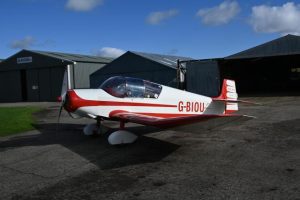
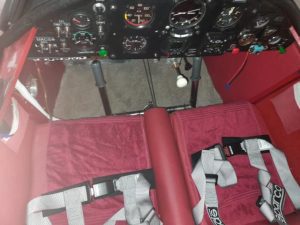
The Jodel D.11 is the French two-seat ‘Club’ monoplane that taught a generation of European pilots to fly. It is a low-wing, all-wood tourer with side-by-side seats, a tailwheel and the distinctive cranked Jodel wing. In the UK the D11, D11A and the closely related D119 fly on an LAA Permit to Fly as Group A aeroplanes. Most are amateur-built from plans.
It suits pilots who want an economical, characterful two-seater that cruises around 100 kt on a 90 hp Continental and can use grass strips. Jodels have a loyal following and the design is well understood by LAA inspectors. You can compare examples on our aircraft listings and other LAA aircraft.
History and design
Édouard Joly and Jean Délémontez designed the D.11 for French flying clubs, which wanted a low-wing two-seater. They combined the wing of the projected D.10 with a lengthened and widened fuselage from the single-seat D.9 Bébé, and the first D.11 flew on 4 April 1950. Licence production followed at Wassmer, SAN, Aero-Difusión and others, and many were homebuilt, including from Falconar plans in Canada. More than 3,000 have reportedly been built.
The fuselage is wood, fully skinned in plywood and fabric-covered, with five frames. The wing is a single piece built around one box spar, with plywood-gusseted ribs and Dacron covering, and the tailplane and rudder are similar. Controls are cable-operated with full dual controls. Fuel is carried in a 60-litre tank behind the seats and a 55-litre rear tank. The type is a taildragger with a fixed, often spatted, undercarriage. Avions Jodel still sells original plans and spare parts today.
Variants
Avions Jodel says the many D11-series designations differ mainly in the engine fitted to the same basic airframe.
D11 (LAA 052): the original airframe, first flown with a 55 hp Salmson. UK D11s are amateur-built and engines vary.
D11A (LAA 052): a D11 variant on the same LAA type acceptance. We couldn’t confirm its differences, so check the aircraft’s records.
D119 (LAA 102): the amateur-built equivalent of the D117 ‘Grande Tourisme’, which used the 90 hp Continental C90.
Related models not on these LAA rows: the D112 (65 hp Continental A65), the SAN-built D117 and the Wassmer-built D120 ‘Paris-Nice’ share the same basic airframe but are not part of LAA types 052 and 102.
Specifications
No single source gives UK D11/D119 data, so figures come from Avions Jodel’s D112 sheet (Continental C90) and Jane’s data for the D117 (C90-14F). Both are very close relatives. Check the individual aircraft’s weight and balance and LAA paperwork.
Specification
Imperial
Metric
Wingspan
26 ft 11 in – 27 ft 0 in
8.20–8.22 m
Length
20 ft 4 in – 21 ft 4 in
6.20–6.50 m
Height
6 ft 11 in
2.12 m
Wing area
137 sq ft
12.7–12.75 m²
Cabin width
41 in
1.05 m
Empty weight (D112 / D117)
728 / 761 lb
330 / 345 kg
MTOW (D112 / D117)
1,360 / 1,323 lb
617 / 600 kg
Fuel (60 l + 55 l tanks)
25 imp gal
115 litres
Engine (D117/D119)
Continental C90, 90 hp
Propeller (D117)
Two-blade fixed pitch
Vne (D112, C90)
151 kt
280 km/h
Cruise (D112 / D117, C90)
100 / 105 kt
185 / 195 km/h
Stall (D112 / D117)
30 / 27 kt
55 / 50 km/h
Climb (D117)
790 ft/min
4 m/s
Take-off run (D112 / D117)
360 / 390 ft
110 / 120 m
Landing run (D112 / D117)
295 / 430 ft
90 / 130 m
Range (D112 at 170 km/h)
540 nm
1,000 km
Performance and handling
With a 90 hp Continental, a D119 or similar Jodel cruises at about 100 kt, and Plane & Pilot’s D-11 data gives a 114 mph cruise and a 35 mph stall. The large fuel capacity gives a still-air range of around 1,000 km on the manufacturer’s D112 figures, so it makes a capable tourer for its size. Short take-off and landing runs of around 100 m make it at home on grass strips.
As a taildragger it needs tailwheel experience and good crosswind technique. The D11 was designed as a club trainer and tourer, and Avions Jodel still describes the ‘Club’ as an economical aircraft for both touring and instruction. Plane & Pilot’s data gives a top speed of 124 mph for the D-11 on 65–90 hp Continentals.
Owning one in the UK
Licence: Group A, so you need an NPPL SSEA, LAPL or PPL, plus tailwheel differences training if you don’t already have it.
Permit to Fly: UK D11s and D119s fly on LAA Permits, inspected annually by an LAA inspector. Because the airframe is wood, have the inspector look closely at the condition of the glue joints and the structure.
Engine and fuel: Continental engines such as the A65, C90 and O-200 are the most common. Some aircraft have other engines, such as the Jabiru 2200, which Avions Jodel lists as an option for the D112. Check which fuels are approved for the specific engine and airframe.
Hangarage: a wooden, fabric-covered aircraft should be hangared. The wing is a single piece and does not fold.
Parts and support:Avions Jodel in Corgoloin, France, sells original plans and spare parts. In the UK, the LAA and its inspectors carry deep Jodel experience.
Related types: for the four-seat member of the family see the Jodel D140 Mousquetaire, or for the single-seat ancestor the Jodel D9 Bébé.
Confirm the exact variant (D11, D11A or D119), the LAA type number and the engine fitted, and check that the paperwork matches.
Have an inspector with wooden-aircraft experience check the box spar, glue joints and plywood skins for delamination, rot or moisture.
Ask about storage history. Wooden airframes kept outside or in damp hangars deteriorate faster.
Check the fabric and dope finish on the wings and tail surfaces, and when they were last recovered.
Inspect the undercarriage legs, shock absorbers and tailwheel steering for wear and correct operation.
Check the fuel tanks, lines and selector, especially on aircraft with two tanks.
Look at the engine’s hours and overhaul history, and confirm parts availability for the specific engine.
LAA type acceptance
The Light Aircraft Association lists these variants under the following type numbers. Check the LAA Type Acceptance Data Sheets (TADS) for the current approved engines, propellers and modifications before you buy.
What licence do I need to fly a Jodel D11 or D119?
They are LAA Group A aeroplanes, so an NPPL SSEA, LAPL or PPL, with tailwheel differences training.
Is the Jodel D11 on a Permit or a CofA?
The D11, D11A and D119 types listed by the LAA fly on an LAA Permit to Fly, inspected each year by an LAA inspector.
What engine does a D119 have?
The D119 is the amateur-built equivalent of the D117, which used the 90 hp Continental C90. Individual aircraft may differ, so check the one you are looking at.
How fast does a Jodel D11 cruise?
Avions Jodel’s D112 data with a C90 gives 185 km/h (about 100 kt), and Plane & Pilot’s D-11 data gives 114 mph.
How far can it fly?
The manufacturer quotes about 1,000 km at 170 km/h on 115 litres of fuel for the D112. Allow for reserves and headwinds when planning a trip to France.
Is it good for grass strips?
Yes. The manufacturer quotes take-off and landing runs of about 110 m and 90 m for the D112.
Can I still build one?
Avions Jodel sells original D112 plans, which it says take about 2,000–2,500 hours to build. A UK build would be supervised through the LAA.
Where do I get parts?
Avions Jodel in France supplies plans and spare parts. LAA inspectors and the UK owner community also have long experience with the type.
What should I check on a wooden Jodel?
Have an inspector with wooden-aircraft experience check the spar, glue joints, plywood and fabric. Storage history matters a lot for wooden airframes.
Is the Jodel D11 aerobatic?
No. It is a touring and club two-seater, and we found no sourced aerobatic clearance for the D11 or D119.
Figures are typical published values for a standard example and vary with engine, propeller, build and modification state. Always use the aircraft’s own Pilot’s Operating Handbook, weight and balance schedule and LAA paperwork. Last checked November 2026.