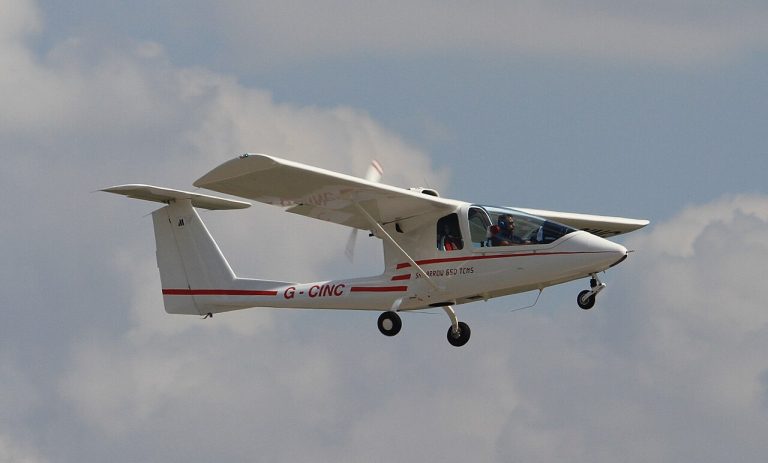
The Stern ST-80 Balade (sometimes spelt Ballade) is a French amateur-built light aircraft designed by René Stern and Marcel Staudt, with wings that fold upwards for storage. The prototype first flew in 1983 with a 60 hp Limbach engine, and René Stern then marketed the design to amateur builders. In the UK it is LAA type 166 in Group A.
This is one of the rarest types on the LAA list. Only two examples are known for certain: the French prototype and a single British-built aircraft, G-BWVI. Published information is very thin, so this page sets out what can be confirmed and is honest about the gaps. It would suit an LAA member who values a folding-wing homebuilt for cheap storage and is prepared to research an almost undocumented type.
History and design
According to the Ron Smith collection notes by Walter van Tilborg, the prototype was built by the two designers with a 60 hp Limbach SL1700 engine. It first flew on 17 July 1983 under the temporary French registration F-WYQA and, after receiving its certificate of airworthiness, was registered F-PYQA on 16 November 1983. Stern then offered the design for amateur construction. The UK example, G-BWVI (construction number PFA 166-11190), was built by Patrick Earle Barker and registered in August 1998. A third aircraft may have been built in France, but this is unconfirmed.
René Stern went on to design the ST 87 Vega, a two-seat wooden low-wing homebuilt that Wikipedia says first flew in July 1992. The Vega is a separate design and is not covered by LAA type 166.
The UK aircraft’s AAIB report describes a nosewheel undercarriage that the pilot called short-coupled, a canopy and a four-point harness, and a Volkswagen 1834 engine with a carburettor hot-air box. We could not confirm from a reliable source whether the ST-80 is a single-seater or a two-seater, its wing position or its construction materials.
Variants
Prototype F-PYQA: 60 hp Limbach SL1700, first flown 1983.
G-BWVI (LAA type 166): UK amateur build completed in 1998 with a Volkswagen 1834 engine.
Specifications
No manufacturer’s data sheet or flight test was available. Only these items could be confirmed:
Specification
Imperial
Metric
Engine (prototype)
Limbach SL1700, 60 hp
Engine (UK example G-BWVI)
Volkswagen 1834 conversion
Wings
Fold upwards
Undercarriage (G-BWVI)
Tricycle, short-coupled nosewheel
Normal approach speed (G-BWVI pilot)
60 kt
111 km/h
First flight
17 July 1983
Performance and handling
We found no published performance figures. The AAIB report on G-BWVI’s 2002 landing accident at the Long Mynd gliding site gives a few handling clues from the pilot’s own account. He gave the normal approach speed as 60 kt, and after a heavy landing and bounce on rough, up-sloping grass the aircraft entered pitch oscillations. In a normal grass landing he would hold the nosewheel off while the elevator was still effective, but here he could not, and the nosewheel dug in and broke off. He felt that tiredness, a poor choice of landing area, not going around after the bounce and over-familiarity with the airfield while flying a relatively new type all contributed.
Owning one in the UK
The ST-80 is LAA type 166 in Group A, so a UK example flies on an LAA Permit to Fly with annual inspection by an LAA inspector. The G-BWVI pilot held a PPL(A); a LAPL(A), PPL(A) or NPPL SSEA with SEP rating would cover the type. Folding wings can reduce hangar costs or allow trailer storage, but check that the fold mechanism and rigging are covered in the permit paperwork. With no factory, agent or owners’ group that we could find, support relies on the LAA, the builder’s records and VW engine specialists. Browse LAA aircraft for sale or all listings, or compare another VW-powered homebuilt on our Druine Turbulent page.
Buying checklist
Confirm the registration and permit status of any example on G-INFO and with the LAA.
Ask for the builder’s log, plans, weight schedule and all LAA correspondence; published data on this type is almost non-existent.
Inspect the wing-fold hinges, locking pins and rigging, and practise the fold with the seller.
Check the nosewheel leg, yoke pivot and engine mounts, which were damaged in the 2002 accident; confirm the repairs were signed off.
Review the VW engine conversion’s history, propeller and carburettor heat system.
Be cautious about resale and insurance for such a rare type.
LAA type acceptance
The Light Aircraft Association lists these variants under the following type numbers. Check the LAA Type Acceptance Data Sheets (TADS) for the current approved engines, propellers and modifications before you buy.
Figures are typical published values for a standard example and vary with engine, propeller, build and modification state. Always use the aircraft’s own Pilot’s Operating Handbook, weight and balance schedule and LAA paperwork. Last checked November 2026.