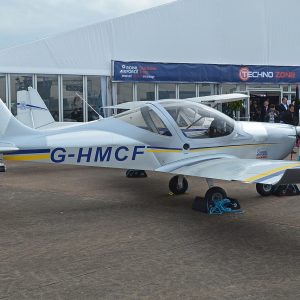
The TL-3000 Sirius is a two-seat, strut-braced, high-wing aircraft from TL-Ultralight of Hradec Králové in the Czech Republic, the maker of the low-wing TL-2000 Sting. It has a carbon-fibre wing, a glass and carbon fuselage, Rotax 912 power, a roomy cabin designed with larger pilots in mind, and a ballistic parachute as standard.
In the UK it can be owned two ways. The LAA accepts it as a Group A Permit aircraft (TADS 386). The British Microlight Aircraft Association (BMAA) has also approved a factory-built 600 kg microlight version, the TL-3000 Sirius 600, under data sheet BM-95.
History and design
TL-Ultralight announced the Sirius in 2007 and showed an unflown example at that year’s Aero show. The first flight was on 21 May 2008, but the prototype was lost in a fatal accident in July 2008, and development continued into 2010 before production. The FAA accepted the design as a special light-sport aircraft, 22 had been sold by September 2010, and Wikipedia reports that 100 had been built by 2015. The Sirius shares many components with the Sting.
The wing has a constant-chord centre section and tapered outer panels with downturned tips, braced by a pair of lift struts. Large electric flaps, a steerable nosewheel, braked mainwheels on composite spring legs and almost fully faired wheels complete the layout. Dual yokes are standard. The maker offers a float version and lists a Garmin G3X Touch glass cockpit as standard, with analogue instruments available. See the TL-Ultralight Sirius page for the current specification.
Variants
TL-3000 Sirius (LAA 386, Group A): the LAA-accepted version, flown on a Permit to Fly with an SEP licence. The UK agent says it can be bought through the LAA route as a Permit aircraft.
TL-3000 Sirius 600 (BMAA BM-95, microlight): factory-built microlight at 600 kg MTOW, approved by the BMAA on behalf of the CAA. The first issue was in October 2022, and issue 2 (February 2026) added the fuel-injected Rotax 912 iS Sport.
Engines: the UK microlight data sheet approves the carburettor Rotax 912 ULS (100 hp) and the injected 912 iS Sport (100 hp). The factory lists other Rotax options for export markets.
Propellers: TL-Ultralight PowerMax three-blade in-flight variable pitch with constant-speed unit, or a DUC Swirl-3 three-blade ground-adjustable.
Specifications
Limitations and performance are from the UK BMAA data sheet BM-95 (issue 2, 2026) for the Sirius 600. Dimensions and cruise are from TL-Ultralight. The LAA Group A TADS 386 may set different limits.
+4 g / -2 g flaps up; non-aerobatic, 60° bank maximum
Performance and handling
TL-Ultralight quotes a cruise of 180–220 km/h (97–119 kt), and Plane & Pilot’s specification for the US light-sport version gave a 120 kt maximum cruise. On the UK data sheet a 600 kg Sirius should climb at 900–950 fpm and stall at about 37 kt IAS with full flap. One UK owner with a 912 iS advertised about 15 litres an hour at 100 kt. The maker quotes 16.2 litres an hour at 75% power and a theoretical range of up to 2,000 km with no wind and no reserve.
The UK data sheet requires a placard warning that the aircraft has not been flight-tested for recovery from unintentional spins, and aerobatics are not permitted. Take-off distances on the data sheet are factored and fairly long, at 514–555 m on a paved runway, so plan grass strips with care at full weight.
Owning one in the UK
Which licence you need depends on how the aircraft is registered. A Sirius 600 on the BMAA microlight route can be flown on an NPPL(M) or a licence with a microlight class rating. A Sirius under LAA TADS 386 is Group A and needs an NPPL SSEA, LAPL(A) or PPL. Both routes use a Permit to Fly rather than a CofA, with annual inspections by approved inspectors. Under the microlight data sheet, approved fuels are 95 RON unleaded to EN 228, avgas 100LL and UL91, with unleaded preferred.
The BMAA data sheet makes a ballistic parachute (Magnum 601 or Galaxy GRS6) and a stall warner mandatory. CAA Mandatory Permit Directive 2019-005 covers parachute placards, and an electronic CO detector is required if a cabin heater is fitted. The UK importer is TL-Sting (UK) Ltd, trading as Sting Aircraft. It quotes new prices on application and lists the 912 iS and PowerMax propeller as upgrades. In 2023 it advertised a new factory-built Sirius at £124,000 plus VAT. Look for one in our listings or browse other LAA aircraft.
Buying checklist
Find out whether the aircraft is on the BMAA microlight route (Sirius 600, BM-95) or LAA Group A (TADS 386). That decides your licence and the limits that apply.
Check the parachute type, repack date and rocket life, and that the MPD 2019-005 placards are fitted.
Confirm the engine (912 ULS or 912 iS Sport), its hours and Rotax service bulletin compliance.
If a PowerMax variable-pitch propeller is fitted, check its maintenance records and that a manifold pressure gauge is installed, as the data sheet requires.
Check the fuel option: standard 90 litres or 130-litre Option 13. Bigger tanks cut payload at 600 kg.
Ask for a current weight and balance. The data sheet’s typical empty weight is 350–356 kg, and a well-equipped G3X aircraft may weigh more.
Check the TL-Ultralight bulletin list and the aircraft’s records for compliance.
LAA type acceptance
The Light Aircraft Association lists these variants under the following type numbers. Check the LAA Type Acceptance Data Sheets (TADS) for the current approved engines, propellers and modifications before you buy.
It depends on the registration. A Sirius 600 on the BMAA microlight route can be flown on an NPPL(M) or with a microlight class rating. A Sirius under LAA TADS 386 is Group A and needs an NPPL SSEA, LAPL(A) or PPL.
Can I fly a Sirius on a microlight licence?
Yes, if it is a factory-built TL-3000 Sirius 600 approved by the BMAA as a 600 kg microlight under data sheet BM-95.
Is it on a Permit or a CofA?
UK Sirius aircraft fly on a Permit to Fly, through either the BMAA microlight route or the LAA Group A route.
How fast does the Sirius cruise?
TL-Ultralight quotes 180–220 km/h (97–119 kt). Plane & Pilot gave 120 kt as the maximum cruise for the US version.
What engines are approved in the UK?
The UK microlight data sheet approves the Rotax 912 ULS and the fuel-injected 912 iS Sport, both 100 hp.
What fuel does it use?
Under the UK microlight data sheet: 95 RON minimum unleaded to EN 228, avgas 100LL or UL91, with unleaded preferred.
How much fuel does it carry?
90 litres usable as standard, or 130 litres with the optional larger wing tanks.
Does it have a parachute?
Yes. TL-Ultralight fits a rescue parachute to all aircraft, and the UK microlight data sheet makes a Magnum 601 or Galaxy GRS6 system mandatory.
Can it do aerobatics or spins?
No. It is non-aerobatic, limited to 60° of bank, and carries a placard saying it has not been tested for spin recovery.
How much does a new Sirius cost in the UK?
The UK agent quotes prices on application. In 2023 it advertised a new factory-built example at £124,000 plus VAT.
Who supports the Sirius in the UK?
TL-Sting (UK) Ltd, trading as Sting Aircraft, is the UK importer named on the BMAA data sheet.
Is it suitable for training?
The UK agent has marketed it as a touring and training aircraft, but check what the Permit and the relevant association allow for instruction.
Figures are typical published values for a standard example and vary with engine, propeller, build and modification state. Always use the aircraft’s own Pilot’s Operating Handbook, weight and balance schedule and LAA paperwork. Last checked November 2026.