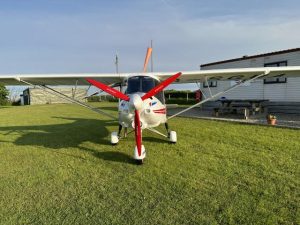
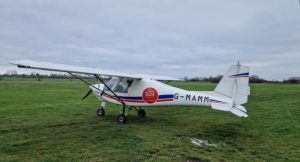
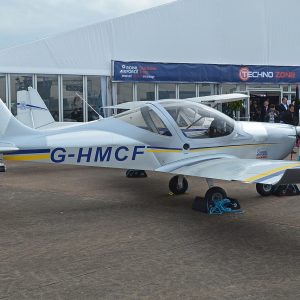
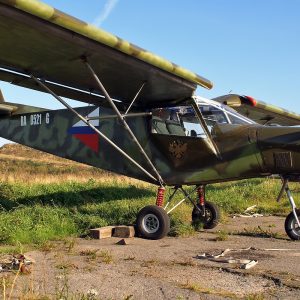
The Comco Ikarus C42 is a two-seat, high-wing microlight from Germany with a fixed tricycle undercarriage and side-by-side seats. It first flew in 1996, more than 1,450 had been delivered by 2021, and it is widely used for training as well as private flying. UK examples fly on a Rotax 912, either the 80 hp 912 UL or the 100 hp 912 ULS, and come either factory-built or from kits.
UK pilots buy the C42 because it is easy to fly, forgiving to land, runs on unleaded mogas and has a UK type approval holder and several UK support companies behind it. It is often sold whole or as syndicate shares. It suits NPPL(M) holders who want a practical, roomy two-seater for local flying and modest touring rather than outright speed.
History and design
Comco Ikarus, a long-established German light aircraft builder, introduced the C42 (later called the C42A) in 1996. It was followed by the C42B and, from 2012, the C42C, which brought a reshaped wing with winglets, aileron spades and more composite parts. The CS model followed in 2015 with new main undercarriage legs and a revised interior. More than 1,450 had been delivered by 2021, according to Plane & Pilot.
A large aluminium tube boom carries most of the loads, with a strut-braced wing on tubular spars, sailcloth covering on the flying surfaces and a composite cabin pod. The upward-hinging doors can be removed, and an approved UK modification allows flight without them.
In the UK the type is split between two organisations. The LAA looks after kit-built examples under TADS 322, while the factory-built aircraft (designated C42 FB80 and FB100) are handled by the BMAA as microlights. The UK type approval holder for factory-built aircraft is The Light Aircraft Company (TLAC) at Little Snoring in Norfolk.
Variants
C42 FB UK (LAA 322): the kit-built UK microlight version, with a maximum total weight of 450 kg on the LAA operating limitations. It can be fitted with the Rotax 912 UL or 912 ULS.
C42 FB100 VLA (LAA 322): a 100 hp Rotax 912 ULS version cleared to 473 kg, which needs a pitot-static drain, an improved firewall and an extra airspeed placard (LAA mod 11097).
Factory-built C42 FB80 / FB100 (BMAA): the version most UK buyers will meet. The later C42 FB80 and FB100 Charlie are approved at 450 kg, or 472.5 kg with an approved parachute or TLAC modification TMC42-15.
C42 B, C and CS: the factory’s own model updates. The C model has a shorter span with winglets, and the German data for it quotes a 560 kg MTOW, which does not apply to UK microlight-registered aircraft.
Specifications
Specification
Imperial
Metric
Wingspan (original C42)
31 ft 0 in
9.45 m
Wingspan (C42 C)
28 ft 7 in
8.71 m
Length (original C42)
20 ft 4 in
6.2 m
Typical empty weight (FB80 / FB100)
584 lb / 628 lb
265 kg / 285 kg
MTOW (UK microlight)
992 lb (1,042 lb with mod)
450 kg (472.5 kg with mod)
Fuel
11 / 14.3 / 22 imp gal
50 L standard, 65 L option, 100 L with second tank
Engine
Rotax 912 UL 80 hp or 912 ULS 100 hp
Vne (LAA kit-built)
139 mph IAS / 121 kt
224 km/h
Vne (BMAA C42 Charlie)
125 kt IAS
232 km/h
Cruise (80 hp, 75% power)
94 kt
175 km/h
Stall, full flap (BMAA Vso)
34 kt CAS
63 km/h
Minimum climb at 450 kg (BMAA)
700 fpm (FB80) / 1,000 fpm (FB100)
3.6 / 5.1 m/s
Take-off distance, short dry grass (BMAA, factored)
673 ft
205 m
Performance and handling
The C42 is not quick, but it is honest. Comco’s own data for the C model gives a cruise of about 172 km/h (93 kt) with the 80 hp engine and about 182 km/h (98 kt) with the 100 hp engine, and older Jane’s data quotes 94 kt at 75% power for the original 80 hp aircraft. The BMAA’s minimum climb figures at 450 kg show why many buyers want the 100 hp FB100: at least 1,000 fpm against 700 fpm for the FB80, which matters from short grass strips on warm days.
In Plane & Pilot‘s 2021 test of a 100 hp C42 C, the controls were well harmonised, roll response was brisk, and the aircraft showed strong pitch stability. The stall with full flap and power was a gentle mush with mild buffet, although an aggressive stall dropped a wing. Full flap gives a marked pitch change that is easily trimmed out. Steerable nosewheel and hydraulic disc brakes make ground handling straightforward.
Owning one in the UK
Licence: UK C42s are microlights, so an NPPL with a microlight rating, or a licence that includes microlight privileges, is the usual route. Because many schools train on the type, it is easy to get a type-specific checkout and differences training.
Permit and oversight: every UK C42 flies on a Permit to Fly. Kit-built examples renew their permits through the LAA with an LAA inspector, while factory-built aircraft are normally overseen by the BMAA. Annual permit costs are modest compared with a certified aircraft, but budget for the inspection, the permit fee and the work found at the annual.
Engine and fuel: the Rotax 912 UL and ULS run on unleaded mogas (EN 228, minimum 90 RON for the 912 UL), with UL91 and 100LL also approved. Plane & Pilot measured about 4 US gallons (around 15 litres) an hour on its 100 hp test aircraft.
Known inspection points: the LAA TADS lists CAA Mandatory Permit Directives covering elevator horn cracking, stub axle shock absorber attachment cracking, fouling of the rear fuselage fairing on the rudder horn bolts, a cracked weld on the wing root rib, inspection of the main fuselage tube for cracking and Neuform propeller hub cracking. The factory service bulletins 1-18 are mandatory for UK kit-built aircraft, and later bulletins cover A-strut cracking, control surface corrosion and wing batten tips. LAA safety articles have also flagged engine mount cracks and, in 2025, a lift strut not correctly engaged at its base.
Parts and support: TLAC at Little Snoring is the UK type approval holder for factory-built aircraft, and the LAA TADS also names Fly Buy Ultralights and Red Aviation as UK contacts. Rotax parts and servicing are widely available. The LAA does list a wing fold kit as an accepted option for kit-built aircraft, but otherwise plan on hangarage as a running cost. For insurance, a microlight-specialist broker is the usual starting point.
Buying checklist
Confirm whether the aircraft is factory-built (BMAA) or kit-built (LAA), and which MTOW and modifications appear on its paperwork.
Check that all Mandatory Permit Directives and the elevator horn, stub axle and fuselage tube inspections are recorded.
Look closely at the main fuselage tube and the engine mount for cracks, especially on ex-school aircraft with many landings.
If a Neuform propeller is fitted, ask whether the hub has been inspected under the spinner.
Check that the lift struts are correctly seated and secured at their base.
Review the hours and calendar status of the Rotax engine, and the sailcloth covering’s condition and age.
Ex-training aircraft can carry very high hours, so price the airframe on its condition and history, not just on the year.
The Light Aircraft Association lists these variants under the following type numbers. Check the LAA Type Acceptance Data Sheets (TADS) for the current approved engines, propellers and modifications before you buy.
UK C42s are microlights, so you need a licence with microlight privileges, usually the NPPL with a microlight rating. Many UK schools train on the C42, so getting checked out on the type is easy.
Is the C42 on a Permit to Fly or a CofA?
It is on a Permit to Fly. Kit-built C42s are looked after by the LAA under TADS 322, and factory-built FB80 and FB100 aircraft are normally overseen by the BMAA.
What is the maximum take-off weight of a UK C42?
The UK microlight figure is 450 kg. Factory-built C42 FB80 and FB100 Charlie aircraft can go to 472.5 kg with an approved parachute or TLAC modification TMC42-15, and the LAA lists 473 kg for the FB100 VLA.
How much does a C42 cost in the UK?
Recent asking prices on aircraftsale.co.uk ranged from about £39,000 for a high-hours FB80 to £56,500 for a 2015 C42A (2023 asking prices). Syndicate shares sell for much less.
What fuel does it use?
The Rotax 912 UL and ULS run on unleaded mogas to EN 228. UL91 and 100LL avgas are also approved, but most owners prefer mogas.
How fast does it cruise?
Expect around 93-94 kt with the 80 hp engine at 75% power, and about 98 kt with the 100 hp engine on the C42 C, based on Comco and Jane’s data.
Is the C42 good for training?
Yes. It is widely used as a trainer, and reviewers note its well-harmonised controls, strong pitch stability and gentle full-flap stall.
Can I build a C42 from a kit in the UK?
Kits are accepted by the LAA under TADS 322 and are built under the 51% rule with LAA inspection. Factory-built C42s are handled by the BMAA instead.
Who supports the C42 in the UK?
The Light Aircraft Company (TLAC) at Little Snoring, Norfolk, is the UK type approval holder for factory-built aircraft. The LAA TADS also lists Fly Buy Ultralights and Red Aviation.
Are there any known airworthiness issues?
CAA Mandatory Permit Directives cover elevator horn cracking, stub axle cracking, a wing root rib weld, main fuselage tube cracking and Neuform propeller hub cracking, among others. Check that the aircraft’s records show all of them complied with.
Can I do aerobatics in a C42?
No. Aerobatics and intentional spinning are prohibited, and the BMAA limits bank angle to 60 degrees.
Can I fly with the doors off?
An approved modification allows flight without doors. The BMAA data sheet then limits Vne to 90 kt IAS.
Figures are typical published values for a standard example and vary with engine, propeller, build and modification state. Always use the aircraft’s own Pilot’s Operating Handbook, weight and balance schedule and LAA paperwork. Last checked November 2026.