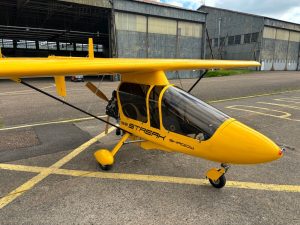
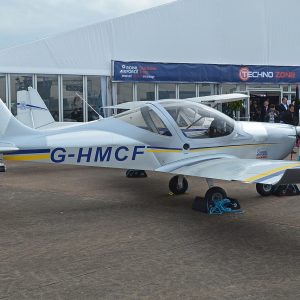
The X’Air Hawk is a two-seat, high-wing microlight kit with side-by-side seating, a tricycle undercarriage and a nose-mounted four-stroke engine. It is the UK and Ireland version of the Indian-built X-Air H, known at home as the Hanuman, and in the UK it is built from kits under LAA supervision and flown on a Permit to Fly at a maximum weight of 450 kg.
It appeals to UK pilots who want an affordable, simple three-axis microlight they can build themselves, with a conventional nose-mounted engine rather than the layout of the earlier X’Air. Its big wing gives a low stall speed for short grass strips, and it can be flown on an NPPL with a microlight rating.
History and design
The X-Air family comes from Raj Hamsa Ultralights in Bangalore, India, and the Hanuman (Hawk) was designed by Joel Koechlin as a development of the X-Air F. By the end of 2011, 216 had been built, according to Wikipedia. In the US it is accepted as a special light-sport aircraft under the name X-Air XA85.
The structure is aluminium tubing with steel reinforcement, covered in Dacron sailcloth, with a strut-braced high wing, flaps and a steerable nosewheel. Full dual controls are fitted, although the brakes and flap controls are at the main pilot’s seat. The standard engine in Raj Hamsa’s data is the Jabiru 2200 four-stroke, which can run on unleaded mogas.
To gain LAA acceptance, ten UK modifications (MOD/340/001 to /010) were required, mostly to lock bolts, pulleys and hinges positively and to improve the fuel drain and trim stops. They are built into the UK build manual and were incorporated at the factory from kit number 1131. The UK agent is the Wessex Light Aeroplane Company in Taunton (xairuk.com), and the LAA warns that parts supplied other than through Wessex or Xair Ireland may not meet the UK standard.
Variants
X’Air Hawk with Jabiru 2200: the standard engine, an air-cooled four-stroke. LAA AIL MOD/340/011 requires engine mount inspection on Jabiru-powered aircraft.
X’Air Hawk with Rotax 912 UL: the 80 hp liquid-cooled Rotax installation, also accepted by the LAA.
X’Air Hawk with DMotor LF26: added to the LAA TADS in 2016, with its own single-radiator cowlings.
Wing and fuel options: an improved short-span wing and a single one-piece 64-litre fibreglass fuel tank are accepted LAA options, as are several brake systems.
All UK versions share the same 450 kg maximum weight and 268 kg maximum empty weight, regardless of engine.
Specifications
Specification
Imperial
Metric
Wingspan (standard wing)
33 ft 0 in
10.05 m
Length
19 ft 9 in
6.03 m
Height
7 ft 7 in
2.30 m
Max empty weight (LAA)
591 lb
268 kg
MTOW (LAA)
992 lb
450 kg
Engines (LAA accepted)
Jabiru 2200, Rotax 912 UL or DMotor LF26
Vne (LAA)
125 mph IAS / 109 kt
201 km/h
Max flap extended speed (LAA)
70 mph IAS
113 km/h
Cruise (Jabiru 2200, Raj Hamsa data)
76 kt
140 km/h
Stall, flaps down (Raj Hamsa data)
24 kt
45 km/h
Rate of climb (Raj Hamsa data)
890 fpm
4.5 m/s
The cruise, stall and climb figures are Raj Hamsa’s published data for the Hanuman with the Jabiru 2200, so treat them as a guide and check the individual aircraft’s operating handbook.
Performance and handling
The Hawk is a slow, gentle aircraft by design. Raj Hamsa quotes a cruise of 140 km/h (76 kt) on the Jabiru 2200 and a flaps-down stall of 45 km/h (24 kt), which makes it well suited to short farm strips and relaxed local flying. The UK Vne is 125 mph IAS, and flaps should not be used above 70 mph.
The LAA TADS has several handling-related warnings. The ailerons must be rigged with the correct slight reflex at neutral, because incorrect neutral settings can cause aileron flutter. The rudder should self-centre in flight, and the nosewheel steering must move freely with centring springs strong enough to return it to the middle. On Jabiru-powered aircraft, the engine must be able to climb for five minutes at full throttle without exceeding temperature limits, so check the cooling, especially if no oil cooler is fitted.
Owning one in the UK
Licence: the Hawk is a 450 kg microlight, so an NPPL with a microlight rating, or a licence with equivalent privileges, is needed.
Permit and oversight: every UK Hawk is amateur-built and flies on an LAA Permit to Fly, with annual inspections by an LAA inspector. As a microlight it must also carry the microlight weight placard. Permit costs are modest, but allow for the inspection and any work found.
Engine and fuel: both the Jabiru 2200 and the Rotax 912 UL are designed to run on unleaded mogas, which keeps running costs down. Engine-specific limits for each are set out in the LAA TADS.
Inspection points: there are currently no type-specific Mandatory Permit Directives, but the LAA requires the ten UK modifications on every aircraft and AIL MOD/340/011 on Jabiru 2200 aircraft after engine mount cracks were found at low hours. The TADS also highlights jury struts that were 10-12 mm too long on some early kits (shown by bowed main struts), the wingtip location pin that sets washout, rudder cable chafing where the cables cross, the security of early orange plastic fuel tanks and an incident where a fuel pump was wired backwards.
Parts and support: the Wessex Light Aeroplane Company in Somerset is the UK agent, with separate sales and technical contacts listed by the LAA. Raj Hamsa still lists the Hanuman on its own website.
Buying checklist
Check the kit number and, for kits before 1131, evidence that all the UK modifications MOD/340/001-010 were retrofitted.
On Jabiru-powered aircraft, confirm the engine mount inspection under AIL MOD/340/011 and look for cracks.
Check that the main wing struts are straight, not bowed, which would suggest over-long jury struts.
Check aileron and flap neutral rigging against the build manual, since wrong settings can cause flutter.
Inspect the Dacron covering for UV damage and the rudder cables for chafing.
Check fuel tank security and clearance from the elevator control rod, especially on early orange plastic tanks.
Ask for evidence that the engine cooling was proved with a five-minute full-power climb.
The Light Aircraft Association lists these variants under the following type numbers. Check the LAA Type Acceptance Data Sheets (TADS) for the current approved engines, propellers and modifications before you buy.
The Hawk is a 450 kg microlight, so you need an NPPL with a microlight rating, or another licence with microlight privileges.
Is the X'Air Hawk on a Permit or a CofA?
It is an amateur-built aircraft on an LAA Permit to Fly, inspected by LAA inspectors under TADS 340.
Is the Hawk the same as the original X'Air?
No. The Hawk is the UK name for the X-Air H, or Hanuman, which has a nose-mounted four-stroke engine. The original X’Air has a different layout and is not covered by LAA TADS 340.
Which engines can it have?
The LAA accepts the Jabiru 2200, the Rotax 912 UL and the DMotor LF26.
How fast is it?
Raj Hamsa quotes a cruise of about 76 kt with the Jabiru 2200. The UK Vne is 125 mph IAS (109 kt).
Is it good for short strips?
Raj Hamsa’s data gives a flaps-down stall of 45 km/h (24 kt), and the large wing makes it well suited to short grass strips. Check the individual aircraft’s handbook figures.
Who supports the X'Air Hawk in the UK?
The Wessex Light Aeroplane Company in Taunton is the UK agent (xairuk.com), and the LAA notes that parts should come through Wessex or Xair Ireland to meet the UK standard.
Are there any airworthiness notices?
There are no type-specific Mandatory Permit Directives at present, but all UK aircraft need the ten UK modifications, and Jabiru-powered aircraft need the engine mount inspection under AIL MOD/340/011.
Can I build one myself?
Yes. The Hawk is built from a kit under the LAA’s 51% rule, using the UK build manual and LAA build inspections.
How much does an X'Air Hawk cost?
Not enough recent UK asking prices were found to give a reliable range. Raj Hamsa lists the Hanuman at US$26,000 on its website (2026), but UK kits need the UK modifications and shipping, so ask the UK agent for a current price.
Can it do aerobatics?
No. Only non-aerobatic flight is allowed, with bank angles up to 60 degrees and no intentional spinning.
Figures are typical published values for a standard example and vary with engine, propeller, build and modification state. Always use the aircraft’s own Pilot’s Operating Handbook, weight and balance schedule and LAA paperwork. Last checked November 2026.