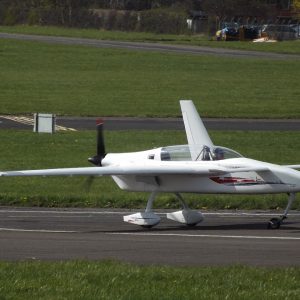
The Luton Minor is a small British single-seat parasol monoplane from the 1930s, built from wood and fabric and designed from the start for amateur construction. The post-war LA4A version became one of the classic UK homebuilds, and most surviving examples were built by amateurs in the 1960s and 1970s. Every UK Minor flies on an LAA Permit to Fly as a Group A aeroplane.
It suits pilots who want the cheapest kind of open-cockpit flying: low and slow, a small four-cylinder engine, and a simple wooden airframe that an owner can understand and maintain with an LAA inspector. It is not a tourer. Buyers choose it for the period feel and low running costs. Browse current examples in our aircraft listings or other LAA aircraft.
History and design
C.H. Latimer-Needham designed the Minor at Luton Aircraft. The L.A.3 prototype first flew on 3 March 1937, powered by a 35 hp Anzani. The L.A.4 was then redesigned for home construction, and the company sold plans from its Phoenix Works at Gerrards Cross. Luton Aircraft closed after the works burned down in 1943. In 1958 Latimer-Needham and Arthur Ord-Hume took over the design rights and produced the LA4A, which was strengthened to allow a maximum weight of 750 lb and given a fixed fin with a separate horn-balanced rudder in place of the earlier all-moving fin.
The airframe is all wood with fabric covering. The parasol wing is strut-braced and carried on a centre-section pylon. Controls work through push-pull rods and stranded steel cables, a single fuel tank sits in the forward fuselage, and the main undercarriage is a sprung split-axle type with a tailskid or a steerable tailwheel. Ord-Hume withdrew the old plans in about 2015 because of concerns over the originals. The redrawn set, which changed little apart from the wing rib gussets, passed to the LAA after his death and has been reapproved by LAA Engineering. The LAA now acts as keeper of the plans.
Variants
LA4 Minor (LAA 051): the pre-war homebuilt version, built in small numbers by Luton Aircraft and amateurs.
LA4A Minor (LAA 051): the post-war development with a higher maximum weight (750 lb, 340 kg) and a fixed fin and separate rudder. Most UK Minors are LA4As.
Minor 3 Duet (LAA 039): the Knowles Duet, a side-by-side two-seat derivative built by Alf Knowles in 1971 (G-AYTT). We found no LAA data sheet for it, so check the individual aircraft’s paperwork.
Engines: the LAA has cleared the LA4A with the Lycoming O-145-A2, Continental A65-8F, JAP J.99, Walter Mikron 3 and VW conversions of 1600 to 1835 cc. Propellers are approved airframe by airframe.
Specifications
UK limits are from the LAA data sheet (TADS 051). Dimensions and performance are Jane’s 1958–59 figures for an LA4A with a 37 hp JAP J-99, as quoted by Wikipedia, cross-checked against Plane & Pilot. Engines vary, so check the individual aircraft.
Specification
Imperial
Metric
Wingspan
25 ft 0 in
7.62 m
Length
20 ft 9 in
6.32 m
Height
6 ft 3 in
1.91 m
Wing area
125 sq ft
11.6 m²
Empty weight (J-99; sources differ)
390–450 lb
177–204 kg
Maximum total weight (LAA)
750 lb
340 kg
Fuel (main tank, Jane’s)
6.5 imp gal
30 litres
Engine (data aircraft)
JAP J-99, 37 hp
Propeller
Two-blade fixed pitch
Vne (LAA)
87 kt
161 km/h
Cruise (J-99)
75 mph (65 kt)
121 km/h
Maximum speed (J-99)
85 mph (74 kt)
137 km/h
Stall
28 mph (24 kt)
45 km/h
Climb
450 ft/min
2.3 m/s
Take-off run (sources differ)
240–250 ft
73–76 m
Landing run
120 ft
37 m
Range (main tank)
156 nm (180 mi)
290 km
Performance and handling
On 37 hp the Minor cruises at about 75 mph and stalls at under 30 mph, so it is a gentle, low-energy aeroplane that uses little runway. The UK Vne is only 87 kt, and the LAA data sheet prohibits aerobatics and intentional spinning, so treat it as a pleasant local and strip flyer rather than a cross-country machine. Range on the standard tank is around 150 nm, and Jane’s mentions provision for auxiliary wing tanks.
Because so many engine and propeller combinations exist, the LAA notes that there is no flight manual as such and that procedures can differ between airframes. An original set of Pilot’s Notes exists. Expect each Minor to have its own character, and get a briefing from the owner or a pilot who knows the type.
Owning one in the UK
Licence: it is a Group A (single-engine piston) type, so you need an NPPL SSEA, LAPL or PPL. It is a single-seater and a taildragger, so you can’t have dual instruction on type. Get tailwheel experience first.
Permit to Fly: UK Minors fly on an LAA Permit, renewed each year after an inspection by an LAA inspector. Flight is limited to day VFR. Permit costs are modest compared with a certified aircraft, but budget for the annual inspection and any fabric or woodwork repairs.
Mandatory items: the LAA requires inspection of the main undercarriage axle welds for cracks and corrosion (MOD/051/001). The data sheet lists no type-specific Mandatory Permit Directives.
Engine and fuel: engines range from VW conversions to the Continental A65 and Lycoming O-145. Fuel approval depends on the engine fitted, so check the aircraft’s operating limitations.
Hangarage: a wooden, fabric-covered aircraft needs dry hangar space. Plane & Pilot notes the wings are built in two halves and can be removed for transport.
Plans and support: plans are available through the Light Aircraft Association, which keeps the type’s drawings. More history is on Wikipedia.
Confirm the variant (LA4, LA4A or Duet), the engine and the propeller against the aircraft’s LAA operating limitations.
Check that MOD/051/001 (axle weld inspection) has been done and recorded.
Have an inspector with wooden-aircraft experience check the spars, glue joints, ply and fabric. Storage history matters.
Inspect the wing struts, pylon and fittings for corrosion and wear.
Check every control cable turnbuckle is complete and locked. The AAIB’s report on the 2019 G-AWMN accident found an aileron turnbuckle barrel missing, though it could not say when it went.
Ask how the engine copes with carburettor icing and look at the carb heat system. The same AAIB report considered carb icing as a possible factor.
Check the weight and balance. With a 340 kg maximum, pilot weight and fuel are closely limited.
LAA type acceptance
The Light Aircraft Association lists these variants under the following type numbers. Check the LAA Type Acceptance Data Sheets (TADS) for the current approved engines, propellers and modifications before you buy.
It is an LAA Group A aeroplane, so an NPPL SSEA, LAPL or PPL. It is a single-seat taildragger, so get tailwheel experience before your first flight.
Is the Luton Minor on a Permit or a CofA?
UK Minors fly on an LAA Permit to Fly, renewed each year after an LAA inspector’s inspection. Flight is limited to day VFR.
Can I carry a passenger?
No. The LA4 and LA4A are single-seaters. The LAA also lists the Minor 3 Duet (Knowles Duet), a rare side-by-side two-seat derivative.
What engines are fitted?
The LAA has cleared the LA4A with the Lycoming O-145-A2, Continental A65-8F, JAP J.99, Walter Mikron 3 and VW conversions of 1600 to 1835 cc. Check the individual aircraft’s operating limitations.
How fast is it?
Jane’s data for a 37 hp JAP-powered LA4A gives a 75 mph (65 kt) cruise. The UK Vne is 87 kt.
What is the maximum weight?
The LAA’s maximum total weight for the LA4/LA4A is 340 kg (750 lb).
Can I build one?
Yes. The LAA keeps the redrawn, reapproved plans and can tell you how to get them. A UK build is inspected by an LAA inspector.
Is it aerobatic?
No. The LAA data sheet prohibits aerobatic manoeuvres and intentional spinning.
Are there any mandatory checks?
Yes. LAA modification MOD/051/001 requires inspection of the main undercarriage axle welds for cracks and corrosion.
Is it good for touring to France?
Not really. On the standard 30-litre tank Jane’s gives a range of about 180 miles, and it cruises at around 65 kt, so it is best for local flying.
Who supports the type in the UK?
The Light Aircraft Association keeps the plans and the type data sheet, and LAA inspectors oversee permit renewals.
Figures are typical published values for a standard example and vary with engine, propeller, build and modification state. Always use the aircraft’s own Pilot’s Operating Handbook, weight and balance schedule and LAA paperwork. Last checked November 2026.