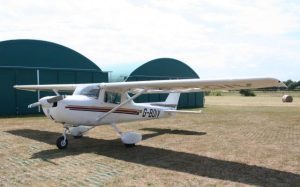
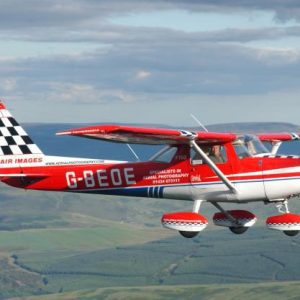
The Cessna 150 is the aeroplane a whole generation of British pilots learned on. It is a small, all-metal, high-wing two-seater with a fixed tricycle undercarriage and a 100 hp Continental O-200 engine. Cessna built it from 1958 to 1977, and Reims Aviation in France built a further 1,764 under licence as the Reims F150, which is why so many UK examples carry an F prefix.
UK buyers choose a 150 because it is cheap to buy, cheap to run, forgiving to fly and supported everywhere. It is a fully certified type on a Certificate of Airworthiness, so it suits PPL and LAPL holders who want a simple aeroplane for hour-building, local flying or short tours, and it remains a staple of club and school fleets.
History and design
The prototype, then called the Model 142, first flew on 12 September 1957 and became the Model 150 a month later. It replaced the tailwheel Cessna 140, and the nosewheel layout made it far easier for students to handle on the ground. Production started at Wichita in 1958 and ran to 1977, when the Cessna 152 took over. Counting the US, French and Argentine lines, more than 23,000 were built.
The basic recipe never changed, but the aeroplane evolved year by year. The 1964 150D gained the wraparound “Omni-Vision” rear window and a gross weight rise from 1,500 lb to 1,600 lb. The 1966 150F brought the swept tail, larger doors and electric flaps with up to 40 degrees of travel (the later 152 is limited to 30 degrees). The 150G widened the cabin slightly by bowing the doors out, and the 1971 150L introduced tubular main gear legs with a wider track. The last model, the 150M, has a taller fin.
Reims started F150 production in 1967. According to the type certificate data sheet, the F150G to F150L used a Rolls-Royce-built Continental O-200-A, giving many European aircraft a British-built engine.
Variants
150 to 150C (1959-63): straight tail, no rear window, 1,500 lb gross weight.
Figures are for the 1976-77 Cessna 150M unless stated. Check the Pilot’s Operating Handbook and weight schedule for any individual aircraft.
Specification
Imperial
Metric
Wingspan
33 ft 2 in
10.11 m
Length
23 ft 11 in
7.29 m
Height
8 ft 6 in
2.59 m
Wing area
160 sq ft
14.9 m²
Empty weight (150M)
1,104-1,122 lb
501-509 kg
Maximum take-off weight
1,600 lb (1,500 lb before 1964)
726 kg (680 kg)
Useful load (150M)
489 lb
222 kg
Fuel
26 US gal total, 22.5 US gal usable
98 L total, 85 L usable
Engine
Continental O-200-A, 100 hp (Rolls-Royce-built on most Reims F150s)
Propeller
McCauley two-blade fixed pitch, 69 in (1.75 m)
Never-exceed speed (Vne)
141 kt CAS
261 km/h
Maximum speed (sea level)
109 kt
202 km/h
Cruise (75% power, 7,000 ft)
106 kt
196 km/h
Stall (flaps down / clean)
42 / 48 kt CAS
78 / 89 km/h
Rate of climb (sea level)
670 ft/min
3.4 m/s
Service ceiling
14,000 ft
4,270 m
Range (standard tanks, 45 min reserve)
340 nm at 75% power; 420 nm at best-range power
630 km; 780 km
Take-off (ground roll / over 50 ft)
735 ft / 1,385 ft
224 m / 422 m
Landing (ground roll / over 50 ft)
445 ft / 1,075 ft
136 m / 328 m
Performance and handling
The 150 is not fast, but it is honest. Cessna’s book cruise for the 150M is 106 kt at 75% power, while owners in practice tend to plan on about 95 kt and roughly 5.5 US gallons (about 21 litres) an hour. Climb with two aboard on a warm day is modest, so pay attention to weight and runway length at small strips.
Handling is docile. The stall gives plenty of warning and the aeroplane is stable in all axes, which is why it has trained so many pilots. It is certified in the utility category and, within the limits placarded in the type data, spins and some basic manoeuvres such as chandelles and lazy eights are approved. The light wing loading makes it bumpy in turbulence, and the cabin is narrow for two larger adults.
Owning one in the UK
Licence: a PPL(A) or LAPL(A) with a single-engine piston (SEP) rating. Since a 2021 change, an NPPL(A) holder with a valid SSEA/SEP rating can also fly G-registered Part 21 aeroplanes such as the 150, but the NPPL is only valid in UK airspace unless another country agrees.
Airworthiness: the 150 is a certified (Part 21) type, not an LAA Permit aircraft. It has a non-expiring Certificate of Airworthiness that is kept valid by an annual Airworthiness Review Certificate, and it is maintained under the CAA’s Part-ML rules by a maintenance organisation or licensed engineer. Pilot-owners may do some limited tasks themselves. Expect higher annual maintenance costs than for a comparable Permit aircraft, because certified parts and licensed engineers are required.
Fuel and engine: the type data sheet specifies 80/87 minimum grade aviation fuel for the O-200-A. Check the records for engine hours against the 1,800-hour overhaul period Cessna quoted for the 150M.
Inspection points: FAA AD 2011-10-09 requires repetitive inspection of seat rails and roller housings on the 150 and 152. Nose-gear and firewall damage from heavy landings is the most common accident damage on ex-training aircraft, so look closely at both.
Support: parts and expertise are widely available through UK maintenance organisations, and the type club, the Cessna 150-152 Club, publishes model-by-model data. Browse current examples in our aircraft listings, or compare a modern LAA two-seater such as the Tecnam P2002 Sierra. More background is on Wikipedia.
Buying checklist
Identify the model year and builder (Cessna or Reims), because gross weight, tail, gear and engine details vary.
Check that FAA AD 2011-10-09 seat rail and roller housing inspections are up to date in the records.
Inspect the nose gear, firewall and engine mounts for signs of heavy-landing damage, typical of ex-school aircraft.
Confirm the Certificate of Airworthiness, a current ARC, and a Part-ML compliant maintenance programme.
Compare engine hours with the overhaul period, and ask for compression and oil analysis history.
Weigh your crew: with 489 lb useful load on a 150M, two adults and full fuel can be tight.
Look for long-range tanks (38 US gal total) if you plan longer trips.
Frequently asked questions
What licence do I need to fly a Cessna 150 in the UK?
A PPL(A) or LAPL(A) with an SEP rating. An NPPL(A) with a valid SSEA/SEP rating can also fly a G-registered Cessna 150 within UK airspace.
Is the Cessna 150 on a Permit to Fly or a CofA?
It is a certified type, so it flies on a Certificate of Airworthiness kept valid by an annual Airworthiness Review Certificate, with maintenance under Part-ML. It is not an LAA Permit type.
What is the difference between a Cessna 150 and a Reims F150?
The F150 was built under licence by Reims Aviation in France, which made 1,764 of them. They are essentially the same aeroplane; most F150s from the F150G onwards have a Rolls-Royce-built Continental O-200-A.
How much does a Cessna 150 cost in the UK?
Recent UK asking prices on aircraftsale.co.uk ran from about £25,000 to £70,000 (2024), depending on engine hours, avionics and condition.
How much fuel does a Cessna 150 use?
Owners typically plan on about 5.5 US gallons (around 21 litres) an hour at a cruise of about 95 kt.
How fast is a Cessna 150?
Cessna quotes 106 kt at 75% power at 7,000 ft for the 150M, with a maximum of 109 kt at sea level. Real-world cruise is often slower.
Can I fly a Cessna 150 to France?
Range on standard tanks is 340 nm at 75% power with reserves, so a Channel crossing is easy. You will need a licence valid abroad; the NPPL is limited to UK airspace unless another country agrees.
Is the Cessna 150 good for training?
Yes. It is stable, gives clear stall warning and is approved for spins in the utility category, which is why it was a standard UK school aircraft for decades.
How many seats does a Cessna 150 have?
Two side-by-side seats. An optional child’s seat in the baggage area was available, limited to 120 lb including baggage.
What should I check when buying a Cessna 150?
Check seat rail AD compliance, nose gear and firewall condition, engine hours, the CofA and ARC, and whether the aircraft has a heavy training history.
Who supports the Cessna 150 in the UK?
Most UK maintenance organisations that work on light Cessnas can support it, and the Cessna 150-152 Club provides owner information and data.
Figures are typical published values for a standard example and vary with engine, propeller, build and modification state. Always use the aircraft’s own Pilot’s Operating Handbook, weight and balance schedule and LAA paperwork. Last checked November 2026.