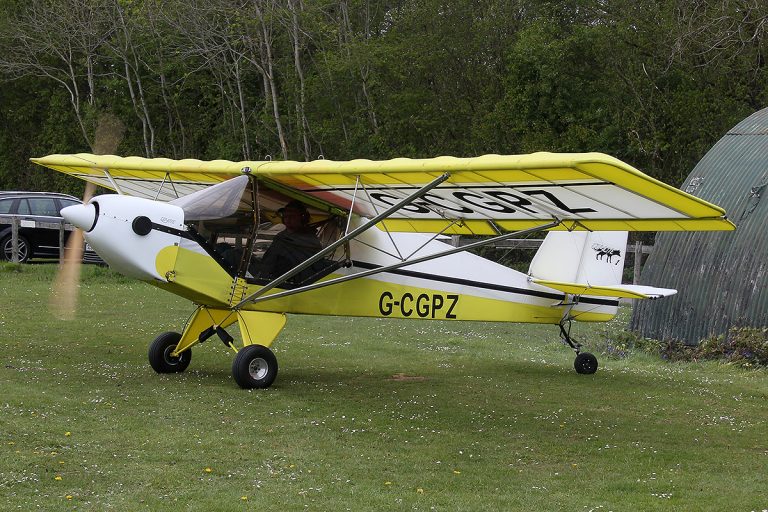
The Cyclone AX3 is a two-seat, three-axis microlight built in Britain in the early and mid-1990s. It is a simple aluminium-tube aeroplane with a fabric (sailcloth) wing, an uncowled two-stroke Rotax engine mounted at the wing leading edge, side-by-side seats in an open frame and a tricycle undercarriage. It is a slow, low-cost aeroplane for fair-weather local flying rather than touring.
Only a few dozen were built, so an AX3 is now a rare, very cheap way into two-seat flying. Buyers are usually microlight pilots or groups who want something basic to fly from a farm strip, and who are happy to deal with an older airframe that is covered by several mandatory modifications. Its later development, the AX2000, is more common.
History and design
The AX3 traces back to the American Weedhopper of the early 1980s. A French company, Ultralair, developed it into the three-axis Premier AX3. Cyclone Airsports of Wallingford, Oxfordshire, then adapted the design to meet British microlight airworthiness requirements (BCAR Section S). The CAA’s microlight type approval data sheet (TADS BM45) was first issued in September 1992.
According to the British Aviation production record, 43 AX3s were built: 35 by or from kits supplied by Cyclone Airsports between 1992 and 1995, and eight by Pegasus Aviation at Manton, Wiltshire, in 1995-96. Pegasus then moved on to the AX2000, which has a double-surface wing of smaller area, a lighter fuselage, more fuel and new engine options. The type is now supported by P&M Aviation of Rochdale, which holds the TADS.
Construction is aluminium tube with a polyester sail covering. The engine sits above the wing root on the centre line. A two-seat school fleet of AX3s was operated from 1993, and an example was evaluated by the Empire Test Pilots’ School at Boscombe Down, as described on the Microlight Flying School’s AX3 page.
Variants
AX3/503: factory version with the 52 hp Rotax 503-2V two-stroke and a two-blade ground-adjustable propeller. This is the version covered by CAA TADS BM45, from which the figures below are taken.
AX3/582: the same airframe with the liquid-cooled 64 hp Rotax 582.
AX3K/582: the LAA’s type list includes a kit-built 582-engined AX3 (type 245) as Group A. Its LAA limits were not checked for this page.
AX2000: the 1996-on successor, a separate type with its own TADS (BM53) and a 450 kg MTOW.
Specifications
Figures are for the factory AX3/503 from CAA TADS BM45 issue 4. Dimensions are taken from the TADS three-view drawing.
GSC Tech II two-blade, ground adjustable, 64 x 46 in
Never exceed speed
90 mph (78 kt)
145 km/h
Manoeuvring speed
60 mph (52 kt)
97 km/h
Stall at MTOW
31 mph (27 kt)
50 km/h
Rate of climb at MTOW
400 ft/min at 44 mph
2.0 m/s
Performance and handling
This is a slow aeroplane. The TADS sets a Vne of 90 mph, a manoeuvring speed of 60 mph, best climb and glide at 45 mph and a minimum climb rate of 400 ft/min at maximum weight. The flight school that ran AX3s describes it as ideal for flying at roughly 35-50 mph. No published cruise speed or fuel-burn figure was found, so neither is given here.
The aeroplane is non-aerobatic, limited to 60 degrees of bank and 45 degrees of pitch, with load limits of +4/-2 g. With the 27.5-litre tank and a 390 kg MTOW, the fuel placard restricts fuel when two heavy occupants fly: at 180 kg cockpit weight only 5.5 litres may be carried. Two-up flights are therefore short.
Owning one in the UK
A factory AX3 is a microlight, so it is flown on an NPPL with a microlight rating or a higher licence that includes microlight privileges, and it operates on a Permit to Fly. The TADS refers to BMAA inspection of modifications, while the LAA lists a kit-built AX3K/582 among its accepted types; check which organisation oversees the aircraft you are looking at, and whether a change of organisation is needed. Browse other LAA aircraft for comparison.
The Rotax 503 runs on unleaded mogas (83 MON or 90 RON minimum), leaded 4-star or Avgas 100LL, mixed 50:1 with two-stroke oil. As with any non-certified two-stroke, good maintenance records matter, and it is wise to plan flights within gliding reach of a landable field.
Several mandatory directives apply. CAA Mandatory Permit Directive 1997-012 followed fatigue cracking of the main beam under the seats; Service Bulletin AX7 and modification AX74 introduced a redesigned cable-braced beam, and the TADS says all aircraft should now have it. MPD 1998-005 covers the aileron return-pulley bracket, MPD 1998-014 introduced a 1,000-hour life for the rudder bracket bolts, and MPD 2016-011 requires repeat checks of clevis pins and split rings at every permit renewal. The TADS also calls for non-PVC fuel hoses and an annual Bettsometer test of the sail.
Buying checklist
Confirm the cable-braced main beam (mod AX74) is fitted and recorded.
Check compliance records for MPDs 1997-012, 1998-005, 1998-014 and 2016-011.
Look for a recent Bettsometer test and the age and condition of the sail.
Check that the fuel hoses are the non-PVC type (mod PG/AX279).
Get engine hours, overhaul history and gearbox condition for the Rotax 503 or 582.
Compare the weighed empty weight with the 206 kg TADS limit at first permit issue.
Confirm whether the aircraft is a factory AX3/503, an AX3/582 or a kit-built AX3K, and which body supervises it.
The Light Aircraft Association lists these variants under the following type numbers. Check the LAA Type Acceptance Data Sheets (TADS) for the current approved engines, propellers and modifications before you buy.
The factory AX3/503 is a two-seat microlight with a 390 kg MTOW, so an NPPL with a microlight rating, or a licence that includes microlight privileges, is needed. A kit-built AX3K listed by the LAA as Group A may have different paperwork, so check the aircraft’s permit.
Is it on a Permit to Fly or a CofA?
A Permit to Fly. The AX3 was approved to BCAR Section S under CAA microlight TADS BM45; it has never had a Certificate of Airworthiness.
What engine does it have?
Either a 52 hp Rotax 503 (AX3/503) or a 64 hp liquid-cooled Rotax 582 (AX3/582), both two-stroke twins with reduction gearboxes.
What is the maximum take-off weight?
TADS BM45 gives 390 kg for the AX3/503, with a typical empty weight of 205 kg and a cockpit load of 55-195 kg.
How fast does it fly?
The never-exceed speed is 90 mph (78 kt) and stall is 31 mph. No published cruise speed was found; the flight school that used them describes typical flying at about 35-50 mph.
What is the fuel burn?
No published fuel-burn figure was found in the sources checked, so none is given here. Usable fuel is 27.5 litres.
What fuel does it use?
Unleaded mogas of at least 83 MON or 90 RON, leaded 4-star, or Avgas 100LL, mixed 50:1 with two-stroke oil, according to the TADS.
Are there any airworthiness directives?
Yes. CAA MPDs cover main beam fatigue (1997-012), the aileron return pulley (1998-005), rudder bracket bolt life (1998-014) and clevis pin split rings (2016-011). The redesigned cable-braced main beam should be fitted to all aircraft.
How many were built?
43 AX3s were built between 1992 and 1996: 35 by or from Cyclone Airsports and 8 by Pegasus Aviation. The AX2000 replaced it.
Who supports the AX3 in the UK?
P&M Aviation of Rochdale is named on the CAA TADS as supporting the type.
Can I take a passenger?
Yes, but fuel is limited at high cockpit weights: with 180 kg of occupants only 5.5 litres may be carried, rising to full fuel below 165 kg.
Figures are typical published values for a standard example and vary with engine, propeller, build and modification state. Always use the aircraft’s own Pilot’s Operating Handbook, weight and balance schedule and LAA paperwork. Last checked November 2026.