± 55 L/hr (14.5 US gal/hr)Estimate from engine type (Lycoming IO-540, typical cruise); not verified
Figures marked estimate are approximate, worked out from the engine type or typical values. They have not been checked against the aircraft’s own documents, so don’t use them for flight planning. Check the Pilot’s Operating Handbook or Operating Limitations of the aircraft you are buying.
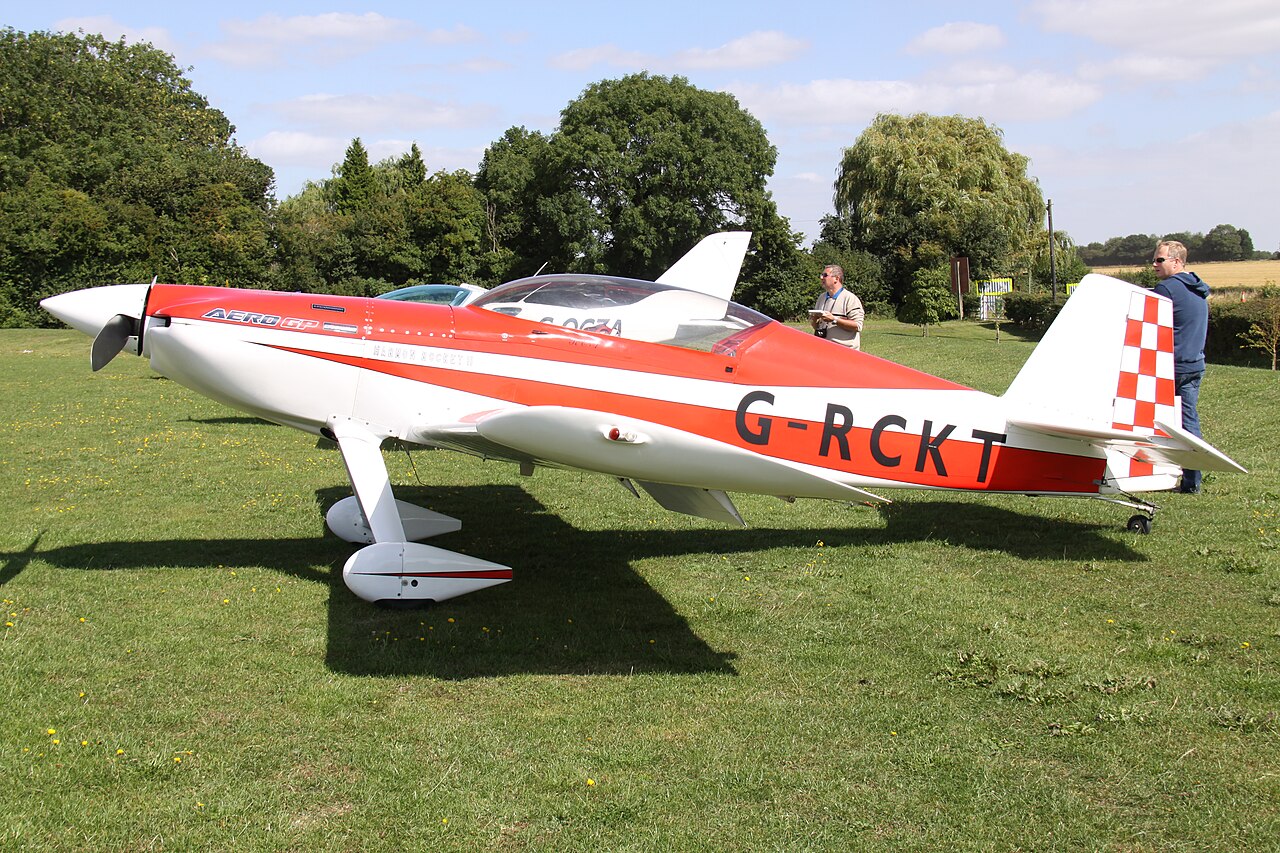
The Harmon Rocket II is what happens when a Van’s RV-4 is given a six-cylinder Lycoming IO-540, a stretched and widened fuselage and clipped wings. The result is a tandem two-seat, all-metal tailwheel sports aeroplane that cruises at around 200 kt and climbs at about 3,000 ft/min, while keeping the friendly handling RV owners know.
It suits an experienced tailwheel pilot who wants serious speed and climb without the cost of a certified high-performance type, and who is happy with a fuel bill to match. In the UK it is very rare: the LAA’s own magazine described G-RCKT as the first and only Rocket in the country when it flight-tested it in 2010. The LAA accepts the type under its type 314 as a Group A aeroplane.
History and design
John Harmon of Bakersfield, California, built several single-seat RV-3s, including a hot-rod version called the Rocket I, before building an RV-4 so his wife could fly with him. He loved the handling but wanted more room and more performance, and in the late 1980s he turned the RV-4 into the Rocket II. The four-cylinder engine Van’s recommends was replaced by an IO-540 swinging an 80 in Hartzell constant-speed propeller, so the main gear legs had to be lengthened; Harmon designed his own titanium legs. The rear fuselage was stretched to restore the centre of gravity, the forward fuselage widened to suit the bigger firewall and cowling, the wing span trimmed by 8 in each side, the integral leading-edge tanks enlarged from 32 to 42 US gallons, and wing ribs moved closer together with thicker skins. A longer, sleeker canopy blends into a fastback turtledeck. (Source: the LAA’s Light Aviation, May 2010.)
There is no complete Rocket kit. The builder buys an RV-4 kit from Van’s, leaving out the parts the Rocket replaces, and buys the conversion parts (canopy, gear legs, engine mount, cowls, bulkheads and skins) from Harmon Rocket. Light Aviation reported that Van’s neither endorses nor criticises the conversion. Harmon says the kit is not a quick-build and suits builders who expect some fitting and trimming.
Variants
Harmon Rocket II (LAA 314): the two-seat RV-4 conversion covered by the LAA. The designer quotes a 250 hp Lycoming IO-540-C4B5 and a 2,000 lb gross weight. The UK example described in Light Aviation has an IO-540 rated at 260 hp.
Harmon Rocket III: a single-seat version listed by the designer with a 400 hp IO-540, 1,800 lb gross and a 310 mph redline. It is not part of the LAA type acceptance list.
Rocket I: Harmon’s earlier single-seat modified RV-3, not LAA-accepted.
Specifications
Figures are the designer’s for the Rocket II with a 250 hp IO-540 and were repeated in the Light Aviation test. Individual aircraft vary with engine, propeller and equipment.
Specification
Imperial
Metric
Wingspan
21 ft 10 in
6.65 m
Length
21 ft 6 in
6.55 m
Height
5 ft 6 in
1.68 m
Wing area
109 sq ft
10.1 m²
Empty weight
1,200 lb
544 kg
Gross weight (designer)
2,000 lb
907 kg
Useful load
800 lb
363 kg
Fuel
42 US gal
159 litres
Engine
Lycoming IO-540-C4B5, 250 hp at 2,575 rpm
Propeller
Hartzell constant-speed, 80 in (2.03 m) diameter
Redline (Vne, true airspeed)
275 mph
239 kt
Cruise, 75% power
230 mph
200 kt
Economy cruise, 55% power
215 mph
187 kt
Stall (designer)
55 mph
48 kt
Rate of climb at gross
3,100 ft/min
15.7 m/s
Performance and handling
Francis Donaldson’s Light Aviation test of G-RCKT found the take-off almost instant and the climb at full throttle around 3,000 ft/min, though at that setting the IO-540 burns over 20 US gallons an hour. Throttling back to 25 in and 2,500 rpm still gave about 1,600 ft/min at 120 kt. Level, the aircraft indicated over 180 kt without trying and over 200 kt at full throttle. The owner cruises at about 175 kt on roughly 15 US gal/hr, or at 130 kt on about 10 US gal/hr for around four hours’ endurance.
The handling is very like an RV, with even crisper roll because of the shorter wing, but pitch is more sensitive two-up and the test warned of pilot-induced oscillation for heavy-handed pilots. Because the 275 mph Vne is a true airspeed, it is easy to exceed at altitude if you fly the indicated figure. The stall was gentle: about 55 kt flapless and 50 kt with full flap on the test aircraft, which is slower than the designer’s 55 mph figure suggests. Approach is flown at about 80 kt and 70 kt over the fence, and the landing roll was around 300 yards in a light wind. The test noted the poor propeller ground clearance, so careful three-point or wheeler landings are needed on grass.
Owning one in the UK
The Rocket is a Group A aeroplane, so you need an NPPL SSEA, LAPL(A) or PPL(A), with tailwheel and variable-pitch propeller differences training. Rockets are amateur-built and fly on an LAA Permit to Fly, revalidated each year after an inspection by an LAA inspector. When G-RCKT was built the design was over the LAA’s then 180 hp power limit and 250 mph Vne limit, so the LAA agreed a special concession with the CAA, and the structure was cleared on the strength of the type’s service history. Light Aviation reported that G-RCKT was restricted to non-aerobatic flight, even though Rockets in the US fly aerobatics, and that several US Rockets had been lost in aerobatic accidents. Check the current Operating Limitations on any aircraft you view.
Running costs are high by LAA standards: the IO-540 is thirsty and needs avgas, and overhauls of the engine and Hartzell propeller are expensive. Parts for the airframe come from Van’s (RV-4 parts) and Harmon Rocket, and engine support is the same as any Lycoming. The LAA’s experience with Van’s types is wide, and you can compare the base aircraft on our Van’s RV-4 and RV-6 pages. Browse aircraft for sale or other LAA aircraft.
Buying checklist
Read the aircraft’s LAA Operating Limitations: Vne, power, weight and whether any aerobatics are permitted.
Check the weight schedule and the maximum weight on the Operating Limitations, which may differ from the designer’s 2,000 lb.
Review the build records for the Van’s RV-4 parts and the Harmon conversion parts, including the titanium gear legs.
Inspect the propeller tips and gear for evidence of prop strikes or heavy landings, given the limited ground clearance.
Check engine and propeller hours and overhaul history; these are the biggest cost items.
Look at the pitch trim system; Light Aviation reported an over-sensitive mechanical trimmer on another Rocket.
LAA type acceptance
The Light Aircraft Association lists these variants under the following type numbers. Check the LAA Type Acceptance Data Sheets (TADS) for the current approved engines, propellers and modifications before you buy.
A two-seat tandem conversion of the Van’s RV-4 with a six-cylinder Lycoming IO-540, a stretched and widened fuselage and clipped wings. It was developed by John Harmon in California in the late 1980s.
What licence do I need to fly one?
An NPPL SSEA, LAPL(A) or PPL(A). You will also need tailwheel and variable-pitch propeller differences training.
Is it on a Permit or a CofA?
Rockets are amateur-built and fly on an LAA Permit to Fly under LAA type 314 (Group A).
How fast is it?
The designer quotes 230 mph (200 kt) at 75% power and 215 mph (187 kt) at 55%. Light Aviation saw over 200 kt indicated at full throttle at low level.
How much fuel does it burn?
Light Aviation reported about 22 US gal/hr at full throttle, about 15 US gal/hr at 175 kt and about 10 US gal/hr at 130 kt.
How many are there in the UK?
Light Aviation said G-RCKT, completed in 2006, was the first and only UK Rocket in 2010. We have not confirmed the current number.
Can I build one in the UK?
There is no complete Rocket kit. You buy an RV-4 kit from Van’s, minus the replaced parts, and the conversion parts from Harmon Rocket. Any UK build must be agreed with the LAA first.
Can it do aerobatics in the UK?
In 2010 the UK example was restricted by the LAA to non-aerobatic flight. Check the Operating Limitations of the individual aircraft.
What is the Vne?
The designer’s redline is 275 mph, which Light Aviation notes is a true airspeed, so the indicated limit falls with altitude.
Can it use a grass strip?
Yes, with care. The Light Aviation test aircraft was based on a long, smooth grass strip, and landing rolls of about 300 yards were seen, but propeller clearance is limited.
Is it good for training?
No. It is a high-performance single-engine tailwheel aircraft with sensitive pitch, best suited to experienced pilots.
Figures are typical published values for a standard example and vary with engine, propeller, build and modification state. Always use the aircraft’s own Pilot’s Operating Handbook, weight and balance schedule and LAA paperwork. Last checked November 2026.