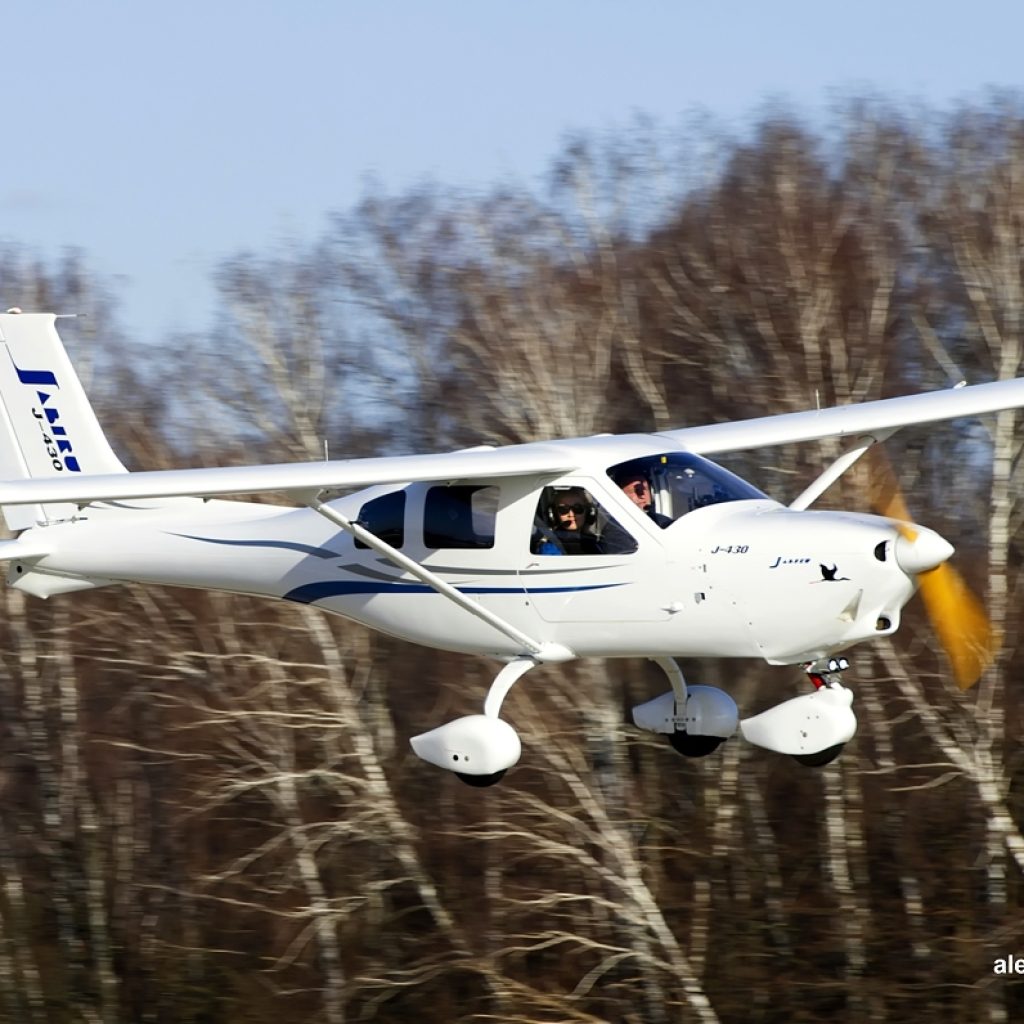
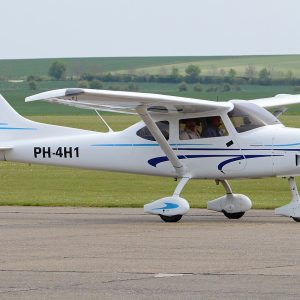
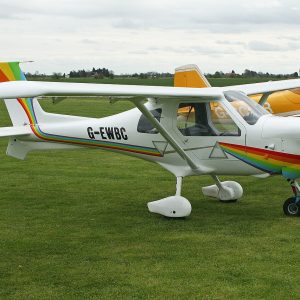
The Jabiru J400 and J430 are four-seat, high-wing composite kit aircraft from Jabiru Aircraft of Bundaberg, Australia, powered by Jabiru’s own six-cylinder 3300 engine of about 120 hp. They are among the very few four-seaters you can build and fly on an LAA Permit in the UK, and they offer four seats for roughly the running cost of a two-seat Permit aircraft.
Both types are LAA Group A, so an NPPL SSEA, LAPL(A) or PPL is enough. They appeal to UK pilots who want an occasional four-seater or a roomy two-seat tourer with baggage space, and who are comfortable with the extra engine care the Jabiru 3300 needs.
History and design
The J400 came first. Jabiru submitted it to the UK’s Popular Flying Association (now the LAA) in January 2002, hoping for its first European approval by the end of that year. At the time the factory sold pre-assembled J400s in Australia and South Africa, but only kits in Europe, because full certification was too expensive. Flight International reported a 700 kg gross weight and a 390 kg useful load for the J400, and a UK distributor, ST Aviation, expected to sell up to 24 kits a year.
The J430 followed as a four-seat version of the two-seat J230, with two rear seats in what had been the baggage area. Kitplanes reported a 44-inch (112 cm) cabin width and about 600 hours of build time for the factory kit, with 25 J430s flying worldwide by the end of 2011. The J430 wing, with winglets, was also used to create Jabiru’s J170 two-seater. The Wikipedia article on the J430 summarises the published data. When Jabiru announced its new European dealership in May 2026, the J430 was still in its range as the four-seat kit.
Variants
Jabiru J400 (LAA 325, Group A): the first four-seat Jabiru kit, powered by the Jabiru 3300. UK examples are advertised with a 700 kg maximum weight.
Jabiru J430 (LAA 336, Group A): the later four-seater derived from the J230, with the Jabiru 3300 and a longer wing with winglets. Published data give a 760 kg gross weight, but UK examples have been advertised at 700 kg. Check the TADS.
J450 (not LAA-listed): a four-seat model with a STOL wing in some markets. It has no separate UK type acceptance.
Specifications
Figures are for the J430, from Kitplanes and Jabiru data via Wikipedia, except where noted. UK limits are set by each type’s LAA TADS, which could not be checked for this guide.
Specification
Imperial
Metric
Wingspan
30 ft 11 in
9.43 m
Length
21 ft 6 in
6.55 m
Height
7 ft 10 in
2.40 m
Wing area
100.5 sq ft
9.34 m²
Cabin width
44 in
112 cm
Empty weight (published)
748 lb
340 kg
Gross weight (published, J430)
1,675 lb
760 kg
Gross weight (J400, Flight International 2002)
1,543 lb
700 kg
Useful load (J400)
860 lb
390 kg
Engine
Jabiru 3300, six-cylinder air-cooled four-stroke, 120 hp (89.5 kW)
Propeller
Two-bladed wood/composite, 1.52 m (5 ft) diameter
Maximum speed
140 kt
256 km/h
Cruise
120 kt
222 km/h
Stall
50 kt
92 km/h
Rate of climb
700 fpm
3.6 m/s
Service ceiling
15,000 ft
4,600 m
Range
800 nm
1,480 km
Load factors
+3.8 g / -1.9 g
Performance and handling
Published data credit the J430 with a 120 kt cruise and an 800 nm range on 120 hp, which makes it a capable tourer for its size and cost. A UK owner selling a 2009 J430 in 2023 described real-world cruising at about 110 kt on around 22 litres an hour, which is a useful guide to what to expect. With four adults aboard, weight and balance decide what you can carry. That seller noted a 120 kg limit on the rear seats and a 366 kg empty weight, which leaves about 334 kg for people, bags and fuel at 700 kg.
The same advert describes a central control column, so check how the aircraft you are viewing is set up if you are used to yokes or dual sticks.
Owning one in the UK
Both types are LAA Group A, flown on a Permit to Fly with annual inspection by an LAA inspector. Flight International noted in 2002 that the UK NPPL covers single-engine piston aircraft up to 2,000 kg, so the J400 and J430 are within its scope, as well as the LAPL(A) and PPL. Permit costs are modest compared with a certified four-seater.
The six-cylinder Jabiru 3300 needs informed care. In July 2025 the LAA published Alert A-08-2025. It covers Gen 4 Jabiru 3300 engines supplied between April 2017 and June 2024 whose crankshafts may have a heat-treatment fault. Under Jabiru bulletin JSB 046 they must be replaced by 15 December 2026 or at 150 hours total time, whichever is later. Earlier, Alert A-03-2025 required pistons in some Gen 4 2200 and 3300 engines (supplied April 2017 to August 2019) to be replaced at or before 200 hours. Jabiru treats both as mandatory. The AAIB’s 2010 report on UK Jabiru exhaust valve failures, on the four-cylinder 2200, linked them to engines running hot, so temperature monitoring matters on the 3300 too.
Jabiru set up Jabiru Europe with JDM Aviation in Darois, France, in May 2026 to handle aircraft, engines, parts and maintenance support across Europe. Look for J400s and J430s in our listings, browse other LAA aircraft, or compare the two-seat Jabiru J160.
Buying checklist
Confirm whether it is a J400 (LAA 325) or J430 (LAA 336), and check the TADS for the UK maximum weight, Vne and approved propeller.
Identify the 3300’s generation and serial number. For Gen 4 engines, check the crankshaft (A-08-2025) and piston (A-03-2025) bulletins have been done or are planned.
Look at engine records for cylinder head and exhaust temperatures, valve work and compressions.
Check that lifed rubber parts, such as hoses and induction couplings, are within their limits and logged.
Get an up-to-date weight and balance and work out real payload with four seats and fuel at the UK maximum weight.
Inspect the composite airframe, gear attachments and wing fittings, and review the build records.
If the aircraft has IFR-style avionics, check what the Permit and TADS actually allow before you rely on them.
LAA type acceptance
The Light Aircraft Association lists these variants under the following type numbers. Check the LAA Type Acceptance Data Sheets (TADS) for the current approved engines, propellers and modifications before you buy.
They are LAA Group A, so an NPPL SSEA, LAPL(A) or PPL with an SEP rating covers them.
Can a J430 be flown on a microlight licence?
No. It is a four-seat Group A aircraft well above the microlight weight limits.
Is it on a Permit or a CofA?
UK J400s and J430s are kit-built and fly on an LAA Permit to Fly.
What is the difference between the J400 and the J430?
The J400 was Jabiru’s first four-seat kit. The J430 is a later four-seat version of the J230 with a longer wing and winglets. Both use the six-cylinder Jabiru 3300.
How fast does a J430 cruise?
Published data give about 120 kt. A UK owner reported about 110 kt at around 22 litres an hour.
What is the maximum take-off weight?
Flight International gave 700 kg for the J400, and UK J430s have been advertised at 700 kg. Published US-market data give 760 kg for the J430. Check the aircraft’s LAA TADS.
Can it really carry four adults?
Only with careful loading. The useful load at 700 kg is limited, and one UK J430 had a 120 kg rear-seat limit, so do a weight and balance for each flight.
Is it good for touring to France?
Published data give an 800 nm range at a 120 kt cruise, which is plenty for Channel crossings and European touring, subject to the aircraft’s Permit limitations.
What engine issues should I know about?
In 2025 the LAA flagged Jabiru bulletins for Gen 4 3300 crankshafts and pistons, which Jabiru treats as mandatory. Check compliance before buying.
Who supports Jabirus in the UK and Europe?
Since May 2026 Jabiru Europe, run with JDM Aviation in France, has been the central dealer for aircraft, engines, parts and support, with existing agents becoming approved maintainers.
Can I build one?
The J430 is sold as a kit, and Kitplanes reported about 600 hours of build time. Check current kit availability with Jabiru Europe.
Figures are typical published values for a standard example and vary with engine, propeller, build and modification state. Always use the aircraft’s own Pilot’s Operating Handbook, weight and balance schedule and LAA paperwork. Last checked November 2026.