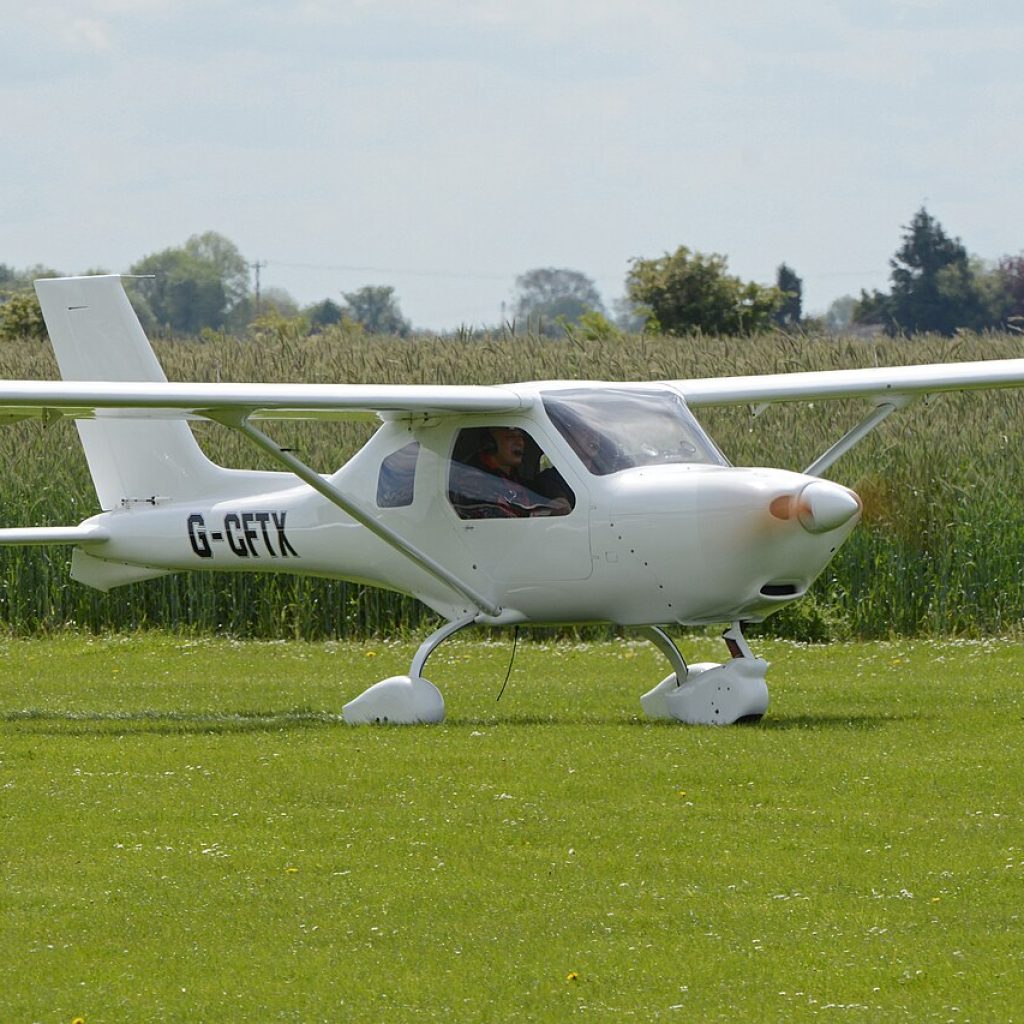
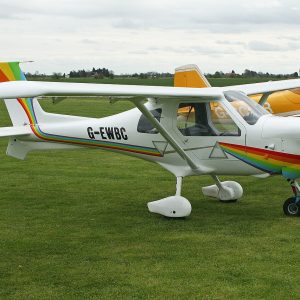
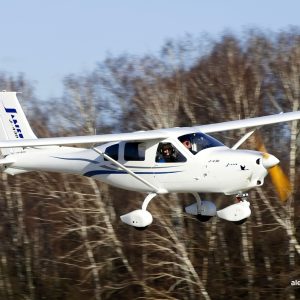
The Jabiru J160 is a two-seat, strut-braced, high-wing composite aircraft from Jabiru Aircraft of Bundaberg, Australia. It was designed mainly for training and recreational flying, and it uses Jabiru’s 80 hp four-cylinder 2200 engine.
In the UK the J160 is an LAA Group A type (TADS 346). At 540 kg it is too heavy for the microlight category, so you need an SEP licence. UK owners like it for its cabin width, its 135-litre fuel load and its economy, and it is one of the cheaper ways into a modern side-by-side tourer on a Permit to Fly.
History and design
Jabiru was set up in Bundaberg in the late 1980s and became known for small composite aircraft and its own air-cooled engines. The J160 is the two-seat trainer in the later Jabiru range. In Australia the factory-built J160-C is certified in the Primary Category by CASA, and its handbook follows the European CS-VLA standard. UK aircraft fly on LAA Permits under type 346. One UK example advertised in 2024 was built in 2008 by a private builder.
The airframe has a composite fuselage, wings and tail, fixed tricycle gear, and forward-hinged doors on each side. Fuel is carried in an integral tank in each wing, feeding a header tank under the baggage shelf behind the seats. Flight controls are conventional and fully duplicated, with flaps. Jabiru later fitted the J430’s longer wing with winglets to the J160 fuselage to create the J170, a 600 kg light-sport model. The J170 is not a separate LAA type. See the Wikipedia article on the J160 for background.
Variants
Jabiru J160 (LAA 346, Group A): the two-seater covered by the UK type acceptance, with the Jabiru 2200 engine and a 540 kg maximum weight.
J160-C: the factory-built Australian model, certified by CASA in the Primary Category. Its handbook is the source of most limitations quoted here.
J160-D: listed by aviation directories as a certified version.
J170 (related): J160 fuselage with the J430 wing and a larger elevator, at 600 kg. It is not listed separately by the LAA.
Specifications
Figures are from the J160-C Pilot’s Operating Handbook (limitations, stall speeds and weights) and from aviation directories via Wikipedia (dimensions, empty weight, fuel and cruise). Check the individual aircraft’s LAA paperwork, because UK kit-built aircraft can differ.
Specification
Imperial
Metric
Wingspan
26 ft 8 in
8.12 m
Wing area
86.5 sq ft
8.04 m²
Empty weight
661 lb
300 kg
Maximum take-off weight
1,190 lb
540 kg
Fuel capacity
30 imp gal
135 litres
Engine
Jabiru 2200B or 2200C, four-cylinder air-cooled, 80 bhp at 3,300 rpm
Propeller
Two-bladed wooden, fixed pitch
Vne
140 kt IAS
259 km/h
Vno (max structural cruise)
112 kt IAS
207 km/h
Vfe (max flap)
84 kt IAS
156 km/h
Cruise
100 kt
185 km/h
Stall, full flap, 540 kg
45 kt CAS (50 kt IAS)
83 km/h CAS
Stall, flaps up, 540 kg
53 kt CAS (60 kt IAS)
98 km/h CAS
Best rate of climb speed
68 kt IAS
126 km/h
Max demonstrated crosswind
14 kt
26 km/h
Performance and handling
On 80 hp the J160 is credited with a cruise of around 100 kt, and UK owners advertising their aircraft describe cruising at 90–100 kt. The handbook gives a best-climb speed of 68 KIAS and a full-flap stall of 45 KCAS at maximum weight. Stalls are allowed up to 60° of bank, but aerobatics and spins are prohibited. Maximum demonstrated crosswind is 14 kt.
Cabin noise is high: the handbook says it exceeds 95 dB and hearing protection must be worn. The handbook also limits operation to ambient temperatures up to 38°C. That is rarely a factor in the UK, but it shows how Jabiru’s air-cooled engines are sensitive to heat.
Owning one in the UK
The J160 is LAA Group A, so you need an NPPL SSEA, LAPL(A) or PPL with an SEP rating. It flies on a Permit to Fly with an annual inspection by an LAA inspector. Permit costs are modest compared with a CofA aircraft.
The J160-C handbook strongly recommends avgas, with mogas allowed under conditions on octane and ethanol content. UK owners also report using UL91. Engine care is the main ownership issue for any Jabiru. The AAIB’s 2010 report on UK Jabiru 2200 exhaust valve failures linked them to engines running hot on lean carburettor jets, which Jabiru replaced with richer jets in 2007. In 2025 the LAA issued Alert A-03-2025 on pistons in some Gen 4 Jabiru 2200 engines supplied between April 2017 and August 2019, to be replaced at or before 200 hours. A 2023 AAIB investigation into another Jabiru found an over-age carburettor-to-plenum coupling, which led to CAA and LAA work on tracking lifed parts.
For support, Jabiru created Jabiru Europe with JDM Aviation in France in May 2026, and existing European agents are becoming approved maintainers. UK sellers name Skycraft as the UK Jabiru agent. See J160s in our listings, other LAA aircraft, the earlier Jabiru SK, SP and UL, or the four-seat J400 and J430.
Buying checklist
Confirm the aircraft is registered as LAA type 346 and check the current TADS for UK limitations and approved engine and propeller.
Find the engine serial and generation. On a Gen 4 2200, check compliance with the Jabiru piston bulletin behind LAA Alert A-03-2025.
Review engine records for cylinder head temperatures, valve work and carburettor jetting. Overheating caused the UK valve failures.
Check that rubber parts, especially the carburettor-to-plenum coupling, are within their life limits and logged.
Get an actual weight and balance. Payload at 540 kg depends on equipment fitted.
Inspect the composite structure and gear legs, and check for repairs.
Check the builder’s records and permit history, and whether any autopilot or avionics changes have LAA approval.
LAA type acceptance
The Light Aircraft Association lists these variants under the following type numbers. Check the LAA Type Acceptance Data Sheets (TADS) for the current approved engines, propellers and modifications before you buy.
It is an LAA Group A aircraft, so you need an NPPL SSEA, LAPL(A) or PPL with an SEP rating.
Can I fly a J160 on a microlight licence?
No. Its 540 kg maximum weight puts it outside the UK microlight category.
Is the J160 on a Permit or a CofA?
UK J160s fly on an LAA Permit to Fly under type acceptance 346. In Australia the factory-built J160-C is certified in the Primary Category.
How fast is the J160?
It is credited with a cruise of about 100 kt on 80 hp, and UK owners describe cruising at 90–100 kt. Vne is 140 kt IAS.
What engine does it have?
The four-cylinder, air-cooled Jabiru 2200 rated at 80 bhp at 3,300 rpm.
What fuel does it use?
The J160-C handbook strongly recommends avgas and allows mogas under conditions on octane and ethanol content. Check the TADS and engine documentation for UK-approved grades.
How much fuel does it carry?
135 litres in two integral wing tanks, feeding a header tank behind the seats.
Is it good for training?
It was designed mainly for training and recreational use, with dual controls and benign stall speeds. Training on an LAA Permit aircraft in the UK is subject to LAA rules, so check them before planning to use one for instruction.
Can it do aerobatics or spins?
No. The handbook prohibits all aerobatic manoeuvres, including spins.
What are the main engine issues to check?
UK Jabiru 2200s suffered exhaust valve failures in 2007–2008 from overheating, and in 2025 the LAA flagged a piston bulletin for some Gen 4 engines. Check bulletin compliance, temperature records and lifed rubber parts.
Who supports the J160 in the UK?
Jabiru set up Jabiru Europe in France in 2026, with existing agents becoming approved maintainers. UK sellers refer to Skycraft as the UK Jabiru agent.
Figures are typical published values for a standard example and vary with engine, propeller, build and modification state. Always use the aircraft’s own Pilot’s Operating Handbook, weight and balance schedule and LAA paperwork. Last checked November 2026.