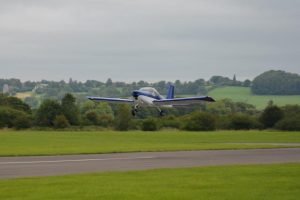
The Van’s RV-12 is a two-seat, low-wing, all-aluminium kit aircraft from Van’s Aircraft of Oregon, the company behind the best-selling RV series. Unlike the earlier RVs, it was conceived as a complete package: airframe, Rotax engine, propeller, avionics and wiring all come from Van’s and are assembled to a tightly defined standard. The current version, the RV-12iS, accepts either the carburetted Rotax 912 ULS or the fuel-injected Rotax 912 iS, both rated at 100 hp.
For UK pilots it offers a modern, well-documented Permit aircraft with a 117 kt cruise, removable wings and an unusually complete set of manuals and service information. It suits first-time builders who want a proven, prescriptive build, and owners looking for an economical tourer or a group aircraft. It is a Group A (SEP) type in the UK, not a microlight, so it needs an aeroplane licence rather than an NPPL(M).
History and design
The prototype first flew on 9 November 2006, partial kits shipped from 2008 and complete kits followed later that year. Van’s designed the RV-12 to fit the US Light Sport rules, so it is a little lighter and slower than the RV-7 or RV-9. The RV-12iS arrived in 2017 with a new cowling, electrically operated flaps, a centre console, a relocated fuel tank directly behind the seats and the option of the injected engine. Van’s moved production of factory-built examples in-house in 2018, and around 800 had been completed by mid-2023.
Structurally it is conventional stressed aluminium. The two-piece wings use a single spar and full-span flaperons, which droop together for take-off and landing while still providing roll control. The wings are designed to be rigged and de-rigged quickly, with automatic control connections and a warning system that prevents the starter working if the wing pins are not in place. An all-moving stabilator with an anti-servo tab gives pitch control, the main gear is a cantilever leaf spring and the nosewheel castors.
The LAA stresses that the RV-12 design is defined in great detail by Van’s, so any deviation from the plans counts as a modification. It also notes that sourcing the engine anywhere other than Van’s creates a lot of extra work, because the firewall-forward kit is matched to the US-specification engine Van’s supplies.
Variants
RV-12: the original kit with the carburetted Rotax 912 ULS, a mechanically operated flap lever and the fuel tank in the baggage area.
RV-12iS: the 2017 update with Rotax 912 ULS or 912 iS, electric flaps, a centre console and a redesigned tank. The LAA TADS notes that the iS is designated type 363A in its records, even when fitted with the ULS.
Both are covered by LAA type 363 with a maximum total weight of 600 kg in the UK. Avionics are Dynon SkyView or Garmin G3X packages supplied by Van’s, with optional autopilots.
Specifications
Specification
Imperial
Metric
Wingspan
26 ft 9 in
8.15 m
Length
19 ft 11 in
6.07 m
Height
8 ft 4 in
2.54 m
Wing area
127 sq ft
11.8 m²
Empty weight (with options, Van’s figure)
775 lb
352 kg
Maximum take-off weight (UK)
1,320 lb
600 kg
Useful load (from figures above)
545 lb
248 kg
Baggage
75 lb
34 kg
Fuel capacity
20 US gal
76 litres
Engine
Rotax 912 ULS or 912 iS, 100 hp
Propeller
Sensenich composite, ground-adjustable
Vne
136 KIAS
252 km/h
Cruise (5,500 rpm, 7,500 ft)
117 kt (135 mph, 912 iS)
217 km/h
Stall (flaps down)
41 kt (47 mph)
76 km/h
Rate of climb
1,000 ft/min (912 iS); 900 ft/min (912 ULS)
5.1 m/s; 4.6 m/s
Range, 5,500 rpm (912 iS)
505 nm (581 statute miles)
935 km
Range, 5,000 rpm (912 iS)
573 nm (660 statute miles)
1,062 km
Take-off distance
700 ft
213 m
Landing distance
525 ft
160 m
Performance and handling
Van’s quotes a cruise of 135 mph (about 117 kt) at 5,500 rpm and 7,500 ft for the injected engine, with the carburetted ULS within a mile an hour of that. Throttling back to 5,000 rpm costs around 14 mph but stretches the range to over 570 nm, which makes cross-Channel and longer UK touring legs realistic. The 912 iS version also climbs better, at about 1,000 ft/min against 900 ft/min for the ULS.
The flaperon layout gives a low stall speed of around 41 kt for a 100 hp metal aircraft, and take-off and landing distances of 700 ft and 525 ft are comfortable for most UK grass strips. The UK operating limitations set Vne at 136 KIAS, Vno at 108 KIAS, flap-extended speed at 82 KIAS and manoeuvring speed at 90 KIAS. Aerobatics and intentional spinning are prohibited, and flight is restricted to day VFR. The LAA notes that the stall warner may need adjusting so that it triggers 4 to 12 kt above the stall.
Owning one in the UK
The RV-12 flies on an LAA-administered Permit to Fly. You need a licence with single-engine piston privileges, such as an NPPL SSEA, LAPL(A) or PPL(A). Each year the aircraft needs an inspection by an LAA inspector and a Permit revalidation through the LAA; costs are generally modest compared with a certified aircraft, but budget for the LAA fees, the inspection and any parts. Owners can do much of their own maintenance under LAA oversight, using Van’s comprehensive Maintenance Manual or a customised LAA generic schedule.
The Rotax 912 ULS and 912 iS are designed to run on unleaded mogas or avgas; Van’s has issued service information about ethanol in fuel, so check the current guidance before using forecourt fuel. Removable wings make trailering or tighter storage possible, though most owners hangar the aircraft. Insurance is usually straightforward for a modern Group A type with tricycle gear; ask a UK aviation broker for a quote based on your hours.
There are no type-specific LAA Mandatory Permit Directives. The only LAA-required change has been the fitting of a back-up compass, ASI and altimeter alongside the EFIS. Van’s supports the RV-12 almost like a certified type and has published a long list of service bulletins, including nose gear leg and nose fork replacement, throttle return springs, carburettor floats, Sensenich propeller inspection, engine mount standoffs and exhaust inspection. There is no UK agent: parts come direct from Van’s, and the UK owners’ group is the RV Squadron, contactable via rvuk.co.uk. Read the Van’s RV-12iS page and the LAA type acceptance data sheet (TADS 363) before you buy. Browse current listings or other LAA aircraft, and compare with the Van’s RV-9 if you want more speed.
Buying checklist
Confirm whether it is an original RV-12 or an RV-12iS, and which engine is fitted (912 ULS or 912 iS).
Ask for a list of Van’s service bulletins and notifications complied with, especially nose gear leg and nose fork, throttle springs, carburettor floats and engine mount standoffs.
Check that the wing pin warning system works and that the starter is inhibited when a pin is out.
Look for any deviations from the Van’s plans; anything non-standard should be covered by an approved LAA modification.
Check the propeller inspection history against the Sensenich bulletins and that the prop has been dynamically balanced if required.
Inspect the stabilator, anti-servo tab and their bearings for cracks or wear.
Confirm that the back-up compass, ASI and altimeter required by the LAA are fitted.
Review the Rotax engine log for hours, service bulletin compliance and any history of throttle creep.
LAA type acceptance
The Light Aircraft Association lists these variants under the following type numbers. Check the LAA Type Acceptance Data Sheets (TADS) for the current approved engines, propellers and modifications before you buy.
What licence do I need to fly a Van's RV-12 in the UK?
It is a Group A (SEP) aeroplane in the UK, so you need a licence with single-engine piston privileges, such as an NPPL SSEA, LAPL(A) or PPL(A). It is not a microlight.
Is the RV-12 on a Permit to Fly or a CofA?
UK-built RV-12s fly on an LAA-administered Permit to Fly under LAA type 363. The aircraft must be revalidated each year after an inspection by an LAA inspector.
What is the UK maximum take-off weight?
The LAA operating limitations set a maximum total weight of 600 kg for the RV-12 and RV-12iS.
How fast does it cruise?
Van’s quotes 135 mph, about 117 kt, at 5,500 rpm and 7,500 ft with the 912 iS. Pulling back to 5,000 rpm gives about 105 kt and better range.
How far can it go on a tank?
With 20 US gallons (76 litres), Van’s quotes 581 statute miles at 5,500 rpm and 660 statute miles at 5,000 rpm, roughly 505 to 573 nm. That is plenty for a Channel crossing and onward touring.
Which engine is better, the 912 ULS or 912 iS?
Both give 100 hp. Van’s figures show the injected 912 iS climbing slightly better (1,000 against 900 ft/min) and offering a little more range, while cruise speeds are almost identical.
Can I build an RV-12 in the UK?
Yes. The LAA accepts the standard Van’s kit as meeting the 51% major portion rule, and build inspections are carried out by an LAA inspector. There is no UK agent, so the kit is ordered direct from Van’s.
Is it aerobatic?
No. The UK operating limitations prohibit aerobatic manoeuvres and intentional spinning. If you want an aerobatic Van’s, look at the RV-4, RV-7 or RV-8.
Can it fly at night or in IMC?
Not under the standard LAA Permit. The operating limitations restrict it to day VFR.
Who supports the RV-12 in the UK?
Van’s Aircraft supports it directly and publishes extensive service information. The UK RV owners’ group, the RV Squadron, is a useful source of advice, and the LAA publishes TADS 363 for the type.
Can I take the wings off?
Yes. The wings are designed for quick rigging and de-rigging, with automatic control connections and a wing pin warning system.
Figures are typical published values for a standard example and vary with engine, propeller, build and modification state. Always use the aircraft’s own Pilot’s Operating Handbook, weight and balance schedule and LAA paperwork. Last checked November 2026.