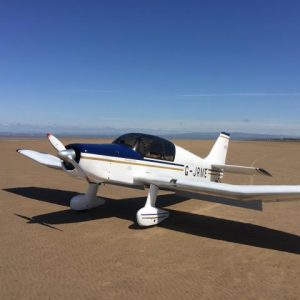
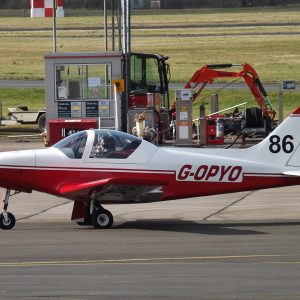
The Jodel D.140 Mousquetaire is the big Jodel: a four-seat, 180 hp, low-wing tourer built of wood, with the family’s cranked wing and a tailwheel. It first flew in 1958 and became a favourite with French flying clubs and the French Air Force, thanks to a useful load roughly equal to its empty weight. In the UK it is an LAA-accepted Group A type (251), and amateur-built examples fly on LAA Permits to Fly.
It suits pilots who want to carry three passengers, or two plus luggage, a long way from grass strips at around 120 kt, in a classic wooden aeroplane. It is a lot of aircraft for the money, but it needs tailwheel skill and careful care of the wooden structure. See current examples in our aircraft listings or other LAA aircraft.
History and design
Société Aéronautique Normande (SAN) at Bernay, which built the two-seat Jodel D.117 under licence, developed the larger D.140 from it. The prototype, F-BIZE, first flew on 4 July 1958 with a 180 hp Lycoming O-360. SAN built 243 aircraft across the D.140A, B, C and E and the D.140R Abeille glider tug, and more than 20 have been homebuilt from plans. The French Air Force ordered both the D.140E and the D.140R, and Avions Jodel notes the Abeille was used for pilot training and glider towing. The type is popular for mountain flying and can be fitted with skis.
The fuselage is wood with full plywood skinning and Dacron covering, built on nine frames. The one-piece wing has a single box spar, truss ribs with plywood gussets, and metal-framed flaps, all covered in Dacron. The elevator is an all-moving (monobloc) surface. Controls are cable-operated with full dual controls. The 1.12 m wide cabin has two baggage holds. The tailwheel undercarriage uses rubber shock absorbers and hydraulic drum or disc brakes. Fuel is in a 90-litre front tank and a 125-litre rear tank, with an optional extra 45-litre front tank.
Variants
D.140 (LAA 251): the prototype, Lycoming O-360 of 180 hp.
D.140A: the first production version, with cabin ventilation (45 built). It is not named in the LAA row, so check its paperwork.
D.140B Mousquetaire II (LAA 251): better brakes, a new cowling and better ventilation (56 built).
D.140C Mousquetaire III (LAA 251): a D.140B with an enlarged swept tail (70 built).
D.140D (LAA 251): listed by the LAA. We couldn’t confirm how it differs, so check the aircraft’s records.
D.140E Mousquetaire IV (LAA 251): a further enlarged tail, modified ailerons and an all-flying tailplane (43 built). Avions Jodel’s current plans are for the D.140E and D.140R.
Not on the LAA row: the D.140R Abeille glider tug, with a cut-down rear fuselage and high-visibility canopy (28 built).
Specifications
Figures are Avions Jodel’s D.140E data with the 180 hp O-360, cross-checked against Jane’s 1962–63 data for the D.140 (via Wikipedia). Where the two differ, both are shown. We found no LAA data sheet for type 251, so check the individual aircraft’s operating limitations.
Specification
Imperial
Metric
Wingspan (Avions Jodel / Jane’s)
33 ft 8 in / 33 ft 6 in
10.27 / 10.22 m
Length (Avions Jodel / Jane’s)
26 ft 0 in / 25 ft 11 in
7.92 / 7.90 m
Height
7 ft 0 in
2.13 m
Wing area (Avions Jodel / Jane’s)
199 / 193 sq ft
18.5 / 17.9 m²
Cabin width
44 in
1.12 m
Empty weight (Avions Jodel D.140E / Jane’s D.140)
1,345 / 1,455 lb
610 / 660 kg
Maximum weight (both sources)
2,646 lb
1,200 kg
Useful load (Avions Jodel)
1,301 lb
590 kg
Fuel (front + rear tanks)
47 imp gal
215 litres (90 + 125)
Optional extra front tank
10 imp gal
45 litres
Engine (both sources)
Lycoming O-360, 180 hp (200 hp Lycoming also offered)
Vne (Avions Jodel)
157 kt
290 km/h
Maximum speed (Avions Jodel / Jane’s)
140 / 135 kt
260 / 250 km/h
Cruise (Avions Jodel / Jane’s economy)
124 / 119 kt
230 / 220 km/h
Climb (Jane’s)
985 ft/min
5.0 m/s
Service ceiling (Jane’s)
14,800 ft
4,500 m
Take-off run (Avions Jodel)
886 ft
270 m
Landing run (Avions Jodel)
394 ft
120 m
Range (both sources)
648 nm
1,200 km
Performance and handling
With 180 hp the Mousquetaire cruises at about 120–124 kt and, on both sets of figures, has a range of around 1,200 km. That makes it a real tourer that can reach most of France or beyond from southern England without refuelling, once you allow for reserves. Avions Jodel’s 590 kg useful load against a 610 kg empty weight is the headline: it can lift four people and fuel, though you will need to do the weight and balance for each flight.
The short take-off and landing runs (270 m and 120 m on the manufacturer’s figures) suit grass strips, and Avions Jodel describes it as a strong choice for mountain flying. As a heavy taildragger it needs current tailwheel skills and good crosswind technique.
Owning one in the UK
Licence: a Group A type, so an NPPL SSEA, LAPL or PPL, plus tailwheel differences training. Check your licence’s privileges for carrying passengers.
Permit or CofA: the D.140 is LAA-accepted (type 251), and amateur-built examples fly on an LAA Permit with annual inspection by an LAA inspector. Factory-built SAN aircraft may be on a Permit or a certificate of airworthiness, so check which applies to the aircraft you are looking at.
Engine and fuel: most have the 180 hp Lycoming O-360. Check the approved fuels for the engine fitted.
Hangarage: it is a large wooden aircraft with a one-piece wing, so you need a full-size dry hangar.
Parts and support:Avions Jodel in Corgoloin, France, sells the original D.140E/R plans (139 drawings, with 3,000–3,500 build hours quoted) and spare parts. More history is on Wikipedia.
Related types: see the two-seat Jodel D11 and D119 or the Jodel D150 Mascaret.
Buying checklist
Confirm the variant (D.140, B, C, D or E), whether it is factory-built or amateur-built, and whether it is on a Permit or CofA.
Have an inspector with wooden-aircraft experience check the box spar, glue joints, plywood skins and Dacron covering.
Check the empty weight and weight-and-balance report. The useful load is the reason to buy one.
Inspect the tailwheel undercarriage, rubber shock absorbers and brakes, which work hard on a heavy taildragger.
Check all fuel tanks, lines and the selector, especially if the optional extra tank is fitted.
Review the Lycoming O-360’s hours, overhaul history and any applicable engine ADs.
Ask about storage history. Wooden airframes kept outside deteriorate faster.
LAA type acceptance
The Light Aircraft Association lists these variants under the following type numbers. Check the LAA Type Acceptance Data Sheets (TADS) for the current approved engines, propellers and modifications before you buy.
It is an LAA Group A aeroplane, so an NPPL SSEA, LAPL or PPL, plus tailwheel differences training.
How many seats does the Mousquetaire have?
Four. Avions Jodel describes it as a four-seater with two baggage holds.
Is it on a Permit or a CofA?
The type is LAA-accepted (type 251), and amateur-built examples fly on LAA Permits. Factory-built SAN aircraft may be on a Permit or a CofA, so check the individual aircraft.
What engine does it have?
Usually a 180 hp Lycoming O-360. Avions Jodel also lists a 200 hp Lycoming.
How fast is it?
Avions Jodel gives a 230 km/h (124 kt) cruise and a 290 km/h (157 kt) Vne with the 180 hp O-360.
How far can it fly?
Both Avions Jodel and Jane’s give about 1,200 km (648 nm), before reserves. It has 215 litres in two tanks, plus an optional 45-litre tank.
What can it carry?
Avions Jodel quotes a 590 kg useful load against a 610 kg empty weight and a 1,200 kg maximum, but always work out the weight and balance for the individual aircraft.
Is it good for grass strips?
Yes. The manufacturer quotes a 270 m take-off run and 120 m landing run, and the type is well known for mountain flying.
Can I build one?
Yes. Avions Jodel sells the original D.140E/R plans, 139 drawings, and quotes 3,000–3,500 hours to build.
Where do I get parts?
Avions Jodel in France supplies plans and spare parts.
Is the D140 aerobatic?
We found no sourced aerobatic clearance. It is a touring and towing aircraft.
Figures are typical published values for a standard example and vary with engine, propeller, build and modification state. Always use the aircraft’s own Pilot’s Operating Handbook, weight and balance schedule and LAA paperwork. Last checked November 2026.