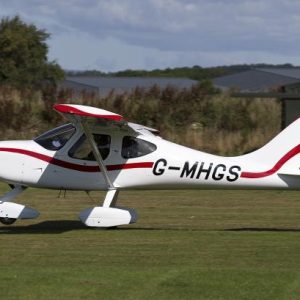
The Tecnam P92 is a strut-braced, high-wing two-seater from Italy, built in large numbers since the 1990s. In the UK it appears on the LAA fleet as an amateur-built kit aircraft in two main forms: the Jabiru-powered P92-EM Echo, which qualifies as a microlight, and the Rotax-powered P92-EA Echo Super, which is a Group A aeroplane.
It suits pilots who want a simple, stable, high-wing aircraft with good visibility downwards, easy door access and the backing of a major manufacturer. It is a relatively rare type in the UK: the LAA says there are nearly twenty P92s of various kinds in its fleet and Tecnam no longer produces the kits, so buyers need to check carefully which variant, engine and weight a particular aircraft has.
History and design
The P92 was designed by Luigi Pascale and first flew at Capua on 14 March 1993, originally for the Italian ultralight category. It has since been built in many versions, from 450 kg ultralights to the JAR-VLA certified P92-J and US light sport models, with more than 2,500 delivered by 2018. The current factory model is the P92 Echo MkII.
The LAA describes a mixed structure: an aluminium-clad welded steel tube truss for the forward fuselage, a riveted aluminium monocoque rear fuselage and a composite rear turtledeck. The single-spar, all-aluminium wings are braced by one strut each side and carry a 35-litre fuel tank in each leading edge root. The ailerons and flaps are slotted, with piano-hinged tops that give strong aerodynamic balance, and the flaps are electrically operated. Pitch control is by an all-flying stabilator with an electric trim tab. The main gear legs are cantilever springs and the steerable nose leg is a rubber-sprung trailing link. The propeller is a fixed-pitch wooden design by GT Tonini.
Variants
P92-EM Echo (LAA 318, microlight): the UK kit, lightened to meet microlight rules at 450 kg. It uses a Jabiru 2200A 80 bhp air-cooled engine instead of a Rotax, glass-fibre main legs, fabric-covered ailerons and flaps, an aluminium wing leading edge and no interior trim, spats, landing light or electric fuel pump. Maximum empty weight is 268 kg.
P92-EM Echo (modified): a few have been converted to the Rotax 912 ULS 100 bhp. They then become Group A aircraft at 535 kg, with a stainless steel firewall, new engine mount and cowlings, steel main legs and a rudder mass balance.
P92-EA Echo: the Group A kit version with steel main gear. The LAA’s example limitations show 500 kg with the Jabiru 2200A; one aircraft has a UL Power 260i at 535 kg.
P92-EA Echo Super (LAA 318A, Group A): a kit version of the certified P92-JS with a Rotax 912 ULS 100 bhp, fuel gauges in the panel, an electric boost pump and a 550 kg maximum weight.
Specifications
UK weights, fuel and speed limits are from the LAA. Performance figures are from an AOPA test of a US-registered Echo Super at its US 1,320 lb gross weight, so treat them as a guide only for UK aircraft.
Specification
Imperial
Metric
Maximum take-off weight, P92-EM (Jabiru)
992 lb
450 kg
Maximum take-off weight, P92-EA (Jabiru)
1,102 lb
500 kg
Maximum take-off weight, EM modified / EA UL Power
1,180 lb
535 kg
Maximum take-off weight, Echo Super
1,212 lb
550 kg
Maximum empty weight, P92-EM microlight
591 lb
268 kg
Baggage
44 lb
20 kg
Fuel capacity
15.4 imp gal
70 litres (2 x 35)
Engine, P92-EM
Jabiru 2200A, 80 bhp
Engine, Echo Super
Rotax 912 ULS, 100 bhp
Propeller
GT Tonini fixed-pitch wood (Hercules propellers also used on the LAA fleet)
Vne, Echo (EM and EA)
113 KIAS (130 mph)
209 km/h
Vne, Echo Super
121 KIAS (139 mph)
224 km/h
Vno, Echo / Echo Super
95 KIAS / 106 KIAS
176 km/h / 196 km/h
Flap limiting speed, Echo / Echo Super
60 KIAS / 68 KIAS
111 km/h / 126 km/h
Cruise, 75% power (US Echo Super)
112 kt
207 km/h
Stall, landing configuration (US Echo Super)
35 KIAS
65 km/h
Rate of climb (US Echo Super)
1,067 ft/min
5.4 m/s
Take-off ground roll (US Echo Super)
590 ft
180 m
Landing ground roll (US Echo Super)
328 ft
100 m
Performance and handling
AOPA’s test of a US Echo Super quoted a 75% power cruise of 112 kt from the spec sheet, with the test text suggesting up to 116 kt, a stall of 35 KIAS in landing configuration and a climb of just over 1,000 ft/min. The testers found it stable, friendly and easy to fly, with enough drag from the struts that it slows quickly when the power comes off, which is helpful in the circuit. They saw it more as a trainer than a long-range tourer. Note that UK Echo Supers are limited to 550 kg, whereas the tested US aircraft was rated at 600 kg.
The Jabiru-powered P92-EM is a different proposition, with 80 bhp and a 450 kg limit; no verified cruise figure for that version was found. UK Vne is 113 KIAS for the Echo and 121 KIAS for the Echo Super. All versions are non-aerobatic with no intentional spinning, and the microlight EM is cleared for steep turns up to 60 degrees of bank. Flight is day VFR only.
Owning one in the UK
The licence you need depends on the version. The Jabiru P92-EM at 450 kg is a microlight, which can be flown on an NPPL with a microlight rating; the EA, modified EM and Echo Super are Group A aircraft and need an NPPL SSEA, LAPL(A) or PPL(A). All are on an LAA-administered Permit to Fly, revalidated yearly after an inspection by an LAA inspector, so running costs are modest compared with a certified P92-J.
The Rotax 912 ULS runs on mogas or avgas; the original UK agent issued a service bulletin on using mogas in the Jabiru engine, so check the engine’s documentation. Tecnam’s authorised UK parts agent is Oriens Aviation at Biggin Hill, and Tecnam service bulletins are free to download; the LAA advises checking all P92 bulletins because the UK variants may not be named specifically. There are no type-specific LAA Mandatory Permit Directives, but a series of LAA-required modifications covers seat stop bolts, the lap strap attachment, the door latch, cowling latch placards, aileron pushrod reinforcement, fuel finger strainers, aircraft turnbuckles, engine mount washers, rod-end safety washers, pulley shields, a starter warning light and improved harnesses. The fibreglass main legs are no longer available, so replacement means heavier steel legs. A Light Aviation Safety Spot (October 2011) covered leaks from the original composite fuel tanks.
Establish exactly which variant it is (EM, modified EM, EA or Echo Super), the engine fitted and the maximum weight on the Operating Limitations.
On a microlight EM, check the empty weight against the 268 kg maximum and look for weight growth from added equipment.
Confirm the LAA-required modifications have been embodied and recorded.
Inspect the composite wing tanks for leaks, or confirm a recorded tank modification.
Check that the main gear legs are tight in their clamps, and whether fibreglass legs are still serviceable.
Check rod-end lock nuts and witness marks in the nosewheel steering, aileron, elevator and flap systems, and the stabilator attachment bolts.
For Jabiru engines, review the engine logbook and compliance with the UK service bulletins, including the distributor rotor arm bulletin.
Ask which P92 flight and maintenance manuals are held, as modified aircraft may differ from the Jabiru manuals supplied with the kit.
LAA type acceptance
The Light Aircraft Association lists these variants under the following type numbers. Check the LAA Type Acceptance Data Sheets (TADS) for the current approved engines, propellers and modifications before you buy.
Can I fly a Tecnam P92 Echo on a microlight licence?
Only the Jabiru-powered P92-EM Echo at 450 kg is a microlight. The EA, the Rotax-converted EM and the Echo Super are Group A aircraft that need an NPPL SSEA, LAPL(A) or PPL(A).
Is the P92 Echo on a Permit or a CofA?
The UK kit versions fly on an LAA-administered Permit to Fly under types 318 and 318A. The factory P92-J is a separate certified version.
What engines are fitted?
The P92-EM was supplied with a Jabiru 2200A of 80 bhp. The Echo Super uses a Rotax 912 ULS of 100 bhp, and some EMs have been converted to the Rotax. One EA has a UL Power 260i.
What is the maximum take-off weight?
450 kg for the microlight P92-EM, 500 kg for the Jabiru-powered EA, 535 kg for Rotax-converted EMs and the UL Power EA, and 550 kg for the Echo Super.
How much fuel does it carry?
Two 35-litre wing root tanks, 70 litres in total.
How fast does it cruise?
An AOPA test of a US Echo Super quoted 112 kt at 75% power. No verified cruise figure was found for the Jabiru-powered EM.
Can I still buy a new P92 kit?
No. The LAA notes that Tecnam no longer produces the P92 kits, so UK examples are second-hand.
Who supports the P92 in the UK?
Tecnam’s authorised UK parts agent is Oriens Aviation at London Biggin Hill. Tecnam’s service bulletins are free to download, and the LAA publishes TADS 318/318A.
Is it a good trainer?
AOPA’s testers found the Echo Super stable, approachable and well suited to primary training, with the strut drag helping students manage speed in the circuit.
Is the P92 aerobatic?
No. Aerobatics and intentional spinning are prohibited on all UK versions.
Are spare parts a problem?
Some kit-specific parts have gone: the LAA notes the fibreglass main gear legs are no longer available from Tecnam, so steel legs are the only replacement, with a weight penalty.
Figures are typical published values for a standard example and vary with engine, propeller, build and modification state. Always use the aircraft’s own Pilot’s Operating Handbook, weight and balance schedule and LAA paperwork. Last checked November 2026.