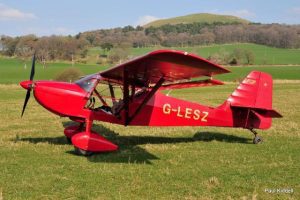
The Supermarine Aircraft Spitfire is an all-metal, two-seat scale replica of the wartime fighter, sold as a kit. The Mk26 has an 80% scale fuselage and the later Mk26B a 90% scale fuselage, both on the smaller wing of the single-seat Mk25. Kits are riveted aluminium, with retractable undercarriage and usually a water-cooled automotive engine in the nose; Kitplanes reported the Isuzu V6 was popular with British customers.
For UK pilots the attraction is obvious: the shape, the sound and the presence of a Spitfire on a Permit to Fly budget, with a rear seat for a passenger. It is a demanding build and a demanding aircraft, though, and recent UK accidents and an LAA directive mean buyers need to do their homework on the individual aircraft.
History and design
Australian pilot and engineer Mike O’Sullivan built his first replica for his own use in 1991, and a Rotax-powered prototype flew in November 1994. In 1995 he and John McCarron formed Supermarine Aircraft to sell kits. The company was not related to the original British Supermarine, although it had permission to use the name, and it later moved its factory to Cisco, Texas. About 100 aircraft of all marks had been completed by December 2011, and the LAA accepted the type in the UK.
The structure is built by riveting aluminium alloy skins onto pre-formed frames, ribs and longerons, and the wing form and tail mirror the original Spitfire apart from their size. The kit uses pull rivets extensively, needs metalworking skills, and the factory estimated around 1,200 hours of builder work. On G-CLHJ, the water-cooled V6 used a radiator under each wing.
Variants
Mk25: the original 75% scale single-seater, not part of LAA type 324 and no longer produced.
Mk26 (LAA 324): a two-seater with the fuselage lengthened to 80% scale, keeping the Mk25 wing. Early aircraft used the 180 hp eight-cylinder Jabiru 5100, which had cooling problems; it had been discontinued by 2011.
Mk26B (LAA 324): the current two-seater with a 90% scale fuselage, wider in the cockpit, and optional dual controls. Common engines are an Isuzu-based V6 (226 hp normally aspirated, up to about 310 hp supercharged) and a GM LS-series V8 conversion offered by the factory.
Specifications
Factory figures for the Mk26B with the 226 hp V6. Kit-built aircraft differ noticeably from one another, so use the individual aircraft’s weight schedule and Permit limitations.
Specification
Imperial
Metric
Wingspan
27 ft 8 in
8.43 m
Length
23 ft 9 in
7.24 m
Height
6 ft 9 in
2.06 m
Wing area
122 sq ft
11.3 m²
Empty weight
992 lb
450 kg
Maximum take-off weight
1,785 lb
810 kg
Engine
GM-Isuzu V6, liquid-cooled, 226 hp (169 kW)
Maximum speed
230 kt (265 mph)
426 km/h
Cruise speed
160 kt (184 mph)
296 km/h
Stall speed
42 kt (48 mph)
77 km/h
Rate of climb
2,500 ft/min
12.7 m/s
Load limits
+6 / −4 g (factory)
Performance and handling
In a 2012 Kitplanes test of a V8-powered Mk26B, the aircraft trued at about 172 kt at 4,000 ft at a modest power setting, with a best-climb speed of 120 kt and a circuit flown at 80 kt downwind and 70 kt on final with full flap. The test aircraft stalled at about 45 kt with gear and flap down and 51 kt clean.
Stall behaviour is the big UK talking point. The LAA’s type data, as quoted by the AAIB, says the first two UK-built examples had a significant wing drop at the stall and no pre-stall warning until leading-edge stall strips were fitted, and that differences in leading-edge profile between individual aircraft are likely to change stall characteristics. The LAA has not approved the Mk26 or Mk26B for aerobatics or spinning, and the AAIB notes the Mk26B is approved for single-pilot operation only because of pitch instability at an aft centre of gravity.
On the ground it is a tailwheel aircraft with a long nose and limited forward view. An AAIB report on a 2021 runway excursion at Breighton records that pilots of the type suggest wheeler landings may suit it better than three-pointers.
Owning one in the UK
Permit and LAA: both the Mk26 and Mk26B are LAA type 324 (Group A) and fly on an LAA Permit to Fly, with LAA inspection during the build and a flight-test programme before the first Permit is issued.
Mandatory directive: after the fatal accident to G-CLHJ near Enstone in August 2023, where the AAIB found the aircraft had been built with a misaligned fin and rudder, the LAA issued Mandatory Technical Directive MTD-01-2024 in February 2024. It requires checks of fin alignment and rudder range of movement on all Mk26 and Mk26B aircraft. A second Mk26B, G-ENAA, was lost at Enstone in July 2024; the AAIB found no technical defect and concluded it most probably stalled after a rapid pitch-up on take-off.
Licence: a PPL, LAPL or NPPL (SSEA), plus tailwheel, retractable-gear and variable-pitch propeller differences training. Insurers will want substantial tailwheel experience on a type like this.
Engines: automotive V6 and V8 conversions are water-cooled and need careful cooling-system maintenance; G-CLHJ’s test programme was interrupted by coolant problems traced to a warped cylinder head. Fuel requirements depend on the engine installation and its LAA approval.
Support: kits and parts come from Supermarine Aircraft in Texas. In the UK, support is through LAA Engineering, inspectors with experience of the type, and other builders. Compare the Isaacs Spitfire replica, or browse LAA aircraft types.
Buying checklist
Confirm MTD-01-2024 fin alignment and rudder checks have been done and recorded.
Ask for the flight-test report and details of stall strip position and stall behaviour on this aircraft.
Check whether a stall warning system is fitted and working.
Review the build log carefully; the AAIB notes that prefabricated kit parts vary and finished aircraft differ.
Inspect the cooling system, radiators, hoses and engine control unit, and check the engine’s history.
Check the retractable undercarriage, emergency extension, tailwheel steering and brakes.
Confirm which mark it is (Mk26 or Mk26B), the engine fitted, and the Permit’s seating and operating limitations.
Get a pre-purchase inspection from an LAA inspector who knows the type.
The Light Aircraft Association lists these variants under the following type numbers. Check the LAA Type Acceptance Data Sheets (TADS) for the current approved engines, propellers and modifications before you buy.
Yes. The Mk26 and Mk26B are LAA type 324 (Group A) and fly on an LAA Permit to Fly.
What licence do I need?
A PPL, LAPL or NPPL (SSEA), plus tailwheel, retractable-gear and variable-pitch propeller differences training.
What is the difference between the Mk26 and Mk26B?
The Mk26 has an 80% scale fuselage and the Mk26B a 90% scale fuselage, wider in the cockpit. Both use the 75% scale Mk25 wing and seat two in tandem.
What engine does it use?
Early Mk26s used a 180 hp Jabiru 5100. Most later aircraft use an Isuzu-based V6 of 226 hp, or more when supercharged, and the factory also offered a GM LS-series V8.
How fast is it?
Factory figures for the Mk26B give a 160 kt cruise and a 230 kt maximum speed. Kitplanes saw about 172 kt true at a moderate power setting in a V8 aircraft.
Can it do aerobatics or spins?
Not in the UK. The LAA has not approved the Mk26 or Mk26B for aerobatics or spinning.
What is MTD-01-2024?
An LAA Mandatory Technical Directive from February 2024 requiring checks of fin alignment and rudder travel on all Mk26 and Mk26B aircraft, after an AAIB investigation found a misaligned fin.
Can I carry a passenger?
It has two seats, but the AAIB notes the Mk26B is approved for single-pilot operation only because of pitch instability at an aft CG. Check the individual aircraft’s Permit limitations.
How long does it take to build?
The factory estimated about 1,200 hours of builder work, and the riveted aluminium kit needs metalworking skills.
How much does one cost?
Kitplanes put a 2012 airframe kit, engine package and propeller at about $232,000 before avionics and paint. We did not find enough current UK asking prices to give a reliable range.
Who supports it in the UK?
Kits and parts come from Supermarine Aircraft in Texas. UK support is through LAA Engineering, experienced inspectors and other builders.
Figures are typical published values for a standard example and vary with engine, propeller, build and modification state. Always use the aircraft’s own Pilot’s Operating Handbook, weight and balance schedule and LAA paperwork. Last checked November 2026.