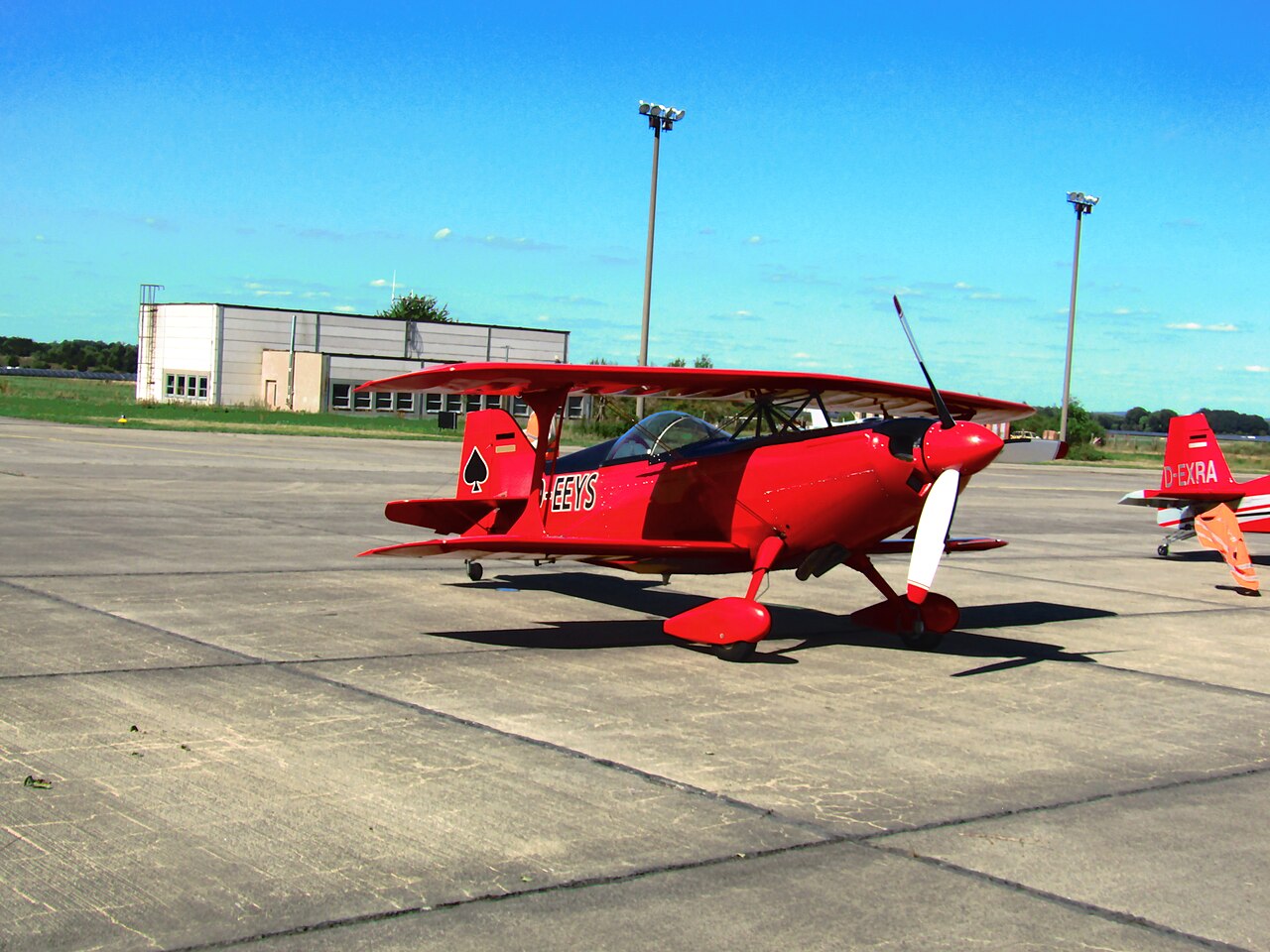
LAA Group ACurtis Pitts / Aero Design Eleven (USA); plans and components later from Aviat (S-1-11B)
BiplaneTailwheelSingle seatAerobaticPlans builtFactory built
Seats
1
Engine
Lycoming O-540/IO-540, 260 hp class (250-300+ hp fitted)
Cruise
165 kt (190 mph, about 55% power)
Fuel burn
about 49 L/hr (13 US gal/hr)
MTOW
680 kg (1,500 lb)
Roll rate
about 400°/sec
Vne
199 kt
Figures marked estimate are approximate, worked out from the engine type or typical values. They have not been checked against the aircraft’s own documents, so don’t use them for flight planning. Check the Pilot’s Operating Handbook or Operating Limitations of the aircraft you are buying.
The Pitts Super Stinker, officially the Model 11-260, is a single-seat, six-cylinder aerobatic biplane designed by Curtis Pitts and a group of friends in the early 1990s. It is essentially a scaled-up Pitts S-1S with a 260 hp-class Lycoming O-540 or IO-540 and Pitts’s light, very fast ailerons. Aviat later developed it as the S-1-11B, selling plans and finished components.
In the UK it is a rare LAA Permit aeroplane flown by serious aerobatic pilots. It suits someone who has outgrown a four-cylinder S-1 and wants unlimited-style performance in a familiar Pitts layout, and who has the skill and currency to handle a powerful, light-controlled single-seater.
History and design
Curtis Pitts formed Aero Design Eleven with friends in 1991, and the prototype was finished in 1993. Following Pitts’s habit of naming his prototypes, Wikipedia confirms that the prototype Model 11, later called the S-1-11B, was the “Super Stinker”. In Budd Davisson’s flight report on the prototype, it had a 260 hp six-cylinder Lycoming, a Hartzell propeller and spring landing gear with a locking Haigh tailwheel, and an airframe of around 1,100 lb.
Its key feature is the aileron system. Pitts designed the “Super Stinker Wing Technology” ailerons to stay light and fast at full deflection without the external spades used on many competition aircraft. AOPA reported in 1998 that some of the wing features were carried over to the two-seat Pitts S-2C. In Davisson’s later S-1-11B report, Aviat sold plans with Super Stinker outlines and finished components with S-1-11B cosmetics, aerodynamically and structurally the same aeroplane. Aviat sold components rather than full kits.
Variants
Pitts Super Stinker 11-260 (LAA type 273): the LAA-accepted type, covering the Super Stinker and the Aviat S-1-11B. UK examples include G-STNK, registered as a Pitts S-1-11 Super Stinker with LAA build number 273-15438.
Engines: the prototype flew with a stock O-540 of about 230-240 hp; Davisson reports a 250 hp O-540 as a normal fit, and his test S-1-11B had a custom IO-540 producing over 300 hp. Wikipedia describes the S-1-11B as 300 hp-plus.
Related types: the four-cylinder Pitts S-1, the two-seat Pitts S-2 and the radial-engined Pitts Model 12 (Macho Stinker).
Specifications
Figures are from Budd Davisson’s S-1-11B flight report; performance is quoted at the 1,350 lb competition weight, sea level and 300 hp, so a 260 hp aircraft will be a little slower in the climb. Each UK aircraft’s Operating Limitations set its actual MTOW and speeds.
In his prototype report Davisson saw 181 mph indicated at 24 inches of manifold pressure and about 200 mph at full power, and estimated a roll rate of over 400 degrees a second. He found snaps started and stopped cleanly, spins stopped precisely on heading, and vertical rolls tracked well, with stability neutral on every axis. The seat is laid back further than in earlier Pitts, the cockpit is roomier and side visibility good, but the nose sits low and straight-ahead view is limited.
Landing needs care: Davisson describes an approach at about 90 mph, a quick sink rate with the power off and a tendency to float, and he recommends dual instruction in a two-seat Pitts before a first flight. His later report found take-offs and landings demanding because of the power and very light controls. This is not an aeroplane for a casual or low-hours tailwheel pilot.
Owning one in the UK
Licence: an LAA Group A type, so an NPPL SSEA, LAPL or PPL, with tailwheel differences training and, in practice, substantial Pitts or high-performance tailwheel experience. Get proper aerobatic training and any rating your licence requires.
Permit to Fly: UK examples fly on an LAA Permit to Fly, renewed annually after an LAA inspector’s inspection. The LAA’s engineering fees list £336 for revalidation at 451-999 kg MTOW; the band depends on your aircraft’s paperwork.
Engine and fuel: six-cylinder Lycoming O-540/IO-540 engines, often modified. At about 49 L/hr (13 US gal/hr) at normal power, fuel is a significant running cost; check which fuels the engine and Operating Limitations allow.
Hangarage and insurance: a high-value single-seat aerobatic aircraft needs a dry hangar, and insurers will look closely at your tailwheel and aerobatic experience.
Parts and support: Aviat in the US produced S-1-11B plans and components. In the UK, support comes from LAA Engineering, LAA inspectors and the UK Pitts and aerobatic community.
Read the Operating Limitations for MTOW, Vne, g limits and aerobatic weight, and check the weight report.
Find out exactly which engine is fitted, any modifications (compression, injection), its hours since overhaul and its inverted fuel and oil systems.
Check the three-blade constant-speed propeller’s overhaul status and any aerobatic life limits.
Ask for g-meter history and a record of competition use, and have an inspector check wing fittings, flying wires and aileron linkages and hinges.
Check the landing gear, its attachment points and the tailwheel for signs of hard landings or ground loops.
Confirm whether the airframe is plans-built or uses Aviat components, and ask for the build records and Permit history.
Arrange an insurance quote and a type check-out before committing.
LAA type acceptance
The Light Aircraft Association lists these variants under the following type numbers. Check the LAA Type Acceptance Data Sheets (TADS) for the current approved engines, propellers and modifications before you buy.
Curtis Pitts’s Model 11-260, a single-seat aerobatic biplane from the early 1990s: essentially a scaled-up S-1S with a six-cylinder 260 hp-class Lycoming. Aviat developed it as the S-1-11B.
What licence do I need?
It is an LAA Group A type, so an NPPL SSEA, LAPL or PPL, plus tailwheel differences training. Realistically you need significant Pitts or high-performance tailwheel experience.
Is it on a Permit or a CofA?
UK examples fly on an LAA Permit to Fly under LAA type 273, inspected annually by an LAA inspector.
How fast is it?
Aviat flight-planned it at 190 mph (165 kt) on about 55% power. Davisson’s S-1-11B data gives 181 kt maximum and a 199 kt Vne.
How does it compare with a Pitts S-1?
It is bigger and much more powerful, with a six-cylinder engine, a roll rate of about 400°/sec and a roomier, more laid-back seat.
Can I carry a passenger?
No. It is a single-seater; for two seats look at the Pitts S-2.
Can I build one?
Aviat sold plans and finished components for the S-1-11B, and Davisson estimated components cut build time by 60-70%. Check current availability with Aviat; a UK build goes through the LAA.
Is it hard to land?
Davisson found it straight on the runway but demanding because of the power and light controls, and recommends dual training in a two-seat Pitts first.
How much does the permit cost?
The LAA lists £336 for revalidation at 451-999 kg MTOW, plus the inspection.
Who supports it in the UK?
There is no UK agent. Owners rely on LAA Engineering, LAA inspectors, Aviat in the US and the UK aerobatic community.
Figures are typical published values for a standard example and vary with engine, propeller, build and modification state. Always use the aircraft’s own Pilot’s Operating Handbook, weight and balance schedule and LAA paperwork. Last checked November 2026.