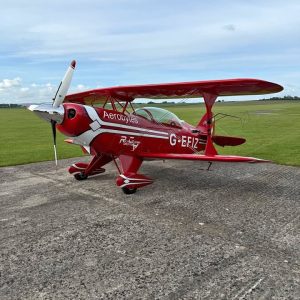
The Pitts S-2 is the two-seat Pitts Special: a short, steel-tube-and-fabric aerobatic biplane with wooden wings, a big Lycoming and tandem seats under a canopy. The S-2B became one of the leading aerobatic trainers of the 1980s, and the two-seat Pitts is still a common choice for pilots moving on to advanced aerobatics.
UK buyers choose one for aerobatic training, competition flying and pure sport. The S-2 series was type-certificated in the US in 1971 and many factory-built aircraft fly on certified paperwork, while the LAA accepts the S-2A, S-2AE and homebuilt S-2E, and the single-seat S-2S, for an LAA Permit to Fly, so check which regime any aircraft you look at is on.
History and design
Curtis Pitts scaled up his single-seat S-1 into the tandem two-seat S-2, which first flew in 1967 and gained its US type certificate in 1971. The prototype had 180 hp; production S-2As had 200 hp Lycoming AEIO-360s and a constant-speed propeller, and Aerotek built 259 of them. The 260 hp S-2B followed, with the landing gear and upper wing moved forward six inches and an auxiliary tank in the upper wing; 196 were built. After 1981 production passed to Christen Industries at Afton, Wyoming, and Aviat took over the factory and rights in the 1990s.
The current S-2C was a major rework by Aviat, introduced in the late 1990s. AOPA Pilot’s 1998 report describes balanced ailerons that did away with the S-2B’s aileron spades, a roll rate of more than 300 degrees a second against the S-2B’s 240, a larger tail for better directional control on landing, a flatter belly, squared wingtips and a reshaped canopy. The fuselage is welded steel tube with fabric covering; the wings are fabric over wooden structure with a plywood torque box. See Wikipedia’s Pitts Special article for the full family tree and Aviat for the current S-2C.
Variants
S-2A (LAA 009A): the original production two-seater, 200 hp Lycoming AEIO-360 with a constant-speed propeller. Later aircraft had longer landing gear and a front cockpit 2 in wider.
S-2AE and S-2E (LAA 009A): amateur-built versions of the S-2A, built from factory kits.
S-2S (LAA 009C): a single-seat derivative with a 260 hp AEIO-540, a fuselage shortened by 14 in ahead of the cockpit, a 20 ft span and a twin-tank fuel system. Only 17 factory examples were built, and there is a homebuilt S-2SE.
S-2B: 260 hp AEIO-540, gear and upper wing moved forward, upper-wing auxiliary tank. Factory built; out of production but supported by Aviat.
S-2C: Aviat’s current factory model, 260 hp with a three-blade constant-speed prop, revised ailerons and rudder, and +6/−5 g aerobatic limits.
Specifications
Figures are Aviat data for the S-2C as published by AOPA Pilot (1998) and Plane & Pilot (2006), with Jane’s data for the S-2B (via Wikipedia) for comparison. Confirmed figures for the 200 hp S-2A were not found.
Specification
Imperial
Metric
Wingspan, S-2C / S-2B
20 ft / 20 ft upper, 19 ft lower
6.10 m / 6.10 m and 5.79 m
Length, S-2C / S-2B
17 ft 5 in / 18 ft 9 in
5.31 m / 5.72 m
Height, S-2C
6 ft 5 in
1.96 m
Wing area, S-2C / S-2B
127.5 sq ft / 125 sq ft
11.8 m² / 11.6 m²
Empty weight, S-2C / S-2B
1,155 lb / 1,150 lb
524 kg / 522 kg
Maximum weight, S-2C / S-2B
1,700 lb / 1,625 lb
771 kg / 737 kg
Useful load, S-2C normal / aerobatic
545 lb / 470 lb
247 kg / 213 kg
Fuel, S-2C normal / aerobatic
29 US gal / 24 US gal (28 / 23 usable)
110 / 91 litres
Engine
Lycoming AEIO-540-D4A5, 260 hp (S-2B, S-2C); AEIO-360, 200 hp (S-2A)
Propeller
Hartzell constant-speed
Vne, S-2C / S-2B
184 KCAS (185 KIAS) / 182 kt
341 km/h / 337 km/h
Cruise, S-2C 75%
150–160 kt
278–296 km/h
Cruise, S-2B max cruise
152 kt
282 km/h
Stall, S-2C clean / S-2B
56 kt / 52 kt
104 km/h / 96 km/h
Rate of climb, S-2C / S-2B
2,900 ft/min / 2,700 ft/min
14.7 m/s / 13.7 m/s
Take-off ground roll / over 50 ft, S-2C
554 ft / 860 ft
169 m / 262 m
Landing ground roll / over 50 ft, S-2C
750 ft / 1,200 ft
229 m / 366 m
Fuel burn, S-2C 75% / 55%
14.0 / 11.5 US gal/h
53 / 44 litres/h
Range with reserve, S-2C 75% / 55%
270 / 310 nm
500 / 574 km
G limits, S-2C aerobatic
+6 / −5 g
Roll rate, S-2C / S-2B
over 300 / 240 degrees per second
Performance and handling
A 260 hp S-2 climbs at close to 3,000 ft/min and cruises at about 150 knots, but it burns around 14 US gallons an hour at 75% power and carries little fuel in aerobatic configuration, so it is a sport aircraft rather than a tourer. An S-2B owner quoted by Aviation Consumer cruises at about 145 knots on 11 gallons an hour. Pilots describe the controls as well harmonised and very responsive, and the S-2C’s stick forces are much the same upright or inverted.
The Pitts is famously hard to land. Forward view is very poor on the approach and roll-out, so pilots fly a curved or slipping approach to keep the runway in sight and S-turn when taxiing, and NTSB reports include many loss-of-control accidents on the landing roll. Experienced Pitts instructor Budd Davisson’s estimate, quoted by Aviation Consumer, is 8–10 hours of dual for a pilot who is already tailwheel-qualified, though he stresses it varies widely. Two average-sized adults and full fuel can put a two-seat Pitts over its aerobatic weight and aft of the centre of gravity limit, so load planning matters.
Owning one in the UK
You need an NPPL SSEA, LAPL(A) or PPL(A), tailwheel and variable-pitch propeller differences training, and an aerobatic rating if you hold a Part-FCL licence and want to fly aerobatics. Plan on a proper Pitts conversion with an instructor who teaches on type. Homebuilt S-2E and S-2AE aircraft, and S-2As and S-2Ss accepted by the LAA under types 009A and 009C, fly on an LAA Permit to Fly with an annual LAA inspection and owner maintenance under LAA oversight. Factory S-2B and S-2C aircraft are normally maintained to certified standards, and some UK-based Pitts are on the US register, so confirm the airworthiness regime and who can sign for maintenance before you buy.
The Lycoming AEIO-360 and AEIO-540 are inverted-system engines, and Aviat lists 100LL avgas for the S-2C and a 1,200-hour TBO for the AEIO-540. Aviat still makes the S-2C and supports parts for earlier models. Insurers usually want to see tailwheel and Pitts-specific dual time before they will quote. Read the LAA type data sheets for 009A and 009C in the LAA Info Library for Permit aircraft.
Three whole-aircraft S-2As advertised in 2023 were asking £79,995 to £99,000, and a quarter share in an LAA-Permit S-2A was offered at £19,000. Browse aircraft for sale and other LAA aircraft, or compare the single-seat Pitts S-1 and the two-seat Christen Eagle II.
Buying checklist
Identify the exact model (S-2A, S-2AE/S-2E, S-2B, S-2C or S-2S), whether it is factory or amateur built, and whether it is on an LAA Permit, a CofA or a foreign register.
Inspect the fabric carefully, especially on aircraft that have not lived in a hangar; covering condition has a big effect on value.
Check for control slop from worn bearings, and look for unofficial inspection holes cut in the underside of the wings.
Look at the anti-drag wire area in the top wing for damage from hard aerobatics, and for washer stacks at the I-strut fittings that hint at rigging problems.
Check that the spinner lines up with the nose bowl; misalignment can mean worn engine mount bushings.
Inspect the tailwheel spring for sag after hard landings, which changes the geometry and can cause shimmy.
Confirm the canopy emergency release works and that parachutes and harnesses are in date.
Check engine hours against the 1,200-hour TBO for the AEIO-540, the inverted oil and fuel systems, and propeller overhaul status.
LAA type acceptance
The Light Aircraft Association lists these variants under the following type numbers. Check the LAA Type Acceptance Data Sheets (TADS) for the current approved engines, propellers and modifications before you buy.
An NPPL SSEA, LAPL(A) or PPL(A) with tailwheel and variable-pitch propeller differences training, plus an aerobatic rating on a Part-FCL licence for aerobatics. A proper Pitts conversion is essential.
Is the Pitts S-2 on a Permit or a CofA?
It depends on the aircraft. The LAA accepts the S-2A, S-2AE, S-2E and S-2S (types 009A and 009C) for a Permit to Fly, while factory S-2B and S-2C aircraft were type-certificated. Some UK-based Pitts are US-registered.
What is the difference between the S-2A, S-2B and S-2C?
The S-2A has a 200 hp AEIO-360. The S-2B has a 260 hp AEIO-540 with the gear and top wing moved forward. The S-2C is Aviat’s reworked 260 hp model with balanced ailerons, a bigger tail and a faster roll rate.
How much does a Pitts S-2 cost in the UK?
Three S-2As advertised on aircraftsale.co.uk in 2023 were asking £79,995 to £99,000. Shares are sometimes available; a quarter share was offered at £19,000.
Is it hard to land?
Yes. Forward visibility is very poor on the approach and roll-out, and directional control on landing is the classic Pitts accident. Expect dual instruction even if you are tailwheel-current.
How much dual will I need?
Budd Davisson’s estimate, quoted by Aviation Consumer, is 8–10 hours for a tailwheel-qualified pilot, but it varies widely.
What are the g limits?
Aviat quotes +6/−5 g in the aerobatic category for the S-2C. Check the limits on the individual aircraft’s flight manual or LAA Operating Limitations.
What is the fuel burn?
Aviat’s S-2C figures are 14 US gal/h at 75% power and 11.5 US gal/h at 55%. An S-2B owner reported about 11 gal/h at 145 knots.
Can I tour in a Pitts S-2?
Only short hops. Aviat gives the S-2C a range with reserve of 270–310 nm on 28 usable gallons, and only 20 lb of baggage.
Can two people do aerobatics together?
Yes, but watch the weights. The S-2C’s aerobatic useful load is 470 lb including fuel, and two large pilots with full fuel can exceed the aerobatic weight and aft CG limit.
Who supports the Pitts?
Aviat Aircraft in Afton, Wyoming, still builds the S-2C and supports parts for earlier models.
Figures are typical published values for a standard example and vary with engine, propeller, build and modification state. Always use the aircraft’s own Pilot’s Operating Handbook, weight and balance schedule and LAA paperwork. Last checked November 2026.