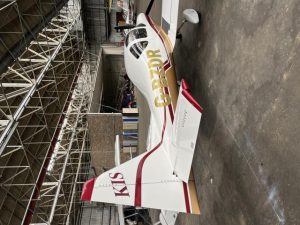
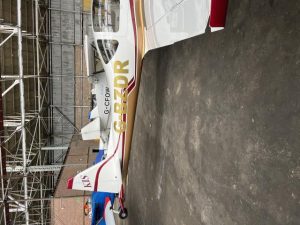
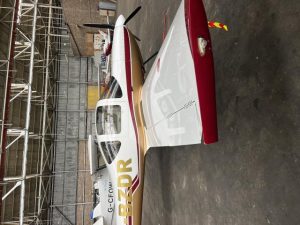
The KIS (‘Keep It Simple’) family is a pair of low-wing, all-composite kit aircraft from Tri-R Technologies of Oxnard, California. The KIS TR-1 is a compact, fast two-seater, and the KIS TR-4 Cruiser is a four-seat touring version. Both are accepted by the LAA as Group A types and fly in the UK on an LAA Permit to Fly.
They are rare. Wikipedia reported seven TR-1s on the UK register in 2014, and the company no longer exists, so buyers are choosing a one-off homebuilt rather than a supported type. In return you get high cruise speeds for the power and a smooth composite airframe. Browse our aircraft listings for examples, or see other LAA aircraft.
History and design
Rich Trickel designed the KIS. His main business, High Tech Composites, made airframe parts for Lancair kits, and Plane & Pilot notes he designed the moulds and structural methods for the Lancair series. The TR-1 began as a set of three-view drawings for an Australian customer who wanted a conventional design; when the customer did not pay, Trickel completed the aircraft himself. It reached the market in the 1990s, with the factory estimating about 1,000 hours to build.
Components are vacuum-formed from epoxy pre-preg glass cloth with foam and Nomex honeycomb cores. Kits were sold without engine, upholstery, avionics or paint. The tricycle TR-1 was joined by the TR-1/TD taildragger, which had 34 US gal of fuel and a 1,425 lb gross weight. By 1998 the company reported 25 tricycle and eight taildragger TR-1s flying. The four-seat TR-4 Cruiser first flew in 1994, and a 210 hp Continental-powered Super Sport Cruiser was also described in 1999.
Variants
Tri-R KIS (LAA 239, Group A): the two-seat TR-1, in tricycle or taildragger (TR-1/TD) form. The design accepts 80–125 hp; listed engines are the 125 hp Continental O-240, 108 hp Lycoming O-235 and 80 hp Limbach L2000. A UK example for sale in 2023, G-BZDR, had a Continental IO-240-A and a three-blade electric variable-pitch propeller.
KIS Cruiser (LAA 302, Group A): the four-seat TR-4, with published data for a 180 hp Lycoming IO-360. At least one UK example, G-BYZD, was destroyed in 2008 after an engine power loss.
Specifications
TR-1 figures are from the AeroCrafter Homebuilt Aircraft Sourcebook (1998), and Cruiser figures from Plane & Pilot, both as quoted by Wikipedia. Sources disagree on several Cruiser figures, and UK limits will be on each aircraft’s LAA paperwork.
Specification
Imperial
Metric
Wingspan (TR-1)
23 ft
7.01 m
Length (TR-1)
22 ft
6.71 m
Wing area (TR-1 / Cruiser)
88 sq ft / 135 sq ft
8.2 m² / 12.5 m²
Empty weight (TR-1 / Cruiser)
750 lb / 1,200 lb
340 kg / 544 kg
Gross weight (TR-1 / TR-1/TD / Cruiser)
1,300 / 1,425 / 2,400 lb
590 / 646 / 1,089 kg
Fuel (TR-1 / TR-1/TD / Cruiser)
20 / 34 / 50 US gal
76 / 129 / 189 litres
Engine (TR-1)
Continental O-240, 125 hp (80–125 hp accepted)
Engine (Cruiser)
Lycoming IO-360, 180 hp
Max speed (TR-1 / Cruiser)
195 mph (169 kt) / 185 mph (161 kt)
314 / 298 km/h
Cruise (TR-1 / Cruiser)
175 mph (152 kt) / 165 mph (143 kt)
282 / 266 km/h
Stall (TR-1)
55 mph / 48 kt
89 km/h
Rate of climb (TR-1 / Cruiser)
1,200 ft/min
6.1 m/s
Range (TR-1 / Cruiser)
650 nm / 700 nm
1,210 / 1,300 km
Service ceiling
17,000 ft
5,200 m
Performance and handling
The published figures make the TR-1 a very quick two-seater: 175 mph cruise on 125 hp, from a small 88 sq ft wing. That small wing also gives it a 55 mph stall, so it needs proper runways and a disciplined approach rather than short farm strips. The Cruiser offers four seats and a 165 mph cruise on 180 hp.
We found no independent UK flight test of either type, so treat handling claims from sellers with caution and arrange a check flight with an experienced pilot. For a composite comparison, look at the Europa or the Lancair 320.
Owning one in the UK
Licence: both are LAA Group A, so you need an NPPL SSEA, LAPL(A) or PPL, plus tailwheel training for a TR-1/TD.
Permit to Fly: KIS aircraft are homebuilts on an LAA Permit to Fly, revalidated yearly after an LAA inspection. Composite repairs need LAA-approved schemes and an inspector familiar with composites.
Engines and fuel: most use Continental or Lycoming flat-four engines. Engine parts and overhauls are likely to be easier to arrange than airframe parts. Check the engine manual and LAA paperwork for approved fuels.
Nose gear: the AAIB report on TR-1 G-BZDR (2014) describes one side of the nose-leg fork failing on landing, with visual evidence of fatigue. Inspect the nose gear carefully on any example.
Engine power loss: the AAIB report on Cruiser G-BYZD (2008) describes a pilot continuing a take-off after suspecting an engine problem, then losing power. The lesson applies to any type: don’t press on with a doubtful engine.
Parts and support: Tri-R Technologies is out of business, so there is no factory support. Owners rely on the LAA, inspectors, other owners and general composite and engine specialists. More background is on Wikipedia.
Buying checklist
Confirm which type it is (TR-1, TR-1/TD or Cruiser) and the LAA type number, MTOW and engine on its paperwork.
Get a composite-experienced inspector to check the airframe for delamination, cracking, impact damage and repairs.
Inspect the nose-leg fork and gear attachments for fatigue cracking, especially on tricycle TR-1s.
Review the engine logbook, time since overhaul and the condition of any variable-pitch propeller.
Check the weight report: on a two-seater with a 1,300 lb published gross, payload with full fuel may be limited.
Ask about spares the owner holds; with no factory, a box of spares is valuable.
Look at the canopy or doors, hinges and seals for cracks and leaks.
LAA type acceptance
The Light Aircraft Association lists these variants under the following type numbers. Check the LAA Type Acceptance Data Sheets (TADS) for the current approved engines, propellers and modifications before you buy.
Both the KIS and KIS Cruiser are LAA Group A, so you need an NPPL SSEA, LAPL(A) or PPL. Taildragger TR-1/TD versions also need tailwheel training.
Is the KIS on a Permit or a CofA?
It is a homebuilt on an LAA Permit to Fly, revalidated every year after inspection by an LAA inspector.
How fast is the KIS?
Published data gives the two-seat TR-1 a 175 mph (152 kt) cruise on a 125 hp Continental O-240. The four-seat Cruiser is listed at 165 mph (143 kt) on 180 hp.
How many seats does it have?
The KIS TR-1 has two seats. The KIS TR-4 Cruiser has four.
What engines are fitted?
The TR-1 accepts 80–125 hp, with the Continental O-240, Lycoming O-235 and Limbach L2000 listed. The Cruiser data is for a 180 hp Lycoming IO-360.
Can I still buy a kit?
No. Tri-R Technologies is out of business, so you would be buying a completed aircraft or an unfinished project.
Who supports it in the UK?
There is no factory or UK agent. Support comes from the LAA, its inspectors, other owners and specialist composite and engine shops.
How rare is it in the UK?
Very rare. Wikipedia reported seven TR-1s on the UK register in March 2014, We couldn’t find a current count for the four-seat Cruiser.
Is it suitable for short grass strips?
It is not a STOL design. The TR-1’s published stall speed is 55 mph (48 kt), so it needs reasonable runway length.
What are the known problem areas?
An AAIB report on G-BZDR describes a nose-gear fork failure with signs of fatigue, so the nose gear needs careful inspection. Composite structure should be checked by an experienced inspector.
Is it good for touring?
Yes, on paper: the TR-1 is listed at 650 nm range and the Cruiser at 700 nm, with high cruise speeds. Check the actual fuel capacity and payload of the aircraft you’re buying.
Figures are typical published values for a standard example and vary with engine, propeller, build and modification state. Always use the aircraft’s own Pilot’s Operating Handbook, weight and balance schedule and LAA paperwork. Last checked November 2026.