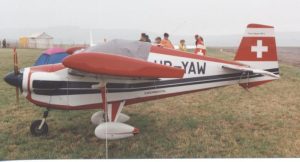
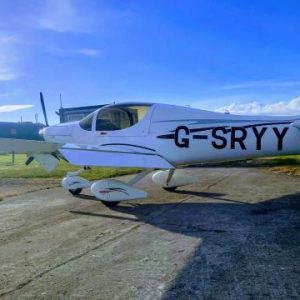
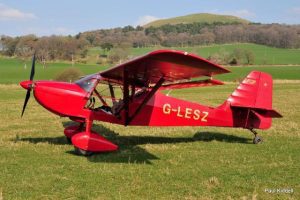
The Tipsy Nipper T.66 is a tiny Belgian single-seater from the late 1950s, designed to be cheap to buy, build and run, and easy to fly. It has a welded steel-tube fuselage and a wooden, fabric-covered mid-set wing. Unusually for such a small, low-powered aircraft, the LAA allows a set of simple aerobatics. In the UK the Nipper flies on an LAA Permit to Fly as a Group A aeroplane.
It suits pilots who want an affordable single-seater for fun local flying and gentle aerobatics on a VW engine. The UK has long been the Nipper’s main home, and parts and plans are still supported from Hampshire. Compare examples in our aircraft listings and other LAA aircraft.
History and design
Ernest Oscar Tips designed the Nipper at Avions Fairey in Gosselies, Belgium. It was named after the nickname of his first grandchild. Test pilot Bernard Neefs flew the first one on 12 December 1957. Fairey built complete aircraft and kits until 1961, when it stopped to make room for F-104G Starfighter work. Cobelavia then assembled more aircraft as the D-158. In 1966 Nipper Aircraft Ltd at Castle Donington took the licence and had Slingsby Sailplanes build the Mk III at Kirkbymoorside. A fire at Slingsby in late 1968, and the firm’s later receivership, ended production. Wikipedia puts the total at about 110.
Nipper Kits and Components then supported owners for decades. Today Airweld of Winchester holds the worldwide licence and runs Nipper Aircraft for parts, plans and support. Nipper Aircraft says around 40 Nippers are on the UK register. The fuselage and fin are welded steel tube with fabric covering. The wing, with wooden spar and ribs, and the tailplane, elevator and rudder are wood and fabric. The rudder is all-moving.
Variants
T.66 Series 1 (Mk 1, LAA 025): the first production model, with a 40 hp Pollmann Hepu engine and an enclosed canopy.
T.66 Series 2 (Mk 2, LAA 025): like the Mk 1 but with a 45 hp Stark Stamo.
T.66 Series 3 (Mk III, LAA 025): built by Slingsby for Nipper Aircraft, normally with a 1500 cc, 45 hp Rollason Ardem Mk X. Optional tip tanks were offered.
Today: the LAA says most Nippers now have VW aero conversions, and some have Jabiru engines. Long-range tip tanks are an LAA-approved option.
Specifications
UK limits are from the LAA data sheet (TADS 025). Dimensions and performance are Wikipedia’s Mk 2 figures (cited to Airlife’s World Aircraft), which Nipper Aircraft repeats. The all-aero Mk III page gives the same 81 kt cruise and 340 kg maximum weight.
Specification
Imperial
Metric
Wingspan
19 ft 8 in
5.99 m
Length
14 ft 9 in
4.5 m
Height
6 ft 2 in
1.88 m
Empty weight (Mk 2)
659 lb
299 kg
Maximum total weight (LAA)
750 lb
340 kg
Engine (Mk 2)
Stark Stamo 1400A, 45 hp
Max rpm (VW 1834, LAA)
3,300
Vne (LAA)
147 mph (128 kt)
237 km/h
Maximum speed (Mk 2)
101 mph (87 kt)
162 km/h
Cruise (Mk 2 / Mk III)
93 mph (81 kt)
150 km/h
Climb (Mk 2)
640 ft/min
3.25 m/s
Range (Mk 2)
173 nm (199 mi)
320 km
Load factors (LAA)
+4 g / -2 g
Performance and handling
With about 45 hp the Nipper cruises at around 80 kt, and the UK Vne is 147 mph. Its party piece is that the LAA permits intentional spinning and a short list of aerobatics: steep turns up to 2 g, inside loops, slow rolls, stall turns, half loop and roll-out, and half roll and dive-out, within +4 g and -2 g. That makes it one of the cheapest ways to learn basic aerobatics in your own aircraft, though you should get proper aerobatic instruction first.
The LAA warns that VW-powered Nippers are particularly prone to carburettor icing, so carb heat technique matters. Range of around 170 nm on the Mk 2 data is enough for local flying. Long-range tip tanks extend it.
Owning one in the UK
Licence: a Group A type, so an NPPL SSEA, LAPL or PPL. It is single-seat, so there is no dual on type. Aerobatics need suitable training.
Permit to Fly: UK Nippers fly on an LAA Permit, renewed annually after an LAA inspection. Flight is limited to day VFR.
Airworthiness notices: MPD 1995-022 (Société Fairey modifications) applies, and LAA MOD/025/003 requires inspection of the mainplane attachment bolts. A 2014 Safety Spot described wing bolt cracks that dye-penetrant testing missed.
Engine and fuel: most aircraft have VW conversions, some have Jabirus. Check the approved fuel for the engine fitted.
Manuals: the Nipper Aircraft Owners Handbook includes pilot’s notes and maintenance information.
Parts and support:Nipper Aircraft (Airweld, Winchester) supplies parts, plans and support. See also the LAA and Wikipedia.
Related types: for another small single-seat homebuild, see the Druine Turbulent.
Buying checklist
Check MOD/025/003 (mainplane attachment bolt inspection) and MPD 1995-022 are recorded.
Check the aileron bellcranks are straight and cable tension is within 35 lb ± 5 lb (LAA note PFA/025/1).
Inspect the rudder pedals for cracks at the cable attachment tabs (PFA/025/2).
Check propeller bolt torque. The LAA records a Nipper losing its propeller in flight through under-torqued bolts.
Check the fuel valve and the tank arrangement. A leaking valve once let fuel transfer between tanks and caused starvation. Make sure the sight gauge has fixed, accurate markings.
Ask about carb icing experience and check the carb heat system on VW engines.
Inspect the welded steel-tube fuselage for corrosion and the wooden wing for glue and fabric condition.
LAA type acceptance
The Light Aircraft Association lists these variants under the following type numbers. Check the LAA Type Acceptance Data Sheets (TADS) for the current approved engines, propellers and modifications before you buy.
It is an LAA Group A aeroplane, so an NPPL SSEA, LAPL or PPL. It is a single-seater, so there is no dual instruction on type.
Is the Nipper on a Permit or a CofA?
UK Nippers fly on an LAA Permit to Fly, renewed each year after an LAA inspection.
Is the Tipsy Nipper aerobatic?
Yes, within limits. The LAA permits spinning, loops, slow rolls, stall turns, half loop and roll-out, and half roll and dive-out, up to +4 g and -2 g.
What engine does it have?
The originals had 40–45 hp Hepu, Stamo or Ardem engines. The LAA says most now have VW aero conversions, and some have Jabirus.
How fast is it?
Mk 2 data gives about 81 kt cruise and 87 kt maximum. The UK Vne is 147 mph (128 kt).
What is the maximum weight?
The LAA gives 340 kg (750 lb).
Who supports the Nipper in the UK?
Airweld of Winchester holds the worldwide licence and runs Nipper Aircraft for parts, plans and support.
Can I build a new one?
Nipper Aircraft supplies plans and parts. The LAA notes no Nipper projects have started since the UK 51% rule came in, so talk to LAA Engineering before starting.
What are the known problem areas?
LAA notes cover wing attachment bolt cracks, bent aileron bellcranks, cracked rudder pedal tabs, propeller bolt torque, fuel valve leaks and carb icing on VW engines.
Is it good for touring?
It is best for local flying. Mk 2 data gives a range of about 170 nm, and long-range tip tanks are an LAA-approved option.
How many are there in the UK?
Nipper Aircraft says around 40 Nippers are on the UK register.
Figures are typical published values for a standard example and vary with engine, propeller, build and modification state. Always use the aircraft’s own Pilot’s Operating Handbook, weight and balance schedule and LAA paperwork. Last checked November 2026.