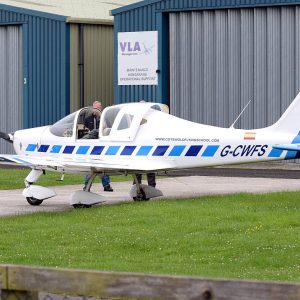
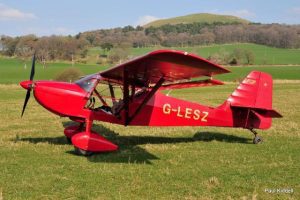
The Van’s RV-8 is the big tandem RV: an all-metal, low-wing two-seater with the pilot on the centreline, a sliding bubble canopy and a cockpit wide enough for larger occupants. It is sold as a kit with a tailwheel (RV-8) or nosewheel (RV-8A) and in the UK flies on an LAA Permit to Fly. Van’s pitches it on speed, climb, range and responsive, well-balanced handling, and it is approved in the US aerobatic category at its aerobatic weight.
UK pilots choose the RV-8 when they want fighter-style seating and sport aerobatics without giving up touring ability. Compared with the older RV-4 it carries more fuel and baggage and takes bigger engines, and kits are still in production, so you can build new or buy a finished aircraft.
History and design
By the mid-1990s the side-by-side RV-6/6A was Van’s best seller, but many pilots still wanted centreline seating. Van’s returned to the tandem layout in 1995 with a one-off demonstrator shown at Oshkosh that year, where it drew strong interest. The RV-8 was marketed from 1996, complete kits were available by the end of 1998, and the nosewheel RV-8A followed soon afterwards (Wikipedia gives the 8A’s first flight as 1998).
Although it follows the RV-4 concept, the RV-8 is a larger aeroplane: 24 ft span against 23 ft, 1,800 lb gross against 1,500 lb, 42 US gal of fuel against 32 and 125 lb of baggage in two compartments against 50 lb. Van’s designed the airframe around the 200 hp Lycoming IO-360 and approved the 210 hp IO-390 in 2020, though it says most flying RV-8s have 180 hp. The canopy slides back behind a fixed windscreen with a steel roll bar, and the rear seat can be fitted with an optional stick, throttle and rudder pedals. Wikipedia, citing Van’s First Flights figures, puts completed RV-8s and RV-8As at 1,611.
Against its side-by-side sibling, the RV-7, the RV-8 has a slightly shorter wing (24 against 25 ft) and is a few mph quicker on the same engine in Van’s figures, but the occupants sit one behind the other.
Variants
RV-8 (LAA type 303): tailwheel version, 21 ft long and 5 ft 7 in high, 1,800 lb gross.
RV-8A (LAA type 303): nosewheel version, same wing, weights and fuel, slightly shorter (20 ft 10 in), taller on its gear (7 ft 4 in) and a few mph slower.
Engines from about 150 hp to 215 hp, with 180 hp the most common according to Van’s, and fixed-pitch or constant-speed propellers. Check the engine fitted, as it changes climb and cruise significantly.
Specifications
Van’s published figures for the tailwheel RV-8, measured with a Hartzell two-blade constant-speed propeller, at 1,800 lb gross unless stated. Speeds converted from statute mph.
Specification
Imperial
Metric
Wingspan
24 ft
7.32 m
Length (RV-8 / RV-8A)
21 ft / 20 ft 10 in
6.40 / 6.35 m
Height (RV-8 / RV-8A)
5 ft 7 in / 7 ft 4 in
1.70 / 2.24 m
Wing area
116 sq ft
10.8 m²
Empty weight
1,067-1,120 lb
484-508 kg
Gross weight (MTOW)
1,800 lb
816 kg
Aerobatic gross weight
1,600 lb
726 kg
Baggage (two compartments)
125 lb
57 kg
Fuel capacity
42 US gal
159 L
Engine
150-215 hp
112-160 kW
Propeller
Fixed-pitch or constant-speed
–
Cruise, 75% at 8,000 ft (160 / 180 / 200 hp)
195 / 203 / 210 mph (169 / 176 / 182 kt)
314 / 327 / 338 km/h
Top speed (180 hp)
213 mph / 185 kt
343 km/h
Stall speed (gross / solo)
58 / 51 mph (50 / 44 kt)
93 / 82 km/h
Rate of climb (160 / 180 / 200 hp)
1,400 / 1,650 / 1,900 fpm
7.1 / 8.4 / 9.7 m/s
Ceiling (180 hp)
20,500 ft
6,250 m
Range, 75% at 8,000 ft (180 hp)
686 nm
1,270 km
Range, 55% at 8,000 ft (180 hp)
830 nm
1,537 km
Take-off distance (180 hp)
575 ft
175 m
Landing distance
500 ft
152 m
Performance and handling
On 180 hp Van’s gives a gross-weight 75% cruise at 8,000 ft of 203 mph (176 kt) and a climb of 1,650 fpm, making it the quickest of the classic two-seat RVs on a given engine in Van’s tables. With the 200 hp IO-360 it was designed around, cruise rises to 210 mph (182 kt) and climb to 1,900 fpm at gross. The stall is 58 mph (50 kt) at gross and 51 mph solo.
Van’s describes the handling as responsive and well balanced, and the type is cleared in the US aerobatic category at 1,600 lb. The tandem seat and roll bar suit aerobatic flying, while 42 US gal of fuel and two baggage areas give quoted ranges of about 686 nm at 75% power and 830 nm at 55% with 180 hp, enough for long European tours. Note that the RV-8’s aerobatic approval in the US does not automatically carry over: UK aerobatic clearance is set on each aircraft’s Permit.
Owning one in the UK
The RV-8/8A is LAA Group A (type 303), so an NPPL SSEA, LAPL(A) or PPL(A) is required, plus tailwheel differences training for the RV-8. It flies on an LAA Permit to Fly, with an annual inspection by an LAA inspector and Permit revalidation; builds are overseen by an LAA inspector, and modifications and engine changes need LAA approval. Running costs are generally lower than for a certified aircraft of similar performance because much maintenance can be owner-done under LAA oversight.
Read the LAA Type Acceptance Data Sheet for type 303 through the LAA engineering pages for UK-accepted engine and propeller combinations, and check the aircraft’s own operating limitations for aerobatic clearance. Mogas suitability depends on the engine and fuel system fitted. Kits come direct from Van’s Aircraft: the 2026 price list gives US$49,700 for a standard RV-8 airframe kit (US$49,900 RV-8A) and US$74,200 for QuickBuild (US$75,500 RV-8A), before engine, propeller, avionics, firewall-forward kit and shipping. Browse our aircraft listings and other LAA aircraft.
Buying checklist
Confirm RV-8 or RV-8A and the exact engine and propeller, and that the combination is LAA-accepted for type 303.
Check the Permit operating limitations for aerobatic clearance and any weight or manoeuvre limits that apply.
If it has been flown aerobatically, ask about its history and have the airframe, wing attachments and control system inspected by an RV-experienced inspector.
Check whether rear-seat controls (stick, throttle, pedals) are fitted if you want to share the flying or receive instruction.
Get a current weighing: empty weight ranges from about 1,067 to 1,120 lb, which sets payload within the 1,800 lb gross and 1,600 lb aerobatic weight.
Inspect the sliding canopy, rails and roll bar, and on an RV-8A the nose gear leg and fork.
Check that Van’s service bulletins for the RV-8 have been reviewed and recorded in the aircraft’s records.
LAA type acceptance
The Light Aircraft Association lists these variants under the following type numbers. Check the LAA Type Acceptance Data Sheets (TADS) for the current approved engines, propellers and modifications before you buy.
The RV-8 and RV-8A are LAA Group A aeroplanes, so an NPPL SSEA, LAPL(A) or PPL(A) is suitable, plus tailwheel differences training for the tailwheel RV-8.
Is the RV-8 on a Permit or a CofA?
UK RV-8s are amateur-built and operate on an LAA Permit to Fly, revalidated each year after an LAA inspection.
Is the RV-8 aerobatic?
Van’s says it is approved in the US aerobatic category at its 1,600 lb aerobatic gross weight. In the UK, aerobatic clearance depends on the individual aircraft’s Permit operating limitations.
How fast is an RV-8?
Van’s quotes a 75% power cruise at 8,000 ft at gross weight of 195 mph (169 kt) on 160 hp, 203 mph (176 kt) on 180 hp and 210 mph (182 kt) on 200 hp.
What engine does the RV-8 use?
It was designed around the 200 hp Lycoming IO-360, Van’s approved the 210 hp IO-390 in 2020, and Van’s says most flying examples have 180 hp. The accepted range is roughly 150-215 hp.
How far can an RV-8 fly?
With 42 US gal and 180 hp, Van’s quotes about 686 nm at 75% power and 830 nm at 55% power, so continental touring is well within reach.
Can I buy a new RV-8 kit for building in the UK?
Yes. Kits are bought direct from Van’s Aircraft and built under LAA oversight. The 2026 standard airframe kit is US$49,700 (RV-8) or US$74,200 QuickBuild, excluding engine, avionics and shipping.
Can the passenger fly an RV-8?
Van’s offers optional rear-seat stick, throttle and rudder pedals, so check whether they are fitted on any aircraft you are considering.
How does the RV-8 differ from the RV-4?
Both are tandem, but the RV-8 is larger, with a wider cockpit, 42 rather than 32 US gal of fuel, 125 lb rather than 50 lb of baggage, a 1,800 lb gross weight and a nosewheel option.
RV-8 or RV-7?
They share engines and gross weight. The RV-8 seats two in tandem and is a little quicker in Van’s figures; the RV-7 seats them side by side with a slightly longer wing.
Who supports the RV-8 in the UK?
Van’s Aircraft supplies kits, parts and technical support directly from Oregon, and the LAA oversees airworthiness through its inspectors and engineering department.
Figures are typical published values for a standard example and vary with engine, propeller, build and modification state. Always use the aircraft’s own Pilot’s Operating Handbook, weight and balance schedule and LAA paperwork. Last checked November 2026.