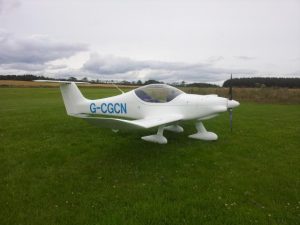
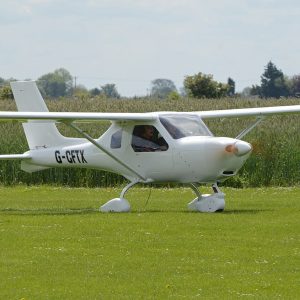
The Dyn’Aéro MCR01 is a tiny, all-composite French two-seater that turns a Rotax 912 into one of the fastest engines-per-pound combinations in light aviation. It grew out of Michel Colomban’s MC-100 Ban-Bi, and UK owners still often call it the Banbi.
In the UK it is a kit-built aircraft on an LAA Permit to Fly, accepted in three forms: the short-wing MCR01 (VLA or Sportster) and the MCR01 Club as Group A aeroplanes, and the long-wing MCR01 ULC as a microlight. It suits experienced pilots who want fast, economical touring and are comfortable with a small, slippery aircraft that has a relatively high stall speed and little tolerance for poor energy management.
History and design
The MCR01 is a development of the Colomban MC-100 Ban-Bi, designed by Michel Colomban, who also drew the tiny Cri-Cri. Dyn’Aéro built it, and the first MCR01 flew in July 1996. More than 500 have been built. Dyn’Aéro later stopped trading, and the family is now offered as kits and complete aircraft by SE Aviation, based at Pontarlier in France, under the MCR Evolution name.
The airframe is a low-wing, predominantly carbon fibre composite structure with side-by-side seats. Early wings had bonded aluminium skins, later replaced by carbon fibre. Pitch control is by an all-moving tailplane mounted on top of the fin and driven by carbon pushrods, with elastic bungees to give the controls feel. When the first UK ULC (G-BZXG) was flight tested by the PFA, now the LAA, in 2001, the report described the pitch stability as generally weak but positive. Fuel is carried in a composite tank, and the type has been built with both nosewheel and tailwheel undercarriage; SE Aviation now calls the tailwheel Club the Sportage.
Variants
MCR01 (LAA 301, Group A): the short-wing JAR-VLA version, also called the Sportster, with combined flaperons. The AAIB describes it as powered by a Rotax 912 UL or ULS.
MCR01 Club (LAA 301A, Group A): a slightly larger wing and gentler controls, intended for club and training use. SE Aviation lists it with the 80 hp Rotax 912 UL, 100 hp 912 ULS or 115 hp 914 UL.
MCR01 ULC (LAA 301B, Microlight): a much longer wing of about 8.6 m span with Fowler-type flaps, designed to fit the FAI microlight rules. The first UK example had a Rotax 912 ULS.
Specifications
Figures are SE Aviation’s current MCR Evolution data unless stated. Older Dyn’Aéro kits and individual UK aircraft can differ, and the UK limits are set by the LAA type data sheet and each aircraft’s Operating Limitations.
Specification
Imperial
Metric
Wingspan, Sportster / Club / ULC
21 ft 9 in / 22 ft 8 in / 28 ft 5 in
6.63 m / 6.90 m / 8.66 m
Length, Sportster
18 ft 0 in
5.48 m
Wing area, Sportster / Club / ULC
56 / 70 / 89 sq ft
5.20 / 6.46 / 8.31 m²
Cabin width
44 in
1.12 m
Empty weight (early MCR01, Brassey’s)
518 lb
235 kg
Maximum take-off weight, Sportster and Club (maker)
1,080 lb
490 kg
Maximum take-off weight, ULC (maker)
1,157 lb
525 kg
Payload, Sportster and Club
496 lb
225 kg
Fuel capacity, standard
17.6 imp gal
80 litres (larger tank options)
Engines
Rotax 912 UL 80 hp, 912 ULS 100 hp or 914 UL 115 hp
Speed, Sportster with 912 ULS
143 kt
265 km/h
Cruise, Club
156 kt TAS at FL65
289 km/h
Top speed, Sportster
172 kt TAS at FL120
320 km/h
Rate of climb, ULC
1,200 ft/min
6.1 m/s
Fuel consumption, Sportster
4.4 imp gal/h
20 litres/h
Take-off distance, Sportster and Club
820 ft
250 m
Performance and handling
Speed is the reason to buy an MCR01. SE Aviation quotes 265 km/h (143 kt) for the 100 hp Sportster and 156 kt TAS at FL65 for the Club, and the short-wing aircraft will reach 172 kt TAS at altitude. Fuel burn of around 20 litres an hour makes it one of the cheapest fast tourers to run. Wikipedia’s Brassey’s-based figures give a cruise of 162 kt and a range of about 567 nm for the original MCR01, but the cruise you see will depend on engine, propeller and altitude.
The price of that speed is a small, highly loaded wing. The AAIB’s report on G-TOMX notes that the MCR01 has a relatively high stall speed and that a turnback after a power loss was not achievable. On that aircraft’s 2024 Permit revalidation flight, the stall warning sounded at 69 kt flaps up and 64 kt with full flap, and buffet came at 63 kt and 53 kt. The long-wing ULC flies much more slowly: SE Aviation says it covers 68 to 250 km/h. Whichever version you fly, brief the engine-failure options before every take-off.
Owning one in the UK
The MCR01 and MCR01 Club are Group A aircraft, so you need an NPPL SSEA, a LAPL(A) or a PPL(A). The ULC is a microlight, which needs a microlight rating; the CAA says Part-FCL and LAPL holders need differences training and NPPL SSEA holders a microlight class rating before flying a microlight. All three fly on an LAA Permit to Fly, revalidated each year after an LAA inspector’s inspection.
There is one standing mandatory item. CAA Mandatory Permit Directive 2011-002-E, issued in April 2011 because of corrosion in primary structure, requires the aluminium fittings on the MCR01, Club and ULC to be inspected to LAA Airworthiness Information Leaflet MOD/301/022, repeated at every annual revalidation. This followed the 2007 accident to G-BZXG, in which the tailplane separated in flight after stress corrosion cracked its aluminium attachment lugs; Dyn’Aéro then introduced stainless steel lugs. Composite fuel tanks can be damaged by ethanol in mogas: in 2012 the LAA agreed a modification to line MCR01 tanks with phenol novolac resin, a demanding job that must be inspected at several stages. The AAIB’s G-TOMX report is also a reminder that maintenance beyond the LAA’s pilot maintenance list must be signed off by an LAA inspector.
Confirm the exact variant (MCR01/Sportster, Club or ULC), the LAA type number and the MTOW and limits on the Operating Limitations.
Check MPD 2011-002-E compliance (aluminium fittings inspection to MOD/301/022) is recorded at every revalidation.
Find out which tailplane attachment lugs are fitted and whether the stainless steel replacement has been embodied.
Ask whether the fuel tank has been lined against ethanol, who signed it off, and what fuel the aircraft has been run on.
Inspect the carbon structure for delamination, impact damage and repairs, especially around the gear and wing roots.
Check the pitch control pushrods, bungees and trim system for free play, and look for non-standard trim modifications.
Review the Rotax engine and propeller history, and confirm propeller changes were inspected by an LAA inspector.
Get a type-experienced instructor or owner to fly with you: approach speeds are higher than most Rotax two-seaters.
LAA type acceptance
The Light Aircraft Association lists these variants under the following type numbers. Check the LAA Type Acceptance Data Sheets (TADS) for the current approved engines, propellers and modifications before you buy.
The MCR01 (Sportster) and MCR01 Club are Group A aircraft needing an NPPL SSEA, LAPL(A) or PPL(A). The ULC is a microlight, so you need a microlight rating.
Is the MCR01 on a Permit or a CofA?
UK MCR01s fly on an LAA-administered Permit to Fly under types 301, 301A and 301B, revalidated each year after an LAA inspection.
How fast is an MCR01?
SE Aviation quotes 143 kt for the 100 hp Sportster, 156 kt TAS at FL65 for the Club and a top speed of 172 kt TAS at FL120.
What does it burn?
SE Aviation gives about 20 litres an hour for the Sportster with a Rotax 912 UL or ULS, and 17 to 20 litres an hour for the ULC.
Is the MCR01 hard to fly?
It is small and fast with a relatively high stall speed, so it is best suited to experienced pilots. One UK aircraft’s stall warning sounded at 69 kt flaps up during its 2024 revalidation flight.
Are there any mandatory directives?
Yes. CAA MPD 2011-002-E requires the aluminium fittings to be inspected to LAA leaflet MOD/301/022 before further flight and again at every annual revalidation.
Can I use mogas?
The AAIB found E5 mogas was an acceptable grade for G-TOMX, but ethanol can damage composite tanks, and the LAA agreed a tank-lining modification in 2012. Check what your aircraft is approved for.
Who supports the MCR01 now?
Dyn’Aéro has stopped trading. SE Aviation at Pontarlier in France sells the MCR Evolution kits and supports the family.
Can I fly the ULC on a microlight licence?
Yes, the MCR01 ULC (LAA 301B) is a microlight in the UK. The short-wing MCR01 and Club are Group A aircraft.
Is it good for touring to France?
Its speed and low fuel burn suit touring well, and SE Aviation quotes long ranges with the larger tank options, but check the tank fitted to the aircraft you are buying.
Can I still buy a kit?
Yes. SE Aviation offers the current MCR Evolution models as kits and as complete aircraft.
Figures are typical published values for a standard example and vary with engine, propeller, build and modification state. Always use the aircraft’s own Pilot’s Operating Handbook, weight and balance schedule and LAA paperwork. Last checked November 2026.