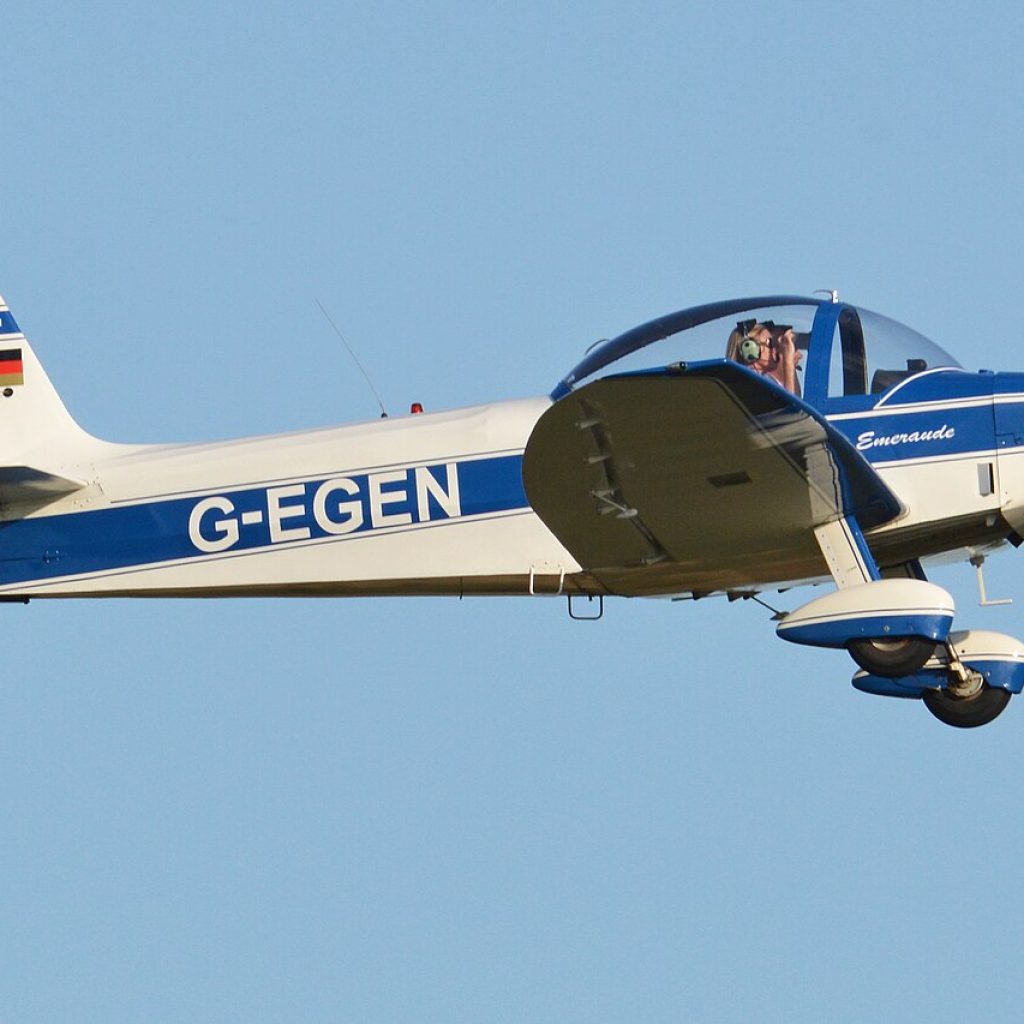
The Piel Emeraude is a French two-seat, side-by-side, low-wing tourer from the 1950s, built in wood with ply and fabric covering and a tailwheel undercarriage. Several French and German factories built it, as did amateurs. The later Super Emeraude has a strengthened airframe and more power. In the UK both factory-built and amateur-built examples fly on LAA Permits to Fly as Group A aeroplanes.
It suits pilots who want a characterful, efficient wooden two-seater that cruises at over 100 kt on a 90 hp Continental. It is a close cousin in spirit to the Jodel and a little sleeker. Find examples in our aircraft listings or other LAA aircraft.
History and design
Claude Piel designed the CP-30 Emeraude (’emerald’), which first flew on 19 June 1954 with a Continental A65. Production versions followed from Coopavia, Rousseau, Scintex and Menavia in France and Binder Aviatik in Germany, with progressive changes such as a sliding canopy, smaller control surfaces, pointed wingtips, wheel spats and a revised tail. In the UK, Garland-Bianchi and Fairtravel built five Linnets, a British factory version of the CP301A.
At Scintex in the early 1960s Piel produced the Super Emeraude, with a stronger spar and longerons, less wing incidence, larger tail surfaces and a cleaned-up canopy and cowling. It became the basis for the CAP 10. The structure throughout is all wood with ply and fabric skins and a one-piece wing built around a laminated box spar. Controls use push-pull rods and steel cables. The main fuel tank behind the firewall holds about 80 litres, depending on variant, and a second 40-litre tank sits under the baggage area. Scintex aircraft have a sliding canopy, while homebuilts usually have a fixed canopy with twin hinged doors.
Variants
CP301A (LAA 050): the basic production version with a 90 hp Continental C90-14F. MTOW 610 kg in the UK.
CP301B (LAA 050): Rousseau-built version with improved interior and minor changes. One UK CP301B was rebuilt with Super Emeraude wings and tail and an O-200A, with a 665 kg MTOW.
CP301C, C1, C2, C3 (LAA 050): Scintex versions with design changes to the span and tail. MTOW 650 kg for the CP301C.
CP301S Smaragd (LAA 050): the German Binder-built version, C90 or O-200A, with a 680 kg MTOW.
Scintex CP1315-C3 (LAA 050): a Super Emeraude with a Potez 4E-20 engine and a 700 kg MTOW. The CP1310-C3 is the O-200 version.
CP.328 Super Emeraude (LAA 216): the homebuilt Super Emeraude with a swept tail. The LAA says only one, G-BPRT, was completed in the UK, and it was written off in 1997.
Linnet: the UK-built Garland-Bianchi and Fairtravel Linnets are covered by a separate LAA type (837) and treated as CP301As for continuing airworthiness.
Specifications
UK limits are from the combined LAA data sheet for types 050 and 216. Dimensions and performance are Jane’s 1961–62 figures for the Scintex CP301C1 with a C90, as quoted by Wikipedia. Limits vary by variant and by individual aircraft, so always check the aircraft’s own operating limitations.
Specification
Imperial
Metric
Wingspan (CP301C1)
27 ft 1 in
8.25 m
Length (CP301C1)
20 ft 1 in
6.12 m
Wing area (CP301C1)
118 sq ft
11.0 m²
Empty weight (CP301C1)
871 lb
395 kg
MTOW: CP301A / CP301C (LAA)
1,345 / 1,433 lb
610 / 650 kg
MTOW: CP301S / CP328 / CP1315-C3 (LAA)
1,499 / 1,504 / 1,543 lb
680 / 682 / 700 kg
Fuel (approximate, varies)
About 18 + 9 imp gal
About 80 + 40 litres
Engine (CP301A/C)
Continental C90-14F, 90 hp
Propeller
Two-blade fixed-pitch wooden
Vne: CP301A / CP301C (LAA)
145 / 148 mph (126 / 129 kt)
233 / 238 km/h
Vne: CP328 / CP1315-C3 (LAA)
150 kt / 173 mph (150 kt)
278 km/h
Flap limit: CP301A / CP301C (LAA)
77 / 80 mph
124 / 129 km/h
Cruise, 75% (CP301C1)
105–108 kt
195–200 km/h
Maximum speed (CP301C1)
113–116 kt
210–215 km/h
Climb (CP301C1)
590 ft/min
3.0 m/s
Service ceiling (CP301C1)
13,000 ft
4,000 m
Range, no reserves (CP301C1)
540 nm
1,000 km
Performance and handling
A C90 Emeraude cruises at around 105 kt at 75% power. Jane’s gives a still-air range of about 1,000 km without reserves, so with two tanks it is a genuine touring aircraft. Flaps are fitted (15° for take-off and 30° for landing on the LAA figures), and flap limits are low, around 77–80 mph on the C90 variants.
Although the Super Emeraude was originally certified for aerobatics in France, a French airworthiness directive (F-1964-020) withdrew aerobatic approval for the CP1310-C3 and CP1315-C3, and the LAA says no UK Emeraudes are cleared for aerobatics. Spinning is also prohibited on the examples the LAA lists.
Owning one in the UK
Licence: a Group A type, so an NPPL SSEA, LAPL or PPL, plus tailwheel differences training.
Permit to Fly: factory-built and amateur-built Emeraudes fly on LAA Permits, inspected annually by an LAA inspector. CAA MPD 1995-001 applies to ex-CofA aircraft now on a Permit.
Airworthiness directives: several old French ADs apply to particular variants and serial numbers. They cover the undercarriage attachment (repeat inspection annually and after any heavy landing or ground loop), main undercarriage tube gussets, control column replacement and, on Potez engines, propeller inspections. The LAA lists no mandatory modifications for Permit aircraft.
Engine and fuel: most have the Continental C90 or O-200. Some have the Lycoming O-235 or Potez 4E. Check the approved fuels for the engine fitted.
Manuals: factory aircraft should have their original flight manual. The LAA can supply an English Emeraude maintenance manual to owners.
Plans and support: there is no UK agent. English plans come from S. Littner Aircraft Plans in Canada, and there is a French owners’ forum. See the LAA and Wikipedia.
Related types: compare the Jodel D11 and D119, or Piel’s four-seat development, the Piel Saphir.
Buying checklist
Confirm the exact variant, maker and serial number, and check which French ADs apply and are recorded.
Inspect the undercarriage attachment fittings and nearby structure for cracking or glue failure (AD F-1960-030-006), especially after any ground loop.
Remove the tailplane occasionally to check the four aluminium attachment brackets for cracks. The LAA recommends repeating the 1985 dye-penetrant check.
Check the aluminium flap and aileron brackets on the spar for corrosion, and the trim tab connections and tailplane, which a 2015 Safety Spot found badly corroded.
Test the canopy latches. An unlatched sliding canopy caused an accident in 1981.
Inspect the spinner backplate for cracks.
Have a wooden-aircraft inspector check the box spar, glue joints, ply and fabric.
LAA type acceptance
The Light Aircraft Association lists these variants under the following type numbers. Check the LAA Type Acceptance Data Sheets (TADS) for the current approved engines, propellers and modifications before you buy.
It is an LAA Group A aeroplane, so an NPPL SSEA, LAPL or PPL, with tailwheel differences training.
Is the Emeraude on a Permit or a CofA?
UK examples, factory-built and amateur-built, fly on LAA Permits to Fly. CAA MPD 1995-001 covers ex-CofA aircraft moved to a Permit.
What is the difference between the Emeraude and Super Emeraude?
The Super Emeraude has a stronger spar and longerons, less wing incidence, larger tail surfaces and a cleaner canopy and cowling, and it usually has a more powerful engine.
What engine does it have?
The CP301A and CP301C have the 90 hp Continental C90-14F. Other variants have the O-200, Lycoming O-235 or Potez 4E-20.
How fast does it cruise?
Jane’s data for the CP301C1 with a C90 gives 105–108 kt at 75% power.
What is the MTOW?
It depends on the variant: the LAA lists 610 kg for the CP301A, 650 kg for the CP301C, 680 kg for the CP301S and 700 kg for the CP1315-C3.
Is the Emeraude aerobatic?
No. The LAA says no UK Emeraudes are cleared for aerobatics, and a French AD withdrew aerobatic approval for the CP1310-C3 and CP1315-C3.
How far can it fly?
Jane’s gives about 1,000 km (540 nm) for the CP301C1 without reserves, using the main and rear tanks.
Can I build one?
Yes, from plans. There is no kit. The LAA says UK builders should get English plans from S. Littner Aircraft Plans in Canada.
Who supports it in the UK?
There is no UK agent. LAA Engineering holds data on the type and can supply an English maintenance manual to owners.
What should I check on an Emeraude?
The undercarriage attachments, tailplane brackets, flap and aileron bracket corrosion, canopy latches, spinner backplate and the wooden structure.
Figures are typical published values for a standard example and vary with engine, propeller, build and modification state. Always use the aircraft’s own Pilot’s Operating Handbook, weight and balance schedule and LAA paperwork. Last checked November 2026.