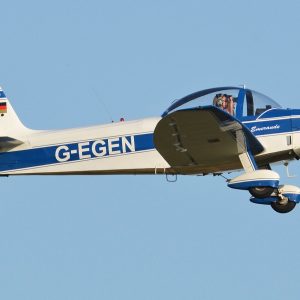
The One Design DR-107 is a small single-seat aerobatic monoplane designed by Dan Rihn to give competition pilots a capable, affordable mount for everything from Basic to Advanced sequences. Stressed to plus and minus 10 g and powered by a 160 to 180 hp Lycoming, it packs serious aerobatic performance into an airframe with a span of under 20 feet.
In the UK the type flies on an LAA Permit to Fly as a Group A aeroplane under LAA type 264. It suits pilots who want a dedicated aerobatic aircraft that is cheaper to buy and run than a factory-built competition machine, and who are comfortable with a light, short-coupled tailwheel aircraft.
History and design
Rihn’s DR-107 first flew in 1993. The aim, as its name suggests, was a single design that many pilots could build and fly in competition on equal terms, at low cost. Plans and a materials kit are sold through Aircraft Spruce & Specialty of Corona, California, and builders sign a licence agreement before plans are shipped. By 1998 hundreds of plans and kits had been sold, and by November 2013 at least 56 had been completed, including ten on the UK register.
The structure mixes traditional materials. The wing is all wood, with a 16 per cent symmetrical Wainfan aerofoil, almost full-span ailerons and no flaps. The fuselage is a welded steel truss with aluminium skin ahead of and behind the cockpit and fabric covering on the tail and lower rear fuselage. The tailplane is low-set and cable-braced, the pilot sits under a bubble canopy, and the undercarriage is a one-piece aluminium spring main gear with a steerable tailwheel. The intended engine is a Lycoming O-360 modified with high-compression pistons, fuel injection and an inverted oil system, although the 160 hp Lycoming (AE)IO-320 is also a standard fit.
Variants
DR-107 One Design (LAA 264, Group A): the only LAA-accepted version. UK examples differ mainly in engine and propeller; the AAIB recorded a Lycoming IO-360-B1B in G-CEPZ, built in 1996.
Rihn’s later DR-109 is a separate design and is not on the LAA type list.
Specifications
Figures are Aircraft Spruce’s published data for the plans-built aircraft unless stated. Weights in particular vary with the engine and equipment of each example, so check the aircraft’s weight report and Operating Limitations.
Specification
Imperial
Metric
Seats
1
Wingspan
19 ft 4 in
5.88 m
Wing area
75.5 sq ft
7.0 m²
Empty weight
710 lb
322 kg
Gross weight
1,140 lb
517 kg
Fuel capacity
20 US gal (16.7 imp gal)
76 litres
Engine
Lycoming IO-320 160 hp standard; modified O-360 180 hp
Cruise (75% power)
139 kt (160 mph)
257 km/h
Maximum level speed
160 kt (184 mph)
296 km/h
Range
330 nm (380 miles)
611 km
Take-off distance
600 ft
183 m
Landing distance
600 ft
183 m
Load factor
+10 g / -10 g
Performance and handling
The DR-107 was drawn to get the most from a Lycoming O-360 in an aerobatic airframe, and the numbers show it. Aircraft Spruce quotes a cruise of 160 mph (139 kt) at 75 per cent power and a maximum level speed of 184 mph, and the airframe is stressed to plus and minus 10 g. The symmetrical aerofoil and near full-span ailerons are chosen for crisp roll response and similar behaviour upright and inverted, which is what a competition aircraft needs.
It is also a light, short tailwheel aircraft, and that shows up in the UK accident record. In 2006 the AAIB reported that G-IIID ground-looped at Tatenhill after the tailwheel securing pin came out of its cantilever spring, and in 2016 G-CEPZ tipped onto its nose at Membury under maximum braking, which the AAIB linked to the type’s light tailwheel design. Treat the brakes with care and keep the tailwheel assembly in good order. With a range of about 330 nm the DR-107 can manage a short cross-country, but it is really a machine for aerobatic boxes and competitions.
Owning one in the UK
The DR-107 is an LAA Group A aircraft, so you need an NPPL SSEA, a LAPL(A) or a PPL(A), plus tailwheel experience and proper aerobatic training. It flies on an LAA-administered Permit to Fly, renewed every year after an inspection by an LAA inspector, which keeps costs well below those of a certified aerobatic aircraft. Check the aircraft’s Operating Limitations for the manoeuvres and limits it has been cleared for.
Because it is plans built from a materials kit, every DR-107 is different. The wooden wing deserves careful inspection and the aircraft should be hangared, and the steel fuselage, fabric and aluminium spring gear need the usual checks for corrosion, damage and fatigue on a hard-worked aerobatic aircraft. Parts for the airframe come through Aircraft Spruce, while engine support is from the usual Lycoming specialists. There is no UK agent.
Check the LAA paperwork for type 264, the Operating Limitations and the cleared aerobatic manoeuvres and g limits.
Ask for a recent weight and balance report: empty weights vary widely between builds and engines.
Have the wooden wing inspected for glue line failure, damp and any overstress, especially after competition use.
Inspect the steel fuselage truss for corrosion and cracking around the engine mount and gear attachments.
Check the tailwheel spring, securing pin and steering, and the main gear spring and brakes.
Confirm the engine type and the condition of the inverted oil and fuel systems, and review the engine logbook.
Look at the fabric and the canopy, and how and where the aircraft has been stored.
Ask how many g the aircraft has been flown to and whether it has a g-meter record.
LAA type acceptance
The Light Aircraft Association lists these variants under the following type numbers. Check the LAA Type Acceptance Data Sheets (TADS) for the current approved engines, propellers and modifications before you buy.
It is an LAA Group A aircraft, so you need an NPPL SSEA, LAPL(A) or PPL(A). You will also want tailwheel experience and formal aerobatic training.
Is the DR-107 on a Permit or a CofA?
It flies on an LAA-administered Permit to Fly under LAA type 264, revalidated each year after an LAA inspection.
How strong is it?
The DR-107 is stressed to plus and minus 10 g, which is why it suits Basic to Advanced competition aerobatics.
What engine does it use?
Aircraft Spruce lists a 160 hp Lycoming IO-320 as standard, with a modified 180 hp O-360 as the intended high-performance fit. One UK example had a Lycoming IO-360-B1B.
How fast does it go?
Aircraft Spruce quotes a 160 mph (139 kt) cruise at 75 per cent power and a maximum level speed of 184 mph.
How many are in the UK?
Wikipedia, citing the CAA register, counted ten in the UK in November 2013, out of at least 56 completed worldwide.
Can I build one?
Yes. Plans and a materials kit are available from Aircraft Spruce, and builders must sign a licence agreement. Estimates of build time range from about 2,000 to 3,000 hours.
Is it a tailwheel aircraft?
Yes. It has an aluminium spring main gear and a steerable tailwheel, and UK accident reports show it is sensitive to heavy braking and tailwheel problems.
Can I take a passenger?
No. The DR-107 is a single-seater.
Is it good for touring?
Not really. Aircraft Spruce quotes a range of about 380 miles on 20 US gallons, and the small cockpit leaves little room for baggage.
Figures are typical published values for a standard example and vary with engine, propeller, build and modification state. Always use the aircraft’s own Pilot’s Operating Handbook, weight and balance schedule and LAA paperwork. Last checked November 2026.