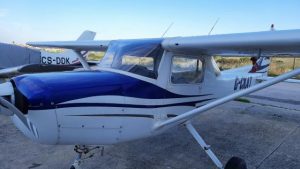
The Cessna 152 is the two-seat high-wing trainer that replaced the Cessna 150, and it is still one of the most common aeroplanes at UK flying schools and clubs. It looks almost identical to the late 150, but it has a 110 hp Lycoming O-235 engine, a higher maximum weight, a 28-volt electrical system and flaps limited to 30 degrees.
For UK pilots the 152 is a known quantity: simple, robust, easy to hire or share, and cheap to insure compared with faster four-seaters. Reims Aviation in France built 552 as the F152 alongside the US production, so many British examples are French-built. It is a certified type on a Certificate of Airworthiness, flown on a PPL, LAPL or NPPL.
History and design
Cessna introduced the 152 for the 1978 model year as a development of the 150. The aims were a higher gross weight (1,670 lb), less noise, and an engine better suited to the 100LL avgas that was replacing 80-octane fuel. Production ran until 1985, when Cessna stopped building light piston aircraft, by which time 7,584 had been built worldwide including the Reims aircraft.
All 152s use the Lycoming O-235. The original O-235-L2C (1978-82) suffered from spark plug lead fouling on 100LL, so from the 1983 model Cessna switched to the O-235-N2C. The 1978 aircraft had a one-piece nose bowl that needs the propeller removed for access; from 1979 a split cowling made maintenance easier. The structure is conventional all-metal, with two 13 US gallon wing tanks as standard and an optional long-range system.
Variants
152 (1978-85): standard US-built model, 6,628 built.
152 II and 152 T: equipment packages; the II adds the Nav Pac avionics, the T is a trainer fit.
Reims F152: French-built 152, 552 built, approved in June 1977.
A152 and FA152 Aerobat: aerobatic versions (315 and 89 built) approved to +6/-3 g. See our Aerobat page for the earlier 150-based aircraft.
Engines: O-235-L2C on 1978-82 aircraft; O-235-N2C on 1983-on aircraft (the type data sheet rates it at 108 hp) and on earlier aircraft converted by Cessna kit.
Specifications
Figures are for the 1978 Cessna 152 unless stated. Check the Pilot’s Operating Handbook and weight schedule for any individual aircraft.
Specification
Imperial
Metric
Wingspan
33 ft 4 in
10.16 m
Length
24 ft 1 in
7.34 m
Height
8 ft 6 in
2.59 m
Empty weight
1,081 lb (1978); 1,109 lb (1985)
490 kg; 503 kg
Maximum take-off weight
1,670 lb (ramp 1,675 lb from 1979)
757 kg
Useful load (1978)
589 lb
267 kg
Fuel (standard)
26 US gal total, 24.5 US gal usable
98 L total, 93 L usable
Fuel (long-range)
39 US gal total, 37.5 US gal usable
148 L total, 142 L usable
Engine
Lycoming O-235-L2C 110 hp (1978-82); O-235-N2C (1983 on)
Propeller
Two-blade fixed pitch, 69 in (1.75 m) McCauley; 72 in Sensenich option
Never-exceed speed (Vne)
149 kt IAS
276 km/h
Maximum structural cruising speed
111 kt IAS
206 km/h
Cruise (75% power, 8,000 ft)
107 kt
198 km/h
Stall (flaps down / clean)
43 / 48 kt
80 / 89 km/h
Rate of climb (sea level)
715 ft/min
3.6 m/s
Service ceiling
14,700 ft
4,480 m
Range (standard tanks, 45 min reserve)
350 nm at 75% power; 415 nm at 10,000 ft best range
648 km; 769 km
Take-off (ground roll / over 50 ft)
725 ft / 1,340 ft
221 m / 408 m
Landing (ground roll / over 50 ft)
475 ft / 1,200 ft
145 m / 366 m
Performance and handling
Performance is close to the 150 it replaced. The book cruise is 107 kt at 75% power at 8,000 ft, burning about 6.1 US gallons (23 litres) an hour. Many owners find real-world figures a little lower; one buyer’s guide calls the published top speed generous for a standard aircraft. Two adults, full fuel and some baggage will often put you close to the 1,670 lb limit, so do the weight and balance properly.
The 152 is certified in the utility category and approved for spins and basic manoeuvres such as chandelles, lazy eights and steep turns within the placarded limits. Handling is predictable and the stall is gentle, which is why schools use it for spin awareness and circuit training. Crosswinds need attention because of the light weight and high wing.
Owning one in the UK
Licence: a PPL(A) or LAPL(A) with an SEP rating. Since 2021 an NPPL(A) with a valid SSEA/SEP rating may fly G-registered Part 21 aircraft such as the 152, but only in UK airspace unless another country agrees.
Airworthiness: the 152 is a certified type with a non-expiring Certificate of Airworthiness, validated each year by an Airworthiness Review Certificate. Maintenance follows the CAA’s Part-ML rules, and pilot-owner maintenance is limited to simple tasks. It is not an LAA Permit type, so expect certified-aircraft maintenance costs.
Fuel and engine: the type data specifies 100LL/100 minimum grade avgas. TBO for the O-235 is quoted at 2,000 hours on the 1978 aircraft and later rose to 2,400 hours, which helps running costs compared with the 150.
Inspection points: FAA AD 2011-10-09 requires repetitive inspection of the seat rails and roller housings on the 150 and 152. Door latches commonly wear and are often replaced, and ex-school aircraft should be checked for nose gear and firewall damage from heavy landings.
Support: almost every UK maintenance organisation working on light Cessnas can support the 152, and the Cessna 150-152 Club is a good source of data. See also the earlier Cessna 150, a modern LAA alternative such as the Tecnam P2002 Sierra, or current examples in our listings. More history is on Wikipedia.
Buying checklist
Check the engine model: early O-235-L2C engines can foul plugs on 100LL; ask how the aircraft has been operated and leaned.
Confirm FAA AD 2011-10-09 seat rail and roller housing inspections are recorded.
Inspect nose gear, firewall and engine mounts for heavy-landing damage typical of training use.
Check door latches and the general cabin condition; latch replacement is common.
Confirm the CofA, current ARC and a Part-ML maintenance programme.
Compare engine hours with the TBO and look for compression and oil analysis history.
Check whether long-range tanks are fitted if you plan longer trips.
Do a realistic weight and balance with your usual crew before you commit.
Frequently asked questions
What licence do I need to fly a Cessna 152 in the UK?
A PPL(A) or LAPL(A) with an SEP rating. An NPPL(A) with a valid SSEA/SEP rating can also fly a G-registered Cessna 152, but only in UK airspace.
Is the Cessna 152 on a Permit or a CofA?
A Certificate of Airworthiness. It is a certified type maintained under Part-ML and needs an annual Airworthiness Review Certificate; it is not an LAA Permit aircraft.
What is the difference between a Cessna 150 and 152?
The 152 has a 110 hp Lycoming O-235 instead of the 100 hp Continental O-200, a 1,670 lb gross weight, a 28-volt electrical system and flaps limited to 30 degrees. Performance is very similar.
What is a Reims F152?
A Cessna 152 built under licence by Reims Aviation in France. 552 were built, and many UK 152s are Reims aircraft.
How much fuel does a Cessna 152 burn?
About 6.1 US gallons (23 litres) an hour at 75% power, according to AOPA’s data for the 1978 model.
How fast is a Cessna 152?
The book cruise is 107 kt at 75% power at 8,000 ft. Many owners see a little less in practice.
What fuel does a Cessna 152 use?
The type data specifies 100LL/100 minimum grade aviation gasoline.
Can a Cessna 152 fly to France?
Yes. Standard tanks give about 350 nm at 75% power with a 45-minute reserve. An NPPL is not valid outside UK airspace unless another country agrees, so check your licence.
Can you spin a Cessna 152?
Yes. In the utility category, intentional spins are approved with flaps up, which is one reason schools use it for spin awareness training.
What should I check before buying a Cessna 152?
Seat rail AD compliance, nose gear and firewall condition, engine type and hours, door latches, and the CofA and ARC paperwork.
Who maintains Cessna 152s in the UK?
Most UK maintenance organisations and licensed engineers that work on light Cessnas, under the Part-ML rules.
Figures are typical published values for a standard example and vary with engine, propeller, build and modification state. Always use the aircraft’s own Pilot’s Operating Handbook, weight and balance schedule and LAA paperwork. Last checked November 2026.