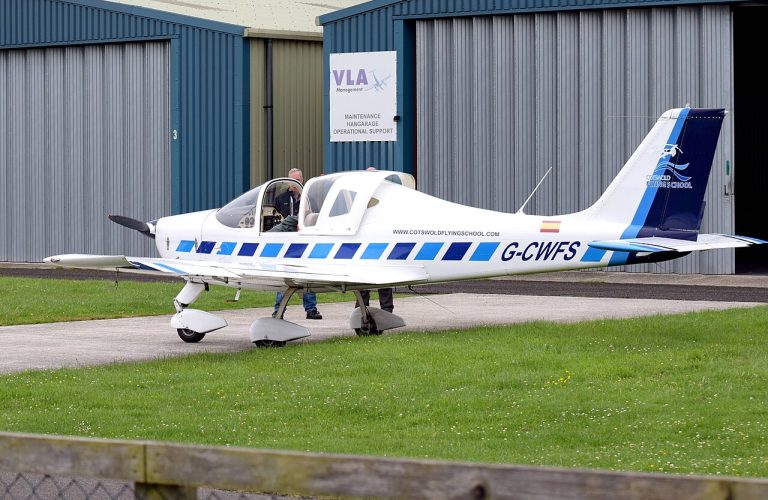
The Piel CP.1320 Saphir is one of Claude Piel’s last designs: a wooden, low-wing touring aircraft that takes the Emeraude family a step further, with a tapered wing, a stronger fuselage and an engine in the 150–160 hp class. It seats two side by side, and the plans allow an optional rear bench for one adult or two children. It was only ever built from plans, so every example is a one-off.
In the UK the Saphir is very rare, and it appeals mainly to builders and owners who already like Piel’s wooden aircraft and want more speed and power than an Emeraude gives. If you are looking at one, you are buying an individual homebuilt aircraft, and its own paperwork matters far more than published figures.
History and design
Claude Piel (1921–1982) designed a long line of light aircraft, the best known being the CP.30 Emeraude and the Super Emeraude. According to Wikipedia’s Claude Piel article, the CP.1320 Saphir combined a new tapered wing with a strengthened Emeraude fuselage and was designed for amateur builders.
Photo-archive notes by Walter van Tilborg in the Henk Wadman collection say the type was meant as a possible successor to the Emeraude, with a wooden fuselage, a wood-skinned wing and provision for retractable landing gear. The first Saphir was built near Bordeaux by Jacques and Jean-Claude Lascoutounas and flew on 31 October 1979 as F-WYIE, with a 160 hp Lycoming O-320-C2A and fixed tricycle gear. Two later French-built examples had retractable gear. Builders could choose a tailwheel or tricycle layout.
English-language plans are sold by S. Littner in Quebec, Canada. Littner’s listing on homebuilt.org describes a wood-and-fabric 2+2 with retractable or fixed tailwheel gear and gives three weight categories (normal, utility and aerobatic), each with its own maximum weight and g limits.
At least one Saphir has been built in the UK under the PFA/LAA system: G-CFIH, a 2008 CP-1320 built as project PFA 170-11266.
Variants
CP.1320 Saphir (LAA type 170): the basic model, for engines of about 100–160 hp. The prototype used a 160 hp Lycoming O-320-C2A. Wikipedia lists the type with the 150 hp O-320-C2A.
CP.1320/CP.1321 Saphir (LAA type 183): the CP.1321 is similar to the CP.1320 but has a 145 hp Continental O-300.
CP.1320 D and CP.1321 B: one-off modified French aircraft. The CP.1320 D had fixed tricycle gear and a 150/160 hp O-320. These are not separate LAA types.
The Saphir is a different aircraft from the Emeraude and Super Emeraude, even though it uses an Emeraude-derived fuselage. Don’t apply Emeraude figures to it.
Specifications
These figures are the plans supplier’s published figures (S. Littner, via homebuilt.org). They are design figures, not measured on a UK aircraft, and I could not find a second source to check them against. Weights are for the normal category unless stated. A UK Saphir’s own Operating Limitations set its actual MTOW and speeds.
Specification
Imperial
Metric
Wingspan
26 ft
7.92 m
Length
22 ft
6.71 m
Wing area
119 sq ft
11.1 m²
Empty weight (normal/utility)
1,190 lb
540 kg
Maximum take-off weight (normal)
2,075 lb
941 kg
Maximum take-off weight (aerobatic)
1,545 lb
701 kg
Engine
Lycoming O-320, 150–160 hp (CP.1320); Continental O-300, 145 hp (CP.1321)
Maximum speed
200 mph
322 km/h (174 kt)
Cruise, 75% at 5,000 ft
167 mph
269 km/h (145 kt)
Cruise, 65% at 5,000 ft
152 mph
245 km/h (132 kt)
Never exceed (Vne)
211 mph
340 km/h (183 kt)
Stall, flaps up / down
62 / 53 mph
100 / 85 km/h (54 / 46 kt)
Rate of climb
1,900 ft/min
9.7 m/s
Take-off distance
650 ft
198 m
Landing distance
980 ft
299 m
Range
680 miles
1,094 km
Limit load factors
+3.8/−1.9 g (normal, 941 kg); +4.4/−2.2 g (utility, 871 kg); +6/−3 g (aerobatic, 701 kg)
Performance and handling
On paper the Saphir is a quick aircraft for a wooden two-seater: the plans figures give a 145 kt cruise at 75% power and a climb of 1,900 ft/min, with a flapped stall of 46 kt. Treat these as best-case design figures. Real aircraft vary with engine, propeller, gear type (fixed or retractable) and the builder’s finish, and I found no independent flight test to confirm them.
The plans give an aerobatic category at a much lower weight (701 kg), and the Wadman notes describe the design as aerobatic. Whether a particular UK Saphir is cleared for aerobatics depends entirely on its LAA Operating Limitations, so check them rather than assume.
Owning one in the UK
Licence: an LAA Group A type, so an NPPL SSEA, LAPL or PPL, with tailwheel differences training if the aircraft is a taildragger. A retractable-gear example also needs retractable-gear differences training.
Permit to Fly: UK Saphirs are amateur-built and fly on an LAA Permit to Fly, with an annual inspection by an LAA inspector and permit revalidation. The LAA’s engineering fees list £336 for revalidating an aeroplane of 451–999 kg MTOW.
Engine and fuel: most will have a Lycoming O-320 or Continental O-300. Check which fuels are approved for the engine fitted in the aircraft’s Operating Limitations.
Hangarage: a wooden, fabric-covered airframe needs a dry hangar. The wing does not fold.
Plans and support: there is no UK agent or factory. Plans come from S. Littner in Canada, and support comes from LAA Engineering, LAA inspectors with wooden-aircraft experience and other Piel owners.
Confirm which LAA type the aircraft is (170 or 183) and that the engine fitted matches its Permit paperwork.
Read the Operating Limitations for MTOW, Vne and any aerobatic clearance; don’t rely on plans figures.
If it has retractable gear, check the gear mechanism, emergency extension and warning system, and ask for its maintenance history.
Have an inspector with wooden-aircraft experience check glue joints, the spar and the wing attachments, and look for moisture damage.
Check the fabric and finish, and when the aircraft was last recovered.
Ask for the build records, the builder’s log and the first-flight test report, as a rare type has no fleet history to fall back on.
Ask how the owner gets parts, especially for the undercarriage and canopy.
LAA type acceptance
The Light Aircraft Association lists these variants under the following type numbers. Check the LAA Type Acceptance Data Sheets (TADS) for the current approved engines, propellers and modifications before you buy.
A wooden, low-wing light aircraft designed by Claude Piel as a possible successor to the Emeraude. It uses a strengthened Emeraude-type fuselage with a new tapered wing and was designed for amateur builders.
How many seats does it have?
Two side by side, with an optional rear bench that the plans say can take one adult of up to 170 lb or two children.
What licence do I need to fly one?
It is an LAA Group A type, so an NPPL SSEA, LAPL or PPL. You’ll need tailwheel differences training for a taildragger and retractable-gear training for a retractable example.
Is it on a Permit or a CofA?
UK Saphirs are amateur-built and fly on an LAA Permit to Fly, with an annual inspection by an LAA inspector.
What engine does it use?
The CP.1320 is designed for engines of about 100–160 hp; the prototype used a 160 hp Lycoming O-320-C2A. The CP.1321 uses a 145 hp Continental O-300.
How fast is it?
The plans supplier quotes 167 mph (145 kt) at 75% power and 5,000 ft, with a Vne of 211 mph (183 kt). These are design figures, and I found no independent test to confirm them.
Is the Saphir aerobatic?
The plans give an aerobatic category at 1,545 lb (701 kg) with +6/−3 g limits. A UK aircraft can only be flown aerobatically if its LAA Operating Limitations allow it.
Can I build one?
Yes. English plans are sold by S. Littner in Quebec, Canada. A UK build is registered and inspected through the LAA.
Are there any in the UK?
Yes, but very few. G-CFIH is a CP-1320 built in 2008 under the PFA/LAA system (PFA 170-11266).
How much does the permit cost?
The LAA lists £336 for permit revalidation of an aeroplane of 451–999 kg MTOW, on top of your inspector’s time.
Who supports it in the UK?
There is no UK agent or factory support. Owners rely on the plans supplier, LAA Engineering and LAA inspectors.
Figures are typical published values for a standard example and vary with engine, propeller, build and modification state. Always use the aircraft’s own Pilot’s Operating Handbook, weight and balance schedule and LAA paperwork. Last checked November 2026.