The Van’s RV-14 is the newest of the two-seat aerobatic RVs: a side-by-side, all-metal, low-wing kit aircraft with a wider and taller cabin than the RV-7, a 200–215 hp Lycoming and a cruise of around 170 knots. It comes as the tailwheel RV-14 or the nosewheel RV-14A, and in the UK both fly on an LAA Permit to Fly as Group A aeroplanes under type 393.
It suits larger pilots, people who want a quick touring two-seater that will also loop and roll, and builders who want the most complete RV kit yet. Flying examples rarely come up for sale in the UK; the RV-14 listings seen on this site have mostly been part-built empennage kits, so many buyers start with a kit or project.
History and design
Van’s unveiled the RV-14 at AirVenture in July 2012 after several years of design work. It borrows ideas from the four-seat RV-10, but it is a two-seater built for aerobatics. Van’s gave it more room for big pilots and baggage, better visibility, bigger flaps for lower landing speeds, and landing gear designed to Part 23 standards. Wikipedia put the number completed and flying at 207 by November 2022.
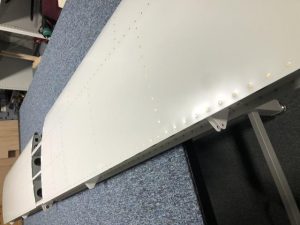
The kit is the most developed Van’s has offered. Parts are pre-formed and match-hole punched, so the airframe is self-jigging. Wing spars arrive assembled, welding is done, the canopy is pre-trimmed and the engine baffles are pre-fitted, and quick-build wings and fuselage are available. Van’s says many builders have finished faster than on earlier driven-rivet RVs, some in under a year. In July 2020 Van’s introduced the 215 hp Lycoming IO-390-EXP119, optimised for the type, which Wikipedia says adds about 11 mph in cruise and 250 ft/min in the climb over the 210 hp IO-390. Specifications are on the Van’s RV-14 page.
Variants
RV-14 (LAA 393): tailwheel version. Van’s performance data is for the 200 hp IO-360; height 5 ft 11.75 in, empty weight 1,225 lb.
RV-14A (LAA 393): tricycle version with an elastomer-sprung nose gear similar to the RV-10’s; data is for the 210 hp IO-390A or 215 hp IO-390-EXP119; height 8 ft 2 in, empty weight 1,240 lb.
Both share the same 27 ft wing, 50 US gallon fuel, 2,050 lb gross weight and 1,900 lb aerobatic gross weight, and both use a constant-speed propeller.
Specifications
Van’s Aircraft figures. Performance is for the RV-14A with the 215 hp IO-390-EXP119 at 2,050 lb gross unless stated; speeds were published in mph and are converted to knots.
Specification
Imperial
Metric
Wingspan
27 ft
8.23 m
Length
21 ft 1 in
6.43 m
Height, RV-14 / RV-14A
5 ft 11.75 in / 8 ft 2 in
1.82 m / 2.49 m
Wing area
126.1 sq ft
11.72 m²
Empty weight, RV-14 / RV-14A
1,225 lb / 1,240 lb
556 kg / 562 kg
Gross weight
2,050 lb
930 kg
Aerobatic gross weight (+6/−3 g)
1,900 lb
862 kg
Useful load, RV-14A (calculated)
810 lb
367 kg
Baggage
100 lb
45 kg
Fuel capacity
50 US gal (41.6 imp gal)
189 litres
Engine
Lycoming IO-360 200 hp (RV-14), IO-390A 210 hp or IO-390-EXP119 215 hp (RV-14A)
Propeller
Constant-speed
Top speed
216 mph (188 kt)
348 km/h
Cruise, 75% at 8,000 ft (215 hp / 210 hp / RV-14 200 hp)
203 / 193 / 195 mph (176 / 168 / 169 kt)
327 / 311 / 314 km/h
Cruise, 55% at 8,000 ft (215 hp)
179 mph (156 kt)
288 km/h
Stall, at gross / solo
59 mph (51 kt) / 54 mph (47 kt)
95 km/h / 87 km/h
Rate of climb, at gross (215 hp / 210 hp)
1,680 / 1,500 ft/min
8.5 / 7.6 m/s
Take-off distance, at gross (RV-14A 215 hp / RV-14 200 hp)
375 ft / 512 ft
114 m / 156 m
Landing distance, at gross (RV-14A / RV-14)
340 ft / 550 ft
104 m / 168 m
Range, 75% / 55% at 8,000 ft (215 hp)
911 / 1,033 statute miles (792 / 898 nm)
1,466 / 1,662 km
Performance and handling
With the 215 hp engine Van’s quotes 203 mph (176 kt) at 75% power and 8,000 ft. A KITPLANES flight review of an EXP119-powered RV-14A recorded 180 knots true at 8,000 ft density altitude on 9.9 US gallons an hour, and 158 knots on 7.8 gallons an hour at a lower power setting, so the factory numbers look realistic. Climb at gross is around 1,500–1,700 ft/min depending on engine, and the gross-weight stall is about 51 knots with flap.
The reviewer found the cabin noticeably easier to get into than an RV-7 or RV-9, with roll forces a little heavier than the RV-7 and RV-8 and pitch on the light side. Stalls were gentle, with a buffet and a straight break. The aircraft is aerobatic up to 1,900 lb, so with two people on board you will need to manage fuel and baggage to stay within the aerobatic weight.
Owning one in the UK
The RV-14 is an LAA Group A aeroplane, flown on an NPPL SSEA, LAPL(A) or PPL(A). You will need variable-pitch propeller differences training if you are new to constant-speed props, tailwheel differences training for the RV-14, and an aerobatic rating to fly aerobatics on a UK Part-FCL licence. Aircraft fly on an LAA Permit to Fly, renewed each year after an LAA inspection, and owners can carry out their own maintenance under LAA oversight. The LAA’s night/IFR page lists the RV-6 to RV-10 among types it has cleared, but does not mention the RV-14, so assume day VFR unless an aircraft’s paperwork says otherwise.
All the engines Van’s lists are Lycomings. The IO-390-EXP119 carries an experimental designation and was supplied specifically for the RV-14, so check how the engine is described on the aircraft’s LAA paperwork and which fuel grades it is approved for. Van’s sells kits and parts direct; we have not confirmed a UK agent. Before you buy, check the LAA type data sheet for type 393 in the LAA Info Library.
On Van’s July 2026 price list the standard airframe kit is US$64,000–$64,300 for the RV-14 and US$64,900–$65,400 for the RV-14A, or about US$90,500–$91,900 as quick-build kits, before engine, propeller and avionics. Several UK listings are for part-built empennage kits rather than flying aircraft. Browse aircraft for sale and other LAA aircraft, or compare the Van’s RV-7, the RV-8 and the four-seat RV-10.
Buying checklist
Confirm whether it is an RV-14 (tailwheel) or RV-14A (nosewheel) and which engine is fitted: IO-360, IO-390A or IO-390-EXP119.
Check the LAA Permit and Operating Limitations, including any aerobatic limits and the aerobatic weight.
Get the weighed empty weight and work out the aerobatic payload; at 1,900 lb aerobatic gross there is not much margin for two large pilots and full fuel.
Check engine and propeller hours and paperwork, especially on an experimental EXP119 engine.
Look at the build log, the inspector’s stage inspections and compliance with Van’s service bulletins.
For part-built projects, confirm the kit serial numbers are registered to the seller and the LAA project registration can be transferred.
On the RV-14A, inspect the nose gear and its elastomer suspension; on the RV-14, the tailwheel and its spring.
LAA type acceptance
The Light Aircraft Association lists these variants under the following type numbers. Check the LAA Type Acceptance Data Sheets (TADS) for the current approved engines, propellers and modifications before you buy.
An NPPL SSEA, LAPL(A) or PPL(A). Add tailwheel differences training for the RV-14, variable-pitch propeller training if needed, and an aerobatic rating if you want to fly aerobatics.
Is the RV-14 on a Permit or a CofA?
UK RV-14s and RV-14As fly on an LAA Permit to Fly under type 393, renewed each year after an LAA inspection.
What is the difference between the RV-14 and RV-14A?
The RV-14 is the tailwheel version and the RV-14A has a nosewheel. Wing, fuel, gross weight and aerobatic limits are the same.
Is it aerobatic?
Yes. Van’s says the structure meets +6/−3 g at an aerobatic gross weight of 1,900 lb (862 kg).
How fast is it?
Van’s quotes 176 kt at 75% power and 8,000 ft with the 215 hp IO-390-EXP119. A KITPLANES flight review measured 180 knots true on 9.9 US gallons an hour.
What is the fuel burn?
Van’s does not publish one. The KITPLANES review saw 9.9 US gal/h at a fast cruise and 7.8 US gal/h at a lower power setting.
How far can it go?
Van’s quotes 911 statute miles (792 nm) at 75% and 1,033 statute miles (898 nm) at 55% on 50 US gallons, before reserves.
Is it good for big pilots?
That was a design goal. It has a wider cabin, taller canopy and more baggage space than the earlier side-by-side RVs.
How much does a kit cost?
Van’s July 2026 price list gives about US$64,000–$65,400 for a standard airframe kit and about US$90,500–$91,900 for quick-build, before engine, prop and avionics.
How long does it take to build?
Van’s says many builders finish faster than on earlier RVs, some in under a year. KITPLANES quoted an estimated 1,100 hours.
Can it fly IFR in the UK?
Only if the aircraft is individually cleared. The LAA night/IFR page names the RV-6 to RV-10 but not the RV-14, so check the Operating Limitations.
Figures are typical published values for a standard example and vary with engine, propeller, build and modification state. Always use the aircraft’s own Pilot’s Operating Handbook, weight and balance schedule and LAA paperwork. Last checked November 2026.