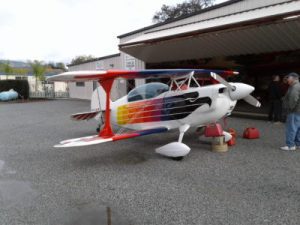
The Christen Eagle II is a two-seat aerobatic biplane designed from the start as a homebuilt kit. It looks like a Pitts at first glance, but it is a separate design with its own wing, a 200 hp Lycoming, a canopy over tandem cockpits and a famously complete kit. In the UK it flies on an LAA Permit to Fly as a Group A aeroplane under type 138.
It suits pilots who want a capable two-seat aerobatic aircraft for training, sport flying or display work, with the lower running costs of a Permit aircraft. Its time with the Eagles Aerobatic Team, from 1979 to 1995, made it one of the best-known airshow aircraft of its era.
History and design
Frank Christensen founded Christen Industries in 1972 and designed the Eagle to compete with the Pitts Special after he could not obtain the Pitts rights. The Eagle II first flew in February 1977. In 1979 the Eagles Aerobatic Team of Charlie Hillard, Tom Poberezny and Gene Soucy replaced their Pitts with Eagles, and flew them on the airshow circuit until 1995. Christen Industries later took over Pitts production at Afton, Wyoming, and in 1991 Aviat Aircraft bought the company, after which the type was sold as the Aviat Eagle. Wikipedia says more than 350 were flying by 2011.
In 2025 Chuck Therriault formed a new Christen Industries, bought the Eagle II rights from Aviat and restored the Christen Eagle name. The company, now in New Hampshire, says it will offer new kits and parts support and new modifications, including lightweight carbon parts. Its website is christenindustries.com.
The fuselage is welded chrome-moly steel tube, with aluminium panels as far back as the rear cockpit and fabric covering behind. The wings have spruce spars and wooden ribs under fabric. The original kit came as a sequence of 25 sub-kits, starting with the ailerons, with an exceptionally detailed manual. Background is in the Wikipedia article.
Variants
Eagle II (LAA 138): the two-seat production kit, with dual controls and a 200 hp Lycoming AEIO-360 driving a constant-speed propeller. This is the type you will find in the UK.
Eagle II-F: Plane & Pilot describes a version with a 260 hp engine and a fixed-pitch propeller; we have not confirmed whether any are in the UK.
Eagle I and Super Eagle: single-seat 260 hp and 300 hp aircraft and a short-fuel two-seat Super Eagle II, built in very small numbers. They are not covered by LAA type 138.
Specifications
Figures for the 200 hp Eagle II from Jane’s All the World’s Aircraft 2003–04 (via Wikipedia), cross-checked with Plane & Pilot. Speeds were published in mph and are converted to knots.
Specification
Imperial
Metric
Wingspan
19 ft 11 in
6.07 m
Length
17 ft 11 in
5.46 m
Height
6 ft 6 in
1.98 m
Wing area
125 sq ft
11.61 m²
Empty weight
1,025 lb
465 kg
Maximum take-off weight
1,578 lb
716 kg
Useful load (calculated)
553 lb
251 kg
Fuel, usable
24 US gal (20 imp gal)
91 litres
Engine
Lycoming AEIO-360-A1D, 200 hp, fuel injected
Propeller
Hartzell HC-C2YK-4/C7666A-2 two-blade constant-speed, 6 ft 4 in (1.93 m)
Vne
210 mph (182 kt)
338 km/h
Maximum speed
184 mph (160 kt)
296 km/h
Cruise
165 mph (143 kt)
266 km/h
Stall
58 mph (50 kt)
93 km/h
Rate of climb
2,100 ft/min
10.7 m/s
Range
380 nm
703 km
Service ceiling
17,000 ft
5,200 m
G limits
+9 / −6 g
Roll rate
187 degrees per second
Performance and handling
The Eagle II has a little less power and roll rate than a 260 hp Pitts S-2, but Jane’s gives it +9/−6 g limits and a 2,100 ft/min climb, which are strong figures for a two-seat aerobatic trainer. Real-world numbers are more modest: in a KITPLANES flight review Bob Grimstead saw about 1,100 ft/min at 75 knots in an aircraft with a high-time engine, a power-off stall of 54 knots and roughly two hours’ endurance on a 25-gallon tank. He flew base at 80 knots and crossed the threshold at 75.
Grimstead found take-offs and curved approaches straightforward, controls with plenty of authority and little friction, and the aircraft only just positively stable in all three axes. Its weak point is yaw: the rudder needs constant attention with every change of power or speed. Like any short-coupled aerobatic biplane, forward view on landing is limited and it needs to be flown by a current tailwheel pilot.
Owning one in the UK
The Eagle II is an LAA Group A aeroplane, so you need an NPPL SSEA, LAPL(A) or PPL(A) with tailwheel and variable-pitch propeller differences training, and an aerobatic rating if you hold a Part-FCL licence and want to fly aerobatics. All Eagles are amateur-built, and UK aircraft fly on an LAA Permit to Fly under type 138, inspected each year by an LAA inspector with owner maintenance under LAA oversight. That keeps running costs well below a certified aerobatic two-seater.
The AEIO-360 is a common aerobatic Lycoming, and UK sale listings show Eagle engines overhauled by UK engine shops. Parts and kit support now come from the revived Christen Industries in the USA. Insurers will want tailwheel and aerobatic experience, ideally on type. Read the LAA type data sheet for type 138 in the LAA Info Library before you buy.
Three UK Eagle IIs advertised on aircraftsale.co.uk in 2023 and 2024 were asking £79,950 (1981), £92,500 (1998) and £120,000 (2010). Browse aircraft for sale and other LAA aircraft, or compare the Pitts S-2 and the single-seat Pitts S-1.
Buying checklist
Check the fuel tank supports on the forward upper longerons, which KITPLANES says are thin tubing prone to fatigue cracking, and the central fuel tank tabs.
Inspect the lower fuselage longerons for cracks at the landing gear attachments, the fuel tank and exhaust mounts, and the smoke system injection point.
Check the wings for spar cracks after any hard landing and for rib glue failures.
Check flying and landing wire tensions; any sudden change means grounding the aircraft until it has been investigated.
Assess the fabric covering carefully, as its condition has a big effect on value.
Confirm the engine model, hours since overhaul and the propeller’s overhaul status, and the inverted fuel and oil systems.
Check the LAA Operating Limitations, including g limits and any aerobatic restrictions, and the build and modification records.
Check the canopy, its emergency release, harnesses and parachutes.
LAA type acceptance
The Light Aircraft Association lists these variants under the following type numbers. Check the LAA Type Acceptance Data Sheets (TADS) for the current approved engines, propellers and modifications before you buy.
What licence do I need to fly a Christen Eagle II?
An NPPL SSEA, LAPL(A) or PPL(A) with tailwheel and variable-pitch propeller differences training, plus an aerobatic rating on a Part-FCL licence for aerobatics.
Is the Eagle II on a Permit or a CofA?
UK Eagle IIs are amateur-built and fly on an LAA Permit to Fly under type 138, inspected each year by an LAA inspector.
How much does an Eagle II cost in the UK?
Three Eagle IIs advertised on aircraftsale.co.uk in 2023–24 were asking between £79,950 and £120,000, depending on age, hours and condition.
Is the Eagle a Pitts?
No. It was designed by Frank Christensen as a competitor to the Pitts Special, though Christen Industries later built Pitts aircraft too.
What engine does it have?
A 200 hp fuel-injected Lycoming AEIO-360-A1D with a Hartzell constant-speed propeller, according to Jane’s.
How aerobatic is it?
Jane’s gives +9/−6 g limits and a 187 degrees per second roll rate. Check the individual aircraft’s LAA Operating Limitations.
How fast is it?
Jane’s quotes 165 mph (143 kt) cruise and a 210 mph (182 kt) Vne.
How far can it go?
Jane’s gives 380 nm, but a KITPLANES reviewer reckoned on about two hours’ endurance, so plan short legs with reserves.
Is it hard to fly?
Take-offs and approaches are straightforward, but KITPLANES found little yaw stability, so it needs constant rudder work, and like any aerobatic biplane it needs a current tailwheel pilot.
Can I still buy a kit?
A newly formed Christen Industries bought the rights from Aviat in 2025 and plans new kits and parts support. Contact the company for availability.
Who supports the Eagle?
Christen Industries in the USA for parts and kits. In the UK, maintenance is under LAA oversight with an LAA inspector.
What should I check before buying?
Fuel tank supports and tank tabs, lower longerons at gear and exhaust mounts, wing spars and ribs, wire tensions and fabric condition.
Figures are typical published values for a standard example and vary with engine, propeller, build and modification state. Always use the aircraft’s own Pilot’s Operating Handbook, weight and balance schedule and LAA paperwork. Last checked November 2026.