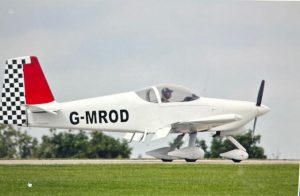
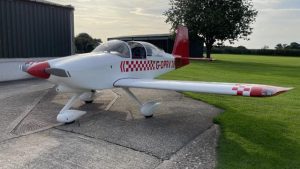
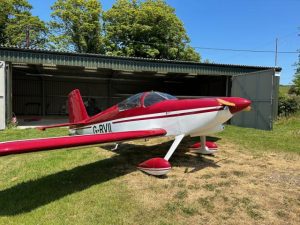
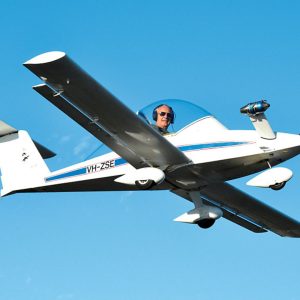
The Van’s RV-7 is the current side-by-side, aerobatic two-seater in the RV range and one of the most popular kit aircraft flying. It is an all-metal low-wing aircraft built from a Van’s kit, offered with a tailwheel (RV-7) or nosewheel (RV-7A), and in the UK it flies on an LAA Permit to Fly. Van’s describes it as roomy, quick across country, capable from short strips and fully aerobatic at its aerobatic weight.
For UK pilots the RV-7 offers a rare mix: touring speeds around 170-180 kt, a side-by-side cabin for sharing the flying, and the option to build new from a current, well-supported kit or buy a completed aircraft. Van’s offers it with engines from about 150 to 215 hp, so two RV-7s can perform quite differently depending on how they were built.
History and design
The RV-7 replaced the RV-6/6A in 2001, after Van’s had shipped more than 2,000 RV-6 kits, and drew on that experience. Compared with the RV-6 it has a longer wing with more area, larger fuel tanks (42 rather than 38 US gal), a bigger rudder that Van’s introduced to improve spin recovery, more headroom and legroom, a higher useful load and room for larger engines, including the 210 hp class Lycoming IO-390.
The RV-7 belongs to the same generation as the tandem RV-8 and the touring RV-9 and shares many parts with them; in particular the RV-9 uses the RV-7’s fuselage and canopy with a different, longer wing. Pre-punched, matched-hole parts cut the build time; Wikipedia, citing Van’s, puts it at about 1,500 hours for an average builder. Van’s says 2,020 RV-7s and RV-7As have flown.
Compared with the RV-9, the RV-7 has a shorter 25 ft wing (against 28 ft), takes much bigger engines (up to 215 hp against 160 hp) and is aerobatic, whereas the RV-9 is aimed at relaxed, economical touring. Compared with the RV-8, the RV-7 seats its occupants side by side rather than in tandem.
Variants
RV-7 (LAA type 323): tailwheel version. Empty weight 1,061-1,114 lb depending on engine and equipment; 1,800 lb gross.
RV-7A (LAA type 323): nosewheel version, otherwise the same airframe. A little heavier (1,077-1,130 lb empty), 2 ft taller on its gear and a few mph slower in Van’s tables.
Engines range from about 150 hp to 215 hp, typically Lycoming O-320, O-360 or IO-390 (or equivalents), with fixed-pitch or constant-speed propellers. Performance varies considerably with the engine fitted, so check which one a particular aircraft has.
Specifications
Van’s published figures for the tailwheel RV-7, measured with a Hartzell two-blade constant-speed propeller, at 1,800 lb gross unless stated. Speeds converted from statute mph.
Specification
Imperial
Metric
Wingspan
25 ft
7.62 m
Length
20 ft 4 in
6.20 m
Height (RV-7 / RV-7A)
5 ft 10 in / 7 ft 10 in
1.78 / 2.39 m
Wing area
121 sq ft
11.2 m²
Empty weight (RV-7 / RV-7A)
1,061-1,114 / 1,077-1,130 lb
481-505 / 489-513 kg
Gross weight (MTOW)
1,800 lb
816 kg
Baggage
100 lb
45 kg
Fuel capacity
42 US gal
159 L
Engine
150-215 hp
112-160 kW
Propeller
Fixed-pitch or constant-speed
–
Cruise, 75% at 8,000 ft (160 / 180 / 200 hp)
191 / 199 / 206 mph (166 / 173 / 179 kt)
307 / 320 / 332 km/h
Top speed (180 hp)
209 mph / 182 kt
336 km/h
Stall speed (gross / solo)
58 / 51 mph (50 / 44 kt)
93 / 82 km/h
Rate of climb (160 / 180 / 200 hp)
1,400 / 1,650 / 1,900 fpm
7.1 / 8.4 / 9.7 m/s
Ceiling (180 hp)
20,500 ft
6,250 m
Range, 75% at 8,000 ft (180 hp)
673 nm
1,246 km
Range, 55% at 8,000 ft (180 hp)
826 nm
1,530 km
Take-off distance (180 hp)
575 ft
175 m
Landing distance
500 ft
152 m
Performance and handling
With 180 hp, Van’s quotes a 75% power cruise at 8,000 ft of 199 mph (173 kt) at gross weight and a climb of 1,650 fpm; a 200 hp engine adds about 6 kt and 250 fpm, while 160 hp costs about 7 kt. The gross-weight stall is 58 mph (50 kt), dropping to 51 mph solo, and Van’s lists take-off and landing distances of 575 ft and 500 ft at full weight with 180 hp, figures that suit many UK grass strips.
The longer wing and bigger rudder over the RV-6 were aimed at improved spin recovery and load-carrying, and the 42 US gal tanks give Van’s quoted ranges of about 670 nm at 75% power and 825 nm at 55% with 180 hp. The tailwheel RV-7 is a little quicker than the RV-7A in Van’s figures (199 against 197 mph at 75% with 180 hp at gross).
Owning one in the UK
The RV-7/7A is an LAA Group A type (323), so you need an NPPL SSEA, LAPL(A) or PPL(A), plus tailwheel differences training for the RV-7. Amateur-built RV-7s fly on an LAA Permit to Fly: the aircraft is inspected by an LAA inspector and the Permit revalidated each year, and builds are inspected in stages by an LAA inspector. Annual costs are generally lower than for a certified aircraft because much of the maintenance can be owner-done under LAA oversight.
Check each aircraft’s Permit operating limitations for aerobatic clearance, and read the LAA Type Acceptance Data Sheet for type 323 via the LAA engineering pages, which sets out the engine and propeller combinations accepted in the UK. Mogas suitability depends on the engine and fuel system fitted. New kits come direct from Van’s Aircraft in Oregon: the 2026 price list gives US$48,300 for a standard RV-7 airframe kit (US$52,900 for the RV-7A) and US$72,200 for QuickBuild (US$77,300 RV-7A), excluding engine, propeller, avionics, firewall-forward kit and shipping. See current aircraft on our listings and other LAA aircraft.
Buying checklist
Confirm whether it is an RV-7 or RV-7A, and the exact engine, propeller and their LAA approval: performance and value vary a lot with engine size.
Review the LAA build file and Permit history, including stage inspections, approved modifications and current operating limitations.
Check aerobatic clearance on that aircraft’s Permit, and the weight it applies at.
Get an actual weighing report: empty weights range from about 1,061 to 1,130 lb, which directly affects payload within 1,800 lb.
On an RV-7A, have the nose gear leg and fork inspected by someone experienced with RVs.
Look at the avionics installation and wiring quality, which vary widely between builders.
Check whether Van’s service bulletins applicable to the RV-7 have been reviewed and recorded.
For an unfinished project, check which kit sections are included, build quality, and that LAA stage inspections have been signed.
LAA type acceptance
The Light Aircraft Association lists these variants under the following type numbers. Check the LAA Type Acceptance Data Sheets (TADS) for the current approved engines, propellers and modifications before you buy.
The RV-7 and RV-7A are LAA Group A aeroplanes, so an NPPL SSEA, LAPL(A) or PPL(A) is suitable. The tailwheel RV-7 also needs tailwheel differences training.
Is the RV-7 on a Permit or a CofA?
UK RV-7s are amateur-built and fly on an LAA Permit to Fly, revalidated annually after inspection by an LAA inspector.
Can I build an RV-7 in the UK?
Yes. Kits are bought direct from Van’s Aircraft and built under LAA oversight. Van’s 2026 standard airframe kit price for the RV-7 is US$48,300, or US$72,200 for QuickBuild, before engine, propeller, avionics and shipping.
What is the difference between the RV-7 and RV-7A?
The RV-7 is the tailwheel version and the RV-7A has a nosewheel. The 7A is slightly heavier and a couple of mph slower in Van’s figures; gross weight is 1,800 lb for both.
How fast is the RV-7?
Van’s quotes a 75% power cruise at 8,000 ft at gross weight of 191 mph (166 kt) on 160 hp, 199 mph (173 kt) on 180 hp and 206 mph (179 kt) on 200 hp.
How far can an RV-7 fly?
With 42 US gal and 180 hp, Van’s gives about 673 nm at 75% power and 826 nm at 55% power, so a trip to southern France is realistic in one or two legs.
Is the RV-7 aerobatic?
Van’s describes it as fully aerobatic at its aerobatic gross weight. In the UK, check that aerobatics are cleared on that aircraft’s Permit operating limitations.
How is the RV-7 different from the RV-6?
It has a longer wing, larger fuel tanks (42 against 38 US gal), a larger rudder for better spin recovery, more cabin room, higher useful load and approval for bigger engines.
Should I choose an RV-7 or an RV-9?
Both share the same fuselage and canopy. The RV-7 has a shorter wing, takes engines up to about 215 hp and is aerobatic; the RV-9 has a longer touring wing, is limited to 160 hp and is not designed for aerobatics.
How long does an RV-7 take to build?
Wikipedia, citing Van’s, gives about 1,500 hours for the average builder with the pre-punched kit; QuickBuild sections reduce this.
Who supports the RV-7 in the UK?
Van’s Aircraft supplies kits, parts and technical support directly from Oregon, and the LAA oversees building and airworthiness through its inspectors and engineering department.
Figures are typical published values for a standard example and vary with engine, propeller, build and modification state. Always use the aircraft’s own Pilot’s Operating Handbook, weight and balance schedule and LAA paperwork. Last checked November 2026.